2007

More reports on yesterday’s HAWSCT arguments in County of Kauai ex rel. Nakazawa v. Baptiste, the appeal challenging the “Kauai v. Kauai” intragovernmental challenge to 2004’s Ohana Kauai property tax Charter Amendment.

   Continue Reading ▪ More on Supreme Court Property Tax Arguments

The Supreme Court of Hawaii heard arguments today in the appeal involving 2004’s property tax Charter Amendment from Kauai.  Details of the case and issue here.

Coverage of today’s arguments:

Past coverage of the appeal:

   
Continue Reading ▪ Supreme Court of Hawaii Hears Property Tax Arguments

Professor Paul Boudreaux at Land Use Prof Blog asks Should government land use science be easier to challenge?  He details a Utah proposal to allow a developer to introduce evidence demonstrating that the science supporting a zoning restriction is faulty, and compel binding arbitration if the government rejects the evidence.

Interesting concept.  One might think, under Euclidean norms, that the comprehensiveness of the process would produce a scientifically-valid outcome, but anyone who plays the land use game knows that is not necessarily the case, and the data used to support land use regulation often reminds me of a certain kind of science….Weird Science.

    
Continue Reading ▪ Land Use Regulation and “Science”

HawsctbldgOn February 15, 2007 from 9:00 – 10:00 a.m., the Supreme Court of Hawaii will hear oral arguments in County of Kauai ex rel. Nakazawa v. Baptiste, the appeal involving 2004’s “Ohana Kauai” charter amendment. 

The hearing will be held in the Supreme Court courtroom in the JudiciaryBuilding on King Street in Honolulu.  Theproceedings are open to the public.

The facts of the case are straightforward.  In November 2004, the people of the Countyof Kauai overwhelmingly approved an amendment to their county Charter addressing propertytaxes.  The Charter Amendment provided that property taxes should be restored to 1998 levels for owner-occupied homes of residents who had owned their properties since at least 1998.  For homeowners who purchased after 1998, the tax level is based on purchase price. Future tax increases for all resident homeowners could not exceed 2% per year.

The Mayor and members of the County Council

Continue Reading ▪ Property Tax Appeal Argument Preview

If the government takes your property for public use by eminent domain, it should make you whole, right?  After all, eminent domain is the government’s ability to force an unwilling owner to sell her property, so shouldn’t the government have to put the owner in as good a position as she was before the taking?

Not quite.  If only “Just Compensation” as required by the constitution were truly just. 

A tale of eminent domain woe out of Cumberland County, Virginia has lessons for Hawaii property owners.  Read the article for the details on the facts, but here’s the short form: the county auctioned off excess property (a dilapidated school), and a local realtor purchased and renovated the property, investing $360,000 into the effort.  Then the government changed its mind, “decided they needed the school after all,” condemned it, deposited $200,000 to the court as “just compensation,” and seized it from

Continue Reading ▪ How Just is “Just Compensation”

Waves KITV reports that “Waves Wash Debris Onto North Shore Roadways” during winter high surf on Oahu’s famed North Shore. 

What does this mean when the boundary between public property and private land on the shoreline is the upper reaches of the wash of the waves, as evidenced by the vegetation or the debris line?  Would a single rogue wave that washes far up past the usual high wash move the property line?

This question may seem far-fetched, but under the present standard for measuring the line between private property and the public beach, there is little standing in the way of a claim that wave action moves property lines.  Good thing Maverick’s, with its 100-footers, isn’t nearby.

Continue Reading ▪ “High Wash of the Waves?”

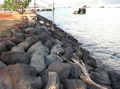
Seawall_1 No easy answers on seawalls, a column in today’s Advertiser, poses an interesting question.  Is it legal to walk on seawalls where there is no beach makai (seaward) of the wall:

Q. In Kane’ohe Bay on O’ahu, there are numerous stretches of the coastline that do not have a beach but rather, the ‘aina ends abruptly with a seawall that is about 2 to 5 feet high. Walking along the makai side of the seawall is not possible due to the depth of the ocean, so is it OK to walk on top of the seawall?  Would this be considered the high water mark?

A. There’s no easy answer, and this might be something for the Legislature to address.

The article then goes on to discuss the possibilities: the legislature can address the issue, or perhaps such seawalls are already subject to public use.  Let me add my

Continue Reading ▪ Trespassing on Shoreline Private Property

We all know that in Public Access Shoreline Hawaii v. Hawaii Planning Comm’n, 79 Haw. 25, 903 P.2d 1246 (1995), the Hawaii Supreme Court held:

Our examination of the relevant legal developments in Hawaiian history leads us to the conclusion that the western concept of exclusivity is not universally applicable in Hawai’i.

The court also noted that “western concepts” of property include a certain bundle of rights:

The western doctrine of “property” has traditionally implied certain rights. Among these are the right to the use of the property, the right to exclude others[,] and the right to transfer the property with the consent of the “owner”.

In 2000, the Hawaii Legislature amended the state’s environmental assessment/impact statement law, Haw. Rev. Stat. ch. 343 to require examination of cultural practices as well as environmental policies, economic welfare, and social welfare:

“Significant effect” means the sum of effects on the quality

Continue Reading ▪ Are Constitutional Property Rights “Cultural Practices” That Should be Considered?

I had the pleasure and honor to participate as faculty in this year’s Hawaii Land Use Conference, which wrapped up yesterday. 

The two-day conference covered the spectrum of topics relating to land use, including eminent domain, regulatory takings, endangered species act and federal Corps of Engineers permits, the treatment of agricultural land under Hawaii’s unique regulatory system, zoning and subdivision rules, RLUIPA, vested rights and development agreements, and cultural impact statements.  All presented by the leaders in their respective fields.  I presented a session of shoreline law and regulation (materials posted here), and spent the remainder of the time listening. 

Great stuff.  If you didn’t have the chance to attend this year, you should consider it for next.Continue Reading ▪ Hawaii Land Use Conference Summary