


October 2009

Beginning at 2pm EST on Wednesday, October 14 (thanks, noLandGrab) the New York Court of Appeals will hear oral arguments in Goldstein v. New York State Urban Development Corp., the latest case involving the controversial Brooklyn Yards development and Kelo-like claims of eminent domain abuse in an economic development taking. 

This post at the Volokh Conspiracy has a good summary of the issues in the case, and why they are important. The merits and amicus briefs in the appeal are posted here.Continue Reading NY Court Of Appeals Oral Arguments In Atlantic Yards Eminent Domain Case

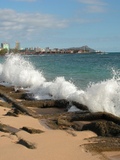
In United States v. Milner, No. 05-35802 (Oct. 9, 2009), a panel of the Ninth Circuit held that littoral (waterfront) property owners in Washington state may be liable for common law trespass and for violations of the Rivers and Harbors Act of 1899 because their land has eroded and their “shore defense structures” (rip-rap and bulkheads) now intersect with the boundary between public tidelands and their private property.

The case involves tidelands held in trust by the federal government for the Lummi Nation, pursuant to treaty and President Grant’s executive order. Upland owners erected and maintained structures on the tidelands to blunt the force of the waves, initially under a lease from the Lummi Nation which expired in 1988. The public-private boundary is the mean high water (MHW) mark, and over the years, the shoreline eroded and as of 2002, many of the structures were seaward of the

Continue Reading Ninth Circuit: Let It Erode – Littoral Owners Have No Right To Install Shore Defense Structures On Their Land

Liveblog On Tuesday, October 13, starting at 10:00 am (Hawaii Standard Time), the Hawaii Supreme Court will hear oral arguments in County of Hawaii v. Ala Loop Homeowners, No. 27707 (cert. granted Sep. 2, 2009) (order here). We will be covering the arguments live here

Details of the argument schedule are posted on the Judiciary site here (the site notes the arguments will be held on “Thursday” October 13, but we’ve confirmed with the Clerk that’s a typo, and the date is Tuesday, October 13).

The last time we live blogged Hawaii Supreme Court oral arguments was in the second “Superferry” appeal. We used the Cover it Live application which seemed to work well and does not require the viewer to install any extra software beyond a web browser, so we’re using it again.

Go to this page to check if the viewer window works

Continue Reading Upcoming Live Blog Of HAWSCT Arguments In Ala Loop Homeowners Appeal: Are State Zoning Laws “Environmental” Statutes?

Our coverage of the Hawaii Supreme Court oral arguments will go live on Tuesday, October 13, 2009, at approximately 9:45 a.m., Hawaii time. 

<p>&lt;p&gt;&amp;lt;a href=”http://www.coveritlive.com/mobile.php?option=com_mobile&amp;amp;task=viewaltcast&amp;amp;altcast_code=7c50a56fae” &amp;gt;HAWSCT Ala Loop arguments 10-13-2009&amp;lt;/a&amp;gt;&lt;/p&gt;</p>


Continue Reading 10-13-2009 Live Blog Of HAWSCT Arguments In Ala Loop Homeowners Appeal: Are State Zoning Laws “Environmental” Statutes?

The property owner has filed a brief responding to the amici brief supporting the application for writ of certiorari which urges the Hawaii Supreme Court to review the Intermediate Court of Appeals’ decision in Unite Here! Local 5 v. City and County of Honolulu, 120 Haw. 457, 209 P.3d 1271 (Haw. Ct. App. 2008). In that case, the ICA held that unless a project changes, a supplemental EIS under Haw. Rev. Stat. ch. 343 is notrequired, even if the circumstances do.

The application and the amici brief urge the Hawaii Supreme Court toadopt a rule requiring a supplemental EIS even when a project does notchange if the “setting,” “circumstances,” or “context” can be allegedto have changed by a single plaintiff who meets the minimal requirements for environmental standing.The amici brief emphasizes the purpose of chapter 343, arguing the ICAmajority opinion was a “cramped” reading of the law and

Continue Reading Response To Amicus Briefs In Kuilima/Turtle Bay HAWSCT Cert Application

With apologies to Jeff Foxworthy, you might be a regulatory takings maven if…you instantly understood this post’s headline, and eagerly clicked through to read the story.

But you don’t have to be a takings nerd to appreciate the import of today’s Ninth Circuit decision in Los Altos El Granada Investors, v. City of Capitola, No, 07-16888 (Oct. 7, 2009). The court held that federal constitutional claims do not have to be litigated in state court:

Despite clear language from the Supreme Courtestablishing that “a state court determination may not be substituted,against a party’s wishes, for his right to litigate his federal claimsfully in the federal courts,” England v. La. State Bd. of Med. Exam’rs, 375 U.S. 411, 417 (1964), two California courts determined that this right to a federal forum was “irrelevant” andstruck appellant’s clear reservation of its federal claims from itscomplaint. The district court then determined that

Continue Reading Ninth Circuit Weighs In On England Reservations In Williamson County Ripeness

In “Supreme Court’s Regulatory Takings Case Draws Widespread Interest,” the New York Times reports about yesterday’s filings by amici supporting the government in the beachfront taking case, Stop the Beachfront Renourishment, Inc. v. Florida Dep’t of Environmental Protection, No. 08-11 (cert. granted. June 15, 2009):

The Supreme Court would likely resist such overt involvement intakings disputes, according to Jay Austin, senior attorney with theEnvironmental Law Institute.

“The only thing that petitionershave to cite to even suggest any precedent is a concurring opinion byformer Justice Potter Stewart in another beach case 40 years ago,”Austin said.

“Well, he’s the justice who famously said aboutobscenity that ‘I’ll know it when I see it.'” This case would put thejustices in the same position, he said, adding: “Just like they had toscreen films in the basement of the Supreme Court to see whether theywere obscene, they’d have to wade into all of

Continue Reading NY Times On Gov’t Amici In Florida Beach Judicial Takings Case

Several amicus briefs have been filed supporting the government’s position in the beachfront taking case, Stop the Beachfront Renourishment, Inc. v. Florida Dep’t of Environmental Protection, No. 08-11 (cert. granted. June 15, 2009):

The government’s merits briefs are posted here.

We filed an amicus brief supporting the property owners, which is available here. The property owners’ merits brief is available here. The other amici briefs supporting the property owners are posted here, here, and here. All briefs and more about the case on

Continue Reading Amicus Briefs Supporting The Gov’t In Florida BeachTakings Case (aka Judicial Takings Case)

WavesOn Tuesday, November 10, 2009, at 9:00 a.m., the Hawaii Intermediate Court of Appeals will hear oral arguments in Maunalua Bay Beach Ohana 28 v. State of Hawaii, No. 28175. The arguments will take place in the Supreme Court courtroom at Aliiolani Hale.

The ICA panel will consist of Judges Nakamura, Watanabe and Foley.

The issue in thatcase is whether the state, or littoral landowners, are entitled toownership of certain accreted lands. In “Act 73,” (codifed here and here) the legislature declared that shoreline land naturally accreted belongs to the State of Hawaii and is public property. The act overturned the age-old rule of shorelineaccretion and erosion, which held that beachfront owners lose ownershipof land when it erodes, but gain it when it accretes. Instead of thesebalanced rules, Act 73 made the erosion/accretion equation one-sided:the State gets it every time.  

The trial court held that Act 73

Continue Reading Upcoming Hawaii Appellate Court Oral Arguments In Beach Takings Case


In today’s Honolulu Star-Bulletin, University of Hawaii lawprof David L. Callies responds to my September 20, 2009 review of Jeff Benedict’s book about the U.S. Supreme Court’s infamous Kelo eminent domain case, Little Pink House: a True Story of Defiance and Courage.

In In defense of taking land for public use, Callies writes:

First, as Thomas suggests, the U.S. Supreme Courtrelied on its earlier Hawaii Land Reform Act decision in deciding Kelo.But the Act does not permit the use of eminent domain by landowners. Astate agency – the Hawaii Housing Authority – condemned the land undersingle-family homes. No court has ever authorized the use ofcondemnation by private citizens.

Second,the Connecticut government redevelopment agency in the Kelo casecondemned the Kelo property in order to economically revitalize anentire neighborhood – not “to entice a major pharmaceutical company torelocate to New London.” The relocation was already a fact of

Continue Reading Professor Callies’ Response To Little Pink House Book Review: New London’s Kelo Taking Was Not To Entice Pfizer