


2009

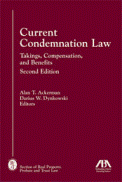
5430464_big A recent book of interest to condemnation lawyers, Current Condemnation Law: Takings, Compensation & Benefits (2d ed.).

The book is co-edited by my Owner’s Counsel of America colleague Alan T. Ackerman. (He also has a blog about eminent domain issues.)

From the blurb:

Condemnation of property is an especially topical subject after the U.S. Supreme Court’s controversial decision in Kelo v. City of New London. This completely revised edition of Current Condemnation Lawexamines the many complexities involved in the practice of eminentdomain law in order to assist lawyers in best protecting the clients’interests in these cases. The book brings together experts in thespecialty to provide analysis of both major and specialty areas ofcondemnation law, providing “how to” tips along with currentdiscussions of case law and theory.

The chapters in Current Condemnation Lawprovide a thought-provoking mix of articles covering the key topics ofbusiness valuation, contamination issues, the right

Continue Reading New Eminent Domain Book: Current Condemnation Law: Takings, Compensation & Benefits (2d ed.)

This continues our summary of today’s oral arguments in the “ceded lands” case. The summary of the state’s argument is posted here, the summary of OHA’s argument is posted here, and the transcript is posted here.

What Issues Are Presented?

Assistant to the Solicitor General William Jay argued for the Obama Administration as amicus curiae, supporting the state’s position. His initial argument — that “three federal laws” (the Newlands Resolution, the Organic Act, and the Admission Act) make it clear that the State of Hawaii has absolute fee simple title to the ceded lands — was immediately challenged by the Chief Justice as perhaps being beyond the the Question Presented (whether the Apology Resolution had any substantive legal effect).  Jay responded that the other issues have been in the case since the start, and were considered by the Hawaii Supreme Court. The Question Presented also posed

Continue Reading Federal Goverment’s Arguments In SCOTUS “Ceded Lands” Case

This continues our summary of today’s oral arguments in the “ceded lands” case. The summary of the state’s argument is posted here, and the transcript is posted here.

Washington, D.C. attorney Kannon Shanmugam argued for OHA. He began by asserting  that the issue in the case should be very narrowly drawn: whether the Hawaii Supreme Court’s decision was based on the Apology Resolution. He staked OHA’s entire argument on the factual issue of whether the Hawaii Supreme Court’s decision was based on the state’s fiduciary duties to Native Hawaiians under state law, and whether the court only relied on the Apology Resolution as a recognition that Native Hawaiians have political claims.  He conceded that if the Hawaii Supreme Court’s decision was based on the Apology Resolution, OHA should lose:

And it’s for that reason, Justice Ginsburg, that we freely concede that if the Hawaii Supreme Court had

Continue Reading OHA’s Argument In SCOTUS “Ceded Lands” Case

The transcript of today’s oral arguments in the “ceded lands” case is posted here.

Hawaii Attorney General Mark Bennett argued for the State.  He began by asserting that the Apology Resolution did not alter the state’s right to transfer the lands, and that it was, “as its sponsor said at the time, a simple apology, and no more.” He argued that the Apology Resolution did not cloud the state’s perfect title to the ceded lands, title that was derived from the United States’ title, transferred to the state in the Admissions Act.

Equitable Interest?

Justice Stevens started off the questioning, asking whether that proposition addresses OHA’s claims to an “equitable” interest in the ceded lands. Bennett responded by pointing out that “from day one in this case,” OHA argued that it has a property right in the land. Justice Kennedy asked hypothetically whether under Hawaii law, the state as

Continue Reading State’s Argument In SCOTUS “Ceded Lands” Case

The Supreme Court’s courtroom reporter has provided the raw transcript of today’s oral arguments in the “ceded lands” case, Hawaii v. Office of Hawaiian Affairs, No. 07-1372 (cert.granted Oct. 1, 2008. 

The transcript is posted here

For a primer/FAQ on appellate oral arguments and what they entail, go here.

While we haven’t reviewed it in detail yet, a quick read shows that one of the more interesting parts is the federal government’s argument as amicus curiae supporting the state. The argument, presented by Assistant to the Solicitor General William Jay, begins on page 18 of the transcript. 

Three binding Federal laws make clear that the State of Hawaii has absolute fee title to the lands in the Federal trust and also has the power to sell those lands for the purposes Congress set out in the trust instrument.

CHIEF JUSTICE ROBERTS: What do you think on

Continue Reading Oral Argument in “Ceded Lands” Case – Transcript And Summary

Thanks to Columbia lawprof Ronald Mann for forwarding his reply brief in AmeriSource Corp. v. United States, No. 08-497 (cert. petition filed Oct. 15, 2008). Responding to the arguments in the federal government’s brief in opposition, the reply argues:

The Government’s brief in opposition to the petition underscores the need for review by this Court. It declines to defend the reasoning of the court below. It offers a new rationale that is neither consistent with the reasoning of the lower court nor defensible on its own terms. Finally, despite the Government’s efforts to minimize the importance of the decision, it remains undisputed that the decision below grants the Federal Government a blank check to confiscate tangible property without any duty of compensation, from the only court in which such actions can be challenged.

Brief at 1. In AmeriSource, a pharmaceutical company whose legalprescription drugs were seizedas evidence

Continue Reading Reply Brief In AmeriSource: Is Destruction of Evidence Seized From Innocent Third Party A Taking?

For those not familiar with appellate oral arguments, here’s a short primer/FAQ:

Why oral argument? – Appellate oral argument has been described as the Court’s “conversationwith counsel” about the case and the law.  Oral argument can illuminatelegal or logical problems not evident from the briefs and which may nototherwise be discovered, distill arguments by testing them, and allowthe advocates to respond to the Court’s specific concerns. The U.S. Supreme Court hears oral arguments in nearly all cases it reviews.

What’s at issue? – The Supreme Court is a discretionary court, meaning it reviews only cases and issues it want to review.  In the course of answering the question presented, the Court may decide related issues. In the ceded lands case, the Court agreed to review the following Question Presented: 

In the Joint Resolution to Acknowledge the 100th Anniversary of theJanuary 17, 1893 Overthrow of the Kingdom of Hawaii, Congressacknowledged and

Continue Reading SCOTUS Oral Argument Primer

We will be posting the transcript — perhaps with some analysis thrown in — of tomorrow’s Supreme Court oral arguments as soon as it becomes available, but in the meantime, here is the latest:

  • David Shapiro posts “Senate sends mixed signals on ceded lands” on his Volcanic Ash blog: “Given that neither the governor nor the Legislature plan to sell cededlands anytime soon, you  wonder why OHA didn’t pursue this kind ofpolitical agreement in the first place instead of pressing the issue incourt and exposing themselves to the unintended consequences they fearfrom an adverse ruling by the Supreme Court.” The old adage of “be careful of what you wish for…” seems to apply here, since many seem to forget or overlook the fact that OHA raised the issue now before the Supreme Court.


Continue Reading The Latest On The “Ceded Lands” Case

Thanks to James Lawlor of the Land Use Legal Report for letting us know that the U.S. Supreme Court has declined to review Ocean Harbor Homeowners Ass’n v. California Coastal Comm’n, 163 Cal. App. 4th 215, 77 Cal. Rptr. 432 (2008). In that case, the California Court of Appeals held that the California Coastal Commission properly conditioned a permit to build a seawall to protect property from erosion on the landowner’s payment of a $5.3 million “mitigation fee.” The fee was to be used to purchase other beach property since Commission claimed the construction of the seawall would result in the loss of beach fronting the property. The property owner challenged the exaction under the nexus and proportionality requirements of Nollan v. California Coastal Commission, 483 U.S. 825 (1987), and Dolan v. City of Tigard, 512 U.S. 374 (1994).

A denial of a petition for writ of

Continue Reading Cert Denied In California Nollan/Dolan $5.3 Million Seawall “Mitigation Fee” Case