2009

The California Coastal Commission has filed its Brief in Opposition to the cert petition in Charles A. Pratt Const. Co. v. California Coastal Comm’n, No. 08-668 (cert. petition filed Nov. 18, 2008) (SCOTUS docket report here).  The California Court of Appeal’s opinion, reported at 76 Cal. Rptr. 2d 466 (Cal. Ct. App. 2008) is available here). 

The issues presented involve the Penn Central ad-hoc test for regulatory takings, and the “final determination” prong of the Williamson County ripeness rule.

We filed an amicus brief in the case, available here. The cert petition and the other amici briefs supporting it are posted here.Continue Reading California Coastal Commission’s Brief In Opposition In Charles A. Pratt Construction Co. Cert Petition (Penn Central and Williamson County)

Here are links to the cases discussed on the conference call this morning:

The majority opinion by Justice Acoba, joined by Justices Nakayama and Duffy is posted here:

We hold that (1) a landowner in a condemnationaction is entitled to damages under HRS § 101-27 where the property atissue is not finally taken in the context of a particular condemnationproceeding, irrespective of whether the government attempts to take theland through subsequent condemnation proceedings; (2) abatement doesnot apply where the relief sought in two concurrent actions is not thesame; and (3) although our courts afford substantial deference to thegovernment’s asserted public purpose for a taking in a condemnationproceeding, where there is evidence that the asserted purpose ispretextual, courts should consider a landowner’s defense of pretext. Therefore, (1) automatic denial of statutory damages under HRS §101-27in Condemnation 1 is vacated and the case remanded for a determinationof damages, (2) the court’s conclusion that Condemnation 2 was notabated by Condemnation 2 is vacated and the case remanded for adetermination of whether the public purpose asserted in Condemnation 2was pretextual.

Slip op. at 5. Here’s the concurring and dissenting opinion by Chief Justice Moon joined by Justice Levinson. The briefs in the case are available here:  Opening Brief, Answering Brief of the County of Hawaii, Reply Brief. Disclosure: we represent the property owner.

      • The Ninth Circuit’s decision in West Linn Corporate Park, LLC v. City of West Linn, Nos. 05-36061, 05-46062 (9th Cir. July 28, 2008) (regulatory takings case removed to US District Court, Ninth Circuit certified questions to Oregon Supreme Court)

        Continue Reading State & Local Government Condemnation Committee Links

        DK_cap3 In the winter, everywhere else has “snow days.”

        But Hawaii — obviously — has not.  

        We have “windy days.” Very windy days.

        Today is one of those days. 

        Schools closed. Sporting events canceled. People evacuated. Even the state courts are shuttered.

        But we’re here, and through whatever today’s weather may bring, we’re blogging.

        As is our custom on days when it seems like no one else is working, we’re distributing some office swag.

        But you have to earn it.

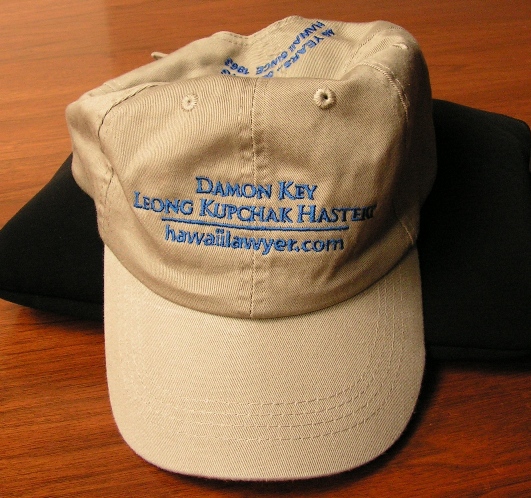
        For the first 3 people who email me today, I will send you a Damon Key | hawaiilawyer.com cap, as depicted above.  Be sure to include your mailing address in your email.

        Color: Island Sand. Sea Blue lettering. The back reads “45 Years – Serving Hawaii Since 1963.”  We have.

        100% cotton. One size fits all. We pay shipping.

        [A bonus tchotchke — a fine Damon Key writing

        Continue Reading A Blustery Day Office Swag Contest

        In 2008, we continued to castigate the Williamson County ripeness rules, culminating in December when we filed an amicus brief urging the Supreme Court to take a harder look at how the “final determination” aspect of the rule is being applied. The rule has two parts.

        First, the state-litigation rule requires a regulatory takings plaintiff to pursue — and lose — their claim in state court before asserting their federal constitutional claims in federal court. In San Remo Hotel, L.P. v. City & County of San Francisco,545 U.S. 323 (2005) four Justices agreed Williamson County produces absurd results and denies federalcourt review of federal constitutional rights, and argued that in an “appropriate case,” the Court should reconsider Williamson County. At least two cert petitions were filed suggesting they were the appropriate case. See Braun v. Ann Arbor Charter Township, No. 08-250 (cert. denied Dec. 1, 2008), and

        Continue Reading 2008 Land Use In Review: Ripeness Games In Regulatory Takings

        Here’s the latest in the “ceded lands” case, now being briefed in the U.S. Supreme Court. 

        The Honolulu Advertiser writes that “OHA looks for some backup,” and has drafted a bill, to be considered by the Hawaii Legislature in its upcoming session, that appears to codify the Hawaii Supreme Court decision in Office of Hawaiian Affairs v. Housing and Community Dev. Corp. of Hawaii, 117 Haw. 174, 177 P.3d 884 (Jan. 31, 2008), now under review by SCOTUS:

        OHA board Chairwoman Haunani Apoliona yesterday said she and hercolleagues will lobby lawmakers to pass a bill that would impose amoratorium on the sale of ceded lands until the “unrelinquished claims”of Native Hawaiians to those lands are settled.

        Such a moratoriumwould mirror the language of a January 2008 Hawai’i Supreme Courtdecision that ordered the state not to sell or transfer ceded landsuntil claims by Hawaiians to those lands are

        Continue Reading Latest Gambit In SCOTUS Ceded Lands Case

        OCA_logo I’m honored to have been designated as the Hawaii member of the Owners’ Counsel of America. OCA is “a voluntary network of experienced eminent domain attorneys from every state of the nation, representing property owners facing condemnation or other infringement on their constitutional rights to own property, and dedicated to advancing the cause of property rights.”

        OCA membership is byinvitation only and is open to only one attorney from every state.

        I attended the OCA annual meeting this past weekend in conjuction with the ALI-ABA conference on Eminent Domain and Land Valuation Litigation, and the depth of knowledge and experience in the room was truly amazing.  Just about every major reported federal and state eminent domain and regulatory takings case or judgment had been litigated by OCA members or honorary members, and it is a real privilege to count them as my colleagues.

        OCA also publishes a blog

        Continue Reading Owners’ Counsel Of America

        09.LULHI It’s not too late to register to attend the Hawaii Land Use Law Conference, taking place January 15 and 16, 2009, in Honolulu. 

        Items on the agenda include eminent domain, environmental law, transit-oriented development, subdivision requirements, and cultural impact statements. The program co-chairs are Professor David Callies and land use lawyer Ben Kudo.

        This conference takes place only once every two years, so this is your last chance for a while to learn of the latest information and updates, and what issues are on the horizon.

        I’m on the faculty, presenting a session on Emerging Water Issues: Coastal Zone Management Permits, and Hawaii’s Floodway, Floodplain and Coastal Inundation Zone Requirements.  The complete agenda and faculty listing is posted here.

        Hope you can attend, and if you do, please stop by and say hello.Continue Reading Upcoming: Hawaii Land Use Law Conference

        Thanks to Professor Patty Salkin’s Law of the Land blog for letting us know that on January 14, 2009, the New York Court of Appeals (that state’s highest court) will be hearing oral arguments in Aspen Creek Estates, Ltd. v. Town of Brookhaven, a case challenging a municipality’s ability to take property.  Professor Salkin summarizes the issues in the case here

        In the opinion now under review, the Appellate Divison approved a taking of private property to preserve it as farmland.  Thecourt’s majority held that the goal of preserving farmland generallyqualifies as a public use/purpose, and that there was no evidence ofpretext in the record demonstrating that the presumption of public useshould be questioned, even though the property owner asserted that theland would eventually be leased or sold to another private owner.

        The property owner also asserted that because the taking was not part of a plan

        Continue Reading New York Court Of Appeals To Hear Appeal Challenging Reason For Taking

        In a development that began in November 2007 (2005 actually, if the starting point is seen as the U.S. Supreme Court’s decision in Lingle v. Chevron, U.S.A., Inc., 544 U.S 528 (2005)), the Ninth Circuit finally ditched Armendariz v. Penman,75 F.3d 1311 (9th Cir. 1996) (en banc), and recognized that property owners are not limited to regulatory takings claims when challenging land use regulation, and the government can violate substantive due process as well.  In 2008, the Ninth Circuit issued a number of decisions in which it recognized that Armendariz‘s forced election of a regulatory takings remedy has been truly overruled. 

        Rather than plow through multiple posts, it would be easier to just download a recently published article I wrote on the subject, collecting all the cases, The Ninth Circuit Rediscovers Substantive Due Process In Land Use Cases (31 Zoning and Planning Law Report (Thomson | West

        Continue Reading 2008 Land Use In Review: The Ninth Circuit Rediscovers Substantive Due Process