January 2010

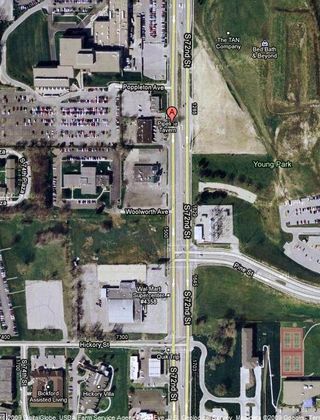
In City of Omaha v. Tract No. 1, No. A-09-323 (Jan. 26, 2010), the Nebraska Court of Appeals held that a post-Kelo “no takings for economic development” statute did not prohibit the city from taking property for a decleration lane on a public road simply because the lane leads to a “well-known national retailer of consumer goods.” (Can we say Wal-Mart?)
Omaha

The statute, Neb. Rev. Stat. § 76-710.04, provides:

   (1)  A condemner may not take property through the use of eminent domain… if the taking is primarily for an economic development purpose.

   (2)  For purposes of this section, economic development purpose means taking property for subsequent use by a commercial for-profit enterprise or to increase tax revenue, tax base, employment, or general economic conditions.

   (3) This section does not affect the use of eminent domain for:

        (a)  Public projects or private projects that make
Continue Reading Nebraska Court Of Appeals: Taking Did Not Violate Post-Kelo Ban On Economic Development Condemnations

Environmental review, as one California municipality discovered, is a double-edged sword, even if the action the city undertakes is supposedly to protect the environment.

The opinion of the California Court of Appeal (Second District) in Save the Plastic Bag Coalition v. City of Manahattan Beach, No. B215788 (Jan. 27, 2010) isn’t all that earth-shattering in its holding: a city must undertake environmental review under CEQA when it passes an ordinance when there is substantial evidence supporting a fair argument that a project may have significant effect on the environment.

The facts of the case are what made this case interesting and worthy of notice, even though its subject matter is slightly off-topic for this blog. And, we must admit, the court’s holding resulted in a moment of frisson — a city ordinance banning plastic bags adopted for the avowed purpose of saving the environment was invalidated because the city

Continue Reading Before Choosing Paper Or Plastic, You Need Environmental Review

Cutting_edge_2009 One of the benefits of doing your own blog is that every now and then you are allowed to engage in a little shameless self-promotion (what’s this “every now and then?”).

Well, here goes.

The ABA has announced the forthcoming publication of a new book by the State and Local Government Law Section: At the Cutting Edge 2009: Land Use Law from The Urban Lawyer, edited by my colleague Dwight H. Merriam, and which features “[a] compilation of the most recent Section of State and Local Government Law committee reports from The Urban Lawyer.”

What this means is that it contains topical and timely articles about the hottest topics in land use law, including exactions and impact fees, green building laws, ethics in land use, regulatory takings, citizen participation in public hearings, and public use and pretext in eminent domain (the piece I authored).

Here’s the Table

Continue Reading New Book: At the Cutting Edge 2009: Land Use Law from The Urban Lawyer

The Federalist Societyhas posted a podcast of my Pacific Legal Foundation colleague Jim Burling discussing Stop the Beach Renourishment, Inc. v. Florida Dep’t of Environmental Protection, No. 08-11 (cert. granted. June 15, 2009):

If that doesn’t work for you, go here to download the mp3.

The Stop the Beach Renourishment case, which has been argued and is currently awaiting dispositionby the Supreme Court, asks whether a state court is constrained by theTakings and Due Process clauses from rewriting the common law rules ofproperty. [Disclosure: we filed an amicus brief in the case supporting the property owners.]

Our summary of the oral arguments as well as links to the briefs are available on our resource page. A recent article summarizing the key amici arguments is posted here.

Also, a distant heads-up: the State and Local Government Law and the Real Property Sections will be presenting a major CLE

Continue Reading Post-Argument Podcast On Florida Judicial Takings Case

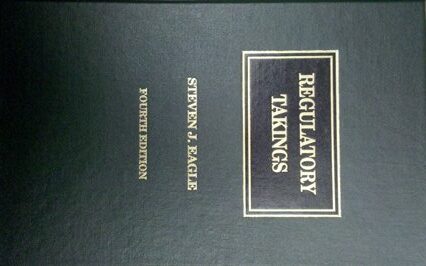
Eagle_reg_takings_cover I just received my copy of the latest edition of Professor Steven J. Eagle‘s definitive treatise Regulatory Takings (Lexis/Nexis, 4th ed. Dec. 2009).

Like the earlier editions, this is a must-have for every land use and property law attorney’s back bookshelf.

Chapters include “Property Rights and Their Sources,” “The Ascendancyof Land Use Regulation,” “Analytical Issues in Regulatory TakingsLitigation,” and “Regulatory Takings Remedies.”

The book is available here (oddly, the Lexis-Nexis web site only has the 3d edition for purchase, but I expect that to be remedied shortly).

From the preface to the fourth edition:

Thisbook is about “regulatory takings,” which is a relatively new term, but not an entirely new idea. The underlying concept is stated simply — government may “regulate” private property, but not to the extent that it constitutes a “taking,” under the United States Constitution, or a state constitution. Owners need not be compensated for losses

Continue Reading Eagle On Regulatory Takings (4th ed. 2009)

The developer in the two condemnation cases arising out of the County of Hawaii’s attemptsto take a Kona family’s property has filed its Answering Brief in the latest phase of County of Hawaii v. C&J Coupe Family Ltd. P’ship.

We posted the County’s Answering Brief here.

We represent the property owner in these appeals, and the brief we filed in November 2009 is posted here. More about thecases here.Continue Reading Developer’s Brief In Hawaii Eminent Domain Abuse Case: Pretext, Actual Purposes, And Private Benefit

The County of Hawaii has filed its Answering Brief in the latest phase of County of Hawaii v. C&J Coupe Family Ltd. P’ship,two condemnation cases arising out of the County’s attemptsto take a Kona family’s property. The brief responds to the Opening Brief which my Damon Key colleagues Ken Kupchak, Mark Murakami, Matt Evans and I filed in November 2009 (available here).

This appeal addresses several issues,but the most critical involve pretext and public purpose, questionsleft open by the U.S. Supreme Court in Kelo v. City of New London,545 U.S. 469 (2005), but which were answered, in part, by the HawaiiSupreme Court in its opinion when these cases were first before thecourt last year. See County of Hawaii v. C&J Coupe Family Ltd. P’ship, 119 Haw. 352, 198 P.3d 615 (2008) (available here)

In that opinion, the court held that a property owner

Continue Reading Government’s Brief In Hawaii Eminent Domain Abuse Case: Pretext, Actual Purposes, And Private Benefit

My Pacific Legal Foundation colleagues Brian Hodges and Daniel Himebaugh have posted a new paper on Nollan/Dolan exactions: Have Washington Courts Lost Essential Nexus to the Precautionary Principle? – Citizens’ Alliance for Property Rights v. Sims, available on SSRN here. The authors’ summary:

ThisArticle examines how Washington State courts have allowed theprecautionary principle to encroach upon the essential nexus test inthe context of land use exactions. The essential nexus test requiresgovernment to establish a cause-and-effect connection betweendevelopment and an identified public problem before placing conditionson development. The precautionary principle, however, endorsesregulation of land use in the absence of causation. Although U.S.Supreme Court precedent requires government to prove causalconnections, recent Washington case law shows that this test ofcausation is morphing into a less scrutinizing means-end test ofrationality. This shift was evident in the recent case of Citizens’Alliance for Property Rights v. Sims. In that case, Washington courtsfound the government’s

Continue Reading New Paper On Washington State’s Approach To Nollan/Dolan Exactions – Do Generalized Assessments Satisfy The “Essential Nexus” Test?

Recently, the owners of vacation cabins located on leased land in a state park on the island of Kauai filed a cert petition which asks the U.S. Supreme Court to review an unpublished decision of the Hawaii Intermediate Court of Appeals which held that the State did not run afoul of the Takings Clause when it required the owners to surrender their cabins at the end of the lease.

The trial court determined that the lessees had no property interest when their leases expired. The Hawaii Supreme Court declined review of the ICA’s disposition.

The lessees’ petition is available here, and presents the following question:

QUESTION PRESENTED

The State of Hawaii owns land in Kokee State Park on the island of Kauai. Petitioners, have leasehold estates in parcels on the land and own private cabins thereon. Each Petitioner, or his or her predecessor in interest, bought, built or inherited

Continue Reading New SCOTUS Cert Petition From Kauai: Is Surrender Clause In State Lease A Taking?

Statelocalcover_1_2010_small The most recent edition of State & Local Law News has an article summarizing the arguments in Stop the Beach Renourishment, Inc. v. Florida Dep’t of Environmental Protection, No. 08-11 (cert. granted. June 15, 2009). 

That case, which has been argued and is currently awaiting disposition by the Supreme Court, asks whether a state court is constrained by the Takings and Due Process clauses from rewriting the common law rules of property. [Disclosure: we filed an amicus brief in the case supporting the property owners.]

In Drawing a Line in the Sand: Stop the Beach Renourishment, Inc. v. Florida Dep’t of Envtl. Protection, six authors of amici briefs in the case — including me — summarized their arguments. I focused on the “background principles” issue, and the notion that certain common law aspects of property are beyond the reach of state court redefinition:

The “judicial takings” question in

Continue Reading New Article On Florida Beach Judicial Takings Case