


May 2010

In County of Cortland v. Miller, No 507725 (Mar. 24, 2010), the New York Appellate Division (Third Department) held that when the county legislature authorized the condemnation of property for a road culvert pursuant to New York’s Eminent Domain Procedure Law, the county highway department must condemn the property pursuant to the EDPL, and not the Highway Law.

Here, the County Legislature’s resolution in August 2008 authorized the acquisition pursuant to the EDPL. Rather than adhering to the method for the taking directed in the resolution (i.e., the EDPL), petitioner instead attempted to use a procedure under a different statute (i.e., Highway Law § 120). This alone is reason enough to dismiss the petition. In addition, Highway Law § 120 is inconsistent with the EDPL in significant aspects relevant in this proceeding, including hearing requirements (see EDPL 201) and who determines compensation (see EDPL 501 [B]). Those aspects of
Continue Reading New York Appellate Division: Condemnation Must Proceed Under Eminent Domain Statutes, Not Highway Law

Our decision today recognizes that snow and snowplowing are facts of life in Vermont, and we do not find a cause of action when defendant has done nothing more than protect public safety by plowing the roads that it has an ongoing legal duty to plow.”

Ondovchick Family Ltd. P’ship v. Agency of Transportation, No 2009-182, at ¶ 22 (Apr. 30, 2010).

There you have it: one of those decisions where its really not productive to dig deeper, or to try and reconcile it with other cases. You know the kind of decision we’re talking about, the kind where the opinion begins with “The widow Plaintiff…” and that you don’t need to read much further to know the result the opinion is going to reach, or why.

Oh, we could try and analyze the Vermont Supreme Court’s opinion in Ondovchick more closely. But that might be a

Continue Reading Vermont Supreme Court: Snow Is A Fact Of Life In Vermont

In Guggenheim v. City of Goleta, 582 F.3d 996 (9th Cir., Sep. 28, 2009), a three-judge panel of the U.S. Court of Appeals for the Ninth Circuit held that the city’s mobile home rent control ordinance (RCO) was a regulatory taking. The court found the case ripe under Williamson County, and addressed the merits of the takings claim under Penn Central Transportation Co. v. New York City, 438 U.S. 104 (1978).

A sharply divided en banc court vacated the panel opinion, and held that the city’s RCO did not work a regulatory taking, because the fact that the Guggenheims purchased their property subject to a rent-control regime was “fatal” to their investment-backed expectations. Our report on the en banc oral arguments is posted here. The video of the arguments is posted here. The en banc opinion is available here.

On March 11, 2011, the

Continue Reading Rent Control Takings Case (Guggenheim) Resource Page

A couple of links following up on our recent post about City of Milwaukee Post No. 2874 Veterans of Foreign Wars of the United States v. Redevelopment Agency of the City of Milwaukee, No. 09-1204 (cert. petition filed Apr. 2, 2010).

That’s the case in which the Supreme Court is being asked to review a decision by the Wisconsin Supreme Court (768 N.W.2d 749 (Wis. 2009)) applying the “undivided fee” rule to conclude that a valuable long-term $1 per year lease was worthless as a matter of law. The VFW was prohibited by the trial court from introducing any evidence of value since under the undivided fee rule, the jury could only determine the value of the fictional fee simple interest. The sharply divided Wisconsin Supreme Court affirmed. [Disclosure: we filed an amicus brief, noted below.]

The cert petition is here. The amicus brief we filed for National

Continue Reading More About The “Undivided Fee Rule” Cert Petition

Yesterday, I had the pleasure of speaking to members of the Western Manufactured Housing Communities Association about some of the legal issues facing their businesses, and property owners in general. Here are the links I mentioned:

  • Guggenheim v. City of Goleta, 582 F.3d 996 (9th Cir. 2009) (en banc review ordered Mar. 12, 2010). This is the very important case regarding the city’s mobile home rent control ordinance, which the Ninth Circuit panel concluded worked a facial taking of property under Penn Central. We have the briefs which have been filed for en banc review, and will be posting them in the upcoming days. Most definitely a case to watch.
  • A recent opinion from the California Court of Appeal in another rent control


Continue Reading Links From WMA Presentation – Regulatory Takings, Rent Control, And Guggenheim

Today, on behalf of the National Association of Home Builders and the Wisconsin Building Association, we filed this brief amici curiae in  City of Milwaukee Post No. 2874 Veterans of Foreign Wars of the United States v. Redevelopment Agency of the City of Milwaukee, No. 09-1204 (cert. petition filed Apr. 2, 2010).

The brief argues that the “undivided fee rule,” as applied by the Wisconsin Supreme Court, violates the Fifth Amendment’s Just Compensation Clause because it  requires that the value of a leasehold interest which would be worth over $1 million if condemned separately be valued at zero. Most eminent domain attorneys know about the infamous undivided feerule (aka as the “unit rule” in some jurisdictions), a legal fictionwhich requires a trial courtto calculate valuation of property as if a single owner possessedeverything, even when it is held by more than one interest. Under therule, the condemnor is not

Continue Reading Home Builders’ Amicus Brief In SCOTUS Eminent Domain Case: Is Wisconsin’s Application Of The Undivided Fee Rule Unconstitutional?

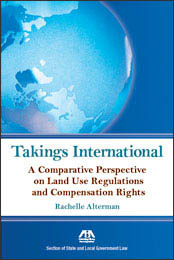
5330205_big My ABA State & Local Government Law colleague Andy Gowder has posted on his blog Grounded, a report and summary of the recent Miami panel discussion of Takings International: A Comparative Perspective on Land Use Regulations and Compensation Rights (Mar. 2010; $95 regular price; $75 for SLG members). 

Takings International is a comparative study of how 13 jurisdictions worldwide treat what we in the U.S. call “regulatory takings.” Visit this page for the Table of Contents and a pdf of Chapter I (scroll to the bottom of the page). Our book review is here.

I concur with Andy’s assessment that it was a fascinating and informative session (and I disclaim any bias resulting from the fact I served as moderator).

The panelists highlighted the issues discussed in the book, and Andy reports:

Professor Alterman began her remarks by pointing out that though no other country comes close to

Continue Reading “Takings International” Panel Report