


August 2010

Mark you calendars: from August 25-28, 2010 in Santa Fe, New Mexico, ALI-ABA is putting on the annual program, Land Use Institute: Planning, Regulation, Litigation, Eminent Domain, and Compensation.

We won’t be able to attend this year, but we have in the past, and the program and the faculty is first-rate. Go here for details, agenda, faculty list, and registration information. Continue Reading Land Use Institute – ALI-ABA Program – Aug. 25, 2010, Santa Fe
Mark you calendars: from August 25-28, 2010 in Santa Fe, New Mexico, ALI-ABA is putting on the annual program, Land Use Institute: Planning, Regulation, Litigation, Eminent Domain, and Compensation.

We won’t be able to attend this year, but we have in the past, and the program and the faculty is first-rate. Go here for details, agenda, faculty list, and registration information. Continue Reading Land Use Institute – ALI-ABA Program – Aug. 25, 2010, Santa Fe

IMG_1861 On Friday, at the ABA Annual Meeting in San Francisco, the Section of State and Local Government Law along with the Section of Real Property, Probate, and Trust Law co-sponsored a panel discussion of what was the most fascinating case of the Supreme Court’s recently-concluded term, Stop the Beach Renourishment, Inc. v. Florida Dep’t of Environmental Protection, No. 08-11 (June 17, 2010).

(Photo, from left to right: Dan Stengle, John Echeverria, James Burling, Richard Frank, and Robert Thomas; photo courtesy Dwight Merriam)

This Term, the Court dealt with corporate speech, guns, “crush videos,” process patents, and Sarbanes-Oxley, but in Stop the Beach Renourishment, the Court attempted to tackle the most metaphysical of questions: can a state supreme court decision “take” property by changing the law? In the case, the Court came tantalizingly close to holding that a state supreme court decision can run afoul of the

Continue Reading Notes From The ABA Panel On The Judicial Takings Case (Stop The Beach Renourishment v. Florida Department of Environmental Protection

IMG_1861 On Friday, at the ABA Annual Meeting in San Francisco, the Section of State and Local Government Law along with the Section of Real Property, Probate, and Trust Law co-sponsored a panel discussion of what was the most fascinating case of the Supreme Court’s recently-concluded term, Stop the Beach Renourishment, Inc. v. Florida Dep’t of Environmental Protection, No. 08-11 (June 17, 2010).

(Photo, from left to right: Dan Stengle, John Echeverria, James Burling, Richard Frank, and Robert Thomas; photo courtesy Dwight Merriam)

This Term, the Court dealt with corporate speech, guns, “crush videos,” process patents, and Sarbanes-Oxley, but in Stop the Beach Renourishment, the Court attempted to tackle the most metaphysical of questions: can a state supreme court decision “take” property by changing the law? In the case, the Court came tantalizingly close to holding that a state supreme court decision can run afoul of the

Continue Reading Notes From The ABA Panel On The Judicial Takings Case (Stop The Beach Renourishment v. Florida Department of Environmental Protection

The State (actually Waiola Waters of Life, the defunct charter school) has asked the Hawaii Supreme Court to reconsider its decision in County of Hawaii v. Ala Loop Homeowners, No. 27707 (July 9, 2010). In that case, the court held “[w]e further conclude that article XI, section 9 of the Hawai’i Constitution creates a private right of action to enforce chapter 205 in the circumstances of this case.” Slip op. at 4. 

The State argues:

Wai’ola asks for reconsideration for three reasons. First, the Court has made new law that will significantly affect multiple sectors of our community, all levels of state and county government, and countless administrative and judicial proceedings that are pending in the courts and before state and county land use and environmental regulatory agencies.

Given the present procedural posture of the case, the principle of judicial restraint counsels again addressing the argument the Ala Loop

Continue Reading Motion For Reconsideration Of HAWSCT’s Opinion In Ala Loop: Are Zoning Statutes “Environmental Laws?”

Well, what do you know. The Hawaii Senate Judiciary Committee voted 4-1 against recommending Intermediate Court of Appeals Judge Katherine Leonard to the full Senate for confirmation as the next Chief Justice of the Hawaii Supreme Court (we live blogged the Judiciary Committee hearing). The full Senate will decide today whether to confirm or not confirm her appointment. 

Earlier, we wrote about the factors that should be part of the evaluation, and summarized the best indicator of how she would be as Chief Justice, her opinions during her time as a Court of Appeals judge. We offer some final thoughts:

  • Is she “qualified?” Plainly so. The Judicial Selection Commission’s constitutional duty is to pass on to the governor only “qualified” applicants. By that definition, she is qualified. Even were that not the case, Judge Leonard has served more than two years as an ICA judge, and her opinions reveal


Continue Reading Some Lingering Thoughts On The Leonard CJ Appointment

This Friday, August 6, 2010 from 2:30 – 4:00 p.m. as part of the ABA Annual Meeting in San Francisco, the Section of State and Local Government Law is co-sponsoring a panel discussion of what was, in my opinion, the most fascinating case of the Supreme Court’s recently-concluded term, Stop the Beach Renourishment, Inc. v. Florida Dep’t of Environmental Protection, No. 08-11 (June 17, 2010).

This Term, the Court dealt with corporate speech, guns, “crush videos,” process patents, and Sarbanes-Oxley, but in Stop the Beach Renourishment, the Court attempted to tackle the most metaphysical of questions: can a state supreme court decision “take” property by changing the law? In the case, the Court came tantalizingly close to holding that a state supreme court decision can run afoul of the Fifth Amendment’s Takings Clause and take property without just compensation. The Court concluded that the Florida Supreme Court’s

Continue Reading Upcoming ABA Panel On The Judicial Takings Case (San Francisco 8/6/2010)

This just received:

Aloha Members:

Undoubtedly you are aware of the controversy and media coverage surrounding the confirmation process now underway for several judicial positions.  In particular, the Board’s assessment that ICA Associate Judge Katherine Leonard is “not qualified” for the position of Chief Justice has come under attack.  The Senate committee however has indicated that the Board’s input has been helpful.

Since 1990, the HSBA’s constitution has required that the HSBA participate in this process and submit testimony to the confirming authority on a nominee’s qualifications.  Over the last 20 years, the HSBA has evaluated and submitted testimony on every nominee except for one occasion, when the board did not take a position due to insufficient time to address its concerns.  The Board policy and procedure for evaluating nominees, developed over 20 years, provides opportunity for member comment and input in a confidential fashion.  For similar reasons, the Judicial Selection Commission’s deliberations are confidential under Hawaii’s constitution. The existing policy does provide that the nominee is apprised of any significant negative comments or concerns before they are interviewed by the full board so that they may respond to those comments.
 
Your elected Board members take this responsibility seriously for each nominee.  I invite you to look at the HSBA website to review the policy/procedures, and the reprint of an article which appeared last year in the Hawaii Bar Journal about this process.  Please again familiarize yourself with this process and comment, if you feel appropriate. These resources will allow you to speak knowledgeably about the process to family, friends and associates. You can play an important role in helping the public better understand the balanced and impartial way the Board arrives at its recommendations based on input from its members and direct interviews with the nominees.
 
Finally, the HSBA’s policy has been amended several times to make adjustments and improvements and the Board members welcome your comments and suggestions on the current policy and will consider additional changes if deemed warranted or appropriate, giving due consideration to all competing factors.
 
Your opinions do matter and will be considered by the HSBA Board.
 
Please direct inquiries from the press to me or the HSBA office. You could also direct people who are interested in learning more about the process to our website.
 
Thank you.
 
Hugh R. Jones

President, HSBA

Our live blog of yesterday’s Judiciary Committee hearing.
Continue Reading Hawaii State Bar Association E-Mail On Leonard CJ Nomination

Guggenheim_enbanc

Last month, we attended the oral arguments in the rehearing en banc of Guggenheim v. City of Goleta, 582 F.3d 996 (9th Cir., Sep. 28, 2009).

The three-judge Ninth Circuit panel held 2-1 that a takings challenge was ripe under Williamson County, and ruled the City of Goleta, California’s ordinance was a facial taking by applying the three-part Penn Central test. The court remanded the case to the district court for a calculation of compensation owed to the property owners. On March 12, 2010, the court ordered en banc review.

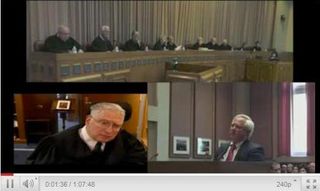
Our summary of the oral argument is posted here. Today, the court posted the video from the hearing, complete with 24-style split screen. Check it out for a rare cameras-in-the-courtroom view of a federal appeals court in action. Continue Reading Ninth Circuit Posts Video Of Guggenheim (Rent Control Takings Case) En Banc Oral Arguments

On Monday, August 2, the Hawaii State Bar Association gave Intermediate Court of Appeals Judge Katherine Leonard an “unqualified” rating. No explanation was available publicly.

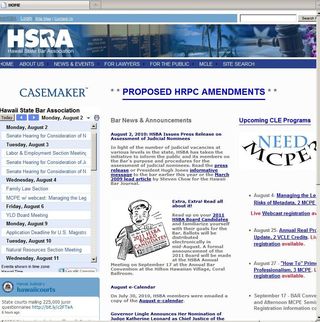
The only reference on the HSBA web site as of 6:20 p.m. was a press release about the HSBA review process, and some other general information about the process. Nothing about why the HSBA came out with a negative recommendation mere hours before the scheduled 9:30 a.m. hearing tomorrow. 

Hsba_8-2-2010

Governor Lingle responded:

“The State Bar Association’s review process was unfair, flawed, and conducted under a veil of secrecy, with no accountability to the public.  The HSBA has refused to state its reasons for its ratings.

“It is impossible to know whether there is political, gender or ethnic bias on the part of the HSBA, since they refuse to state their reasons.  I hope the Senate will see there is no validity to their ratings.  I have confidence that the Senate will carefully consider the overwhelming favorable testimony from the legal community and those who know Judge Leonard’s and Judge To‘oto‘o’s respective bodies of work, as well as their character and integrity.

I believe [t]he Senate committee has the responsibility to do the right thing and give both judges a positive recommendation.

Remember that tomorrow (August 3) at 9:30 a.m. (HST), we will be live blogging the Senate Judiciary hearing.
Continue Reading Hawaii State Bar Association Gives CJ-Appointee “Unqualified” Rating