


2010

In 1978, the people of Hawaii amended the state constitution to recognize “the right to a clean and healthful environment,” and expressly enabled lawsuits by private parties to enforce “laws relating to environmental quality” —

Each person has the right toa clean and healthful environment, as defined by laws relating to environmentalquality, including control of pollution and conservation, protection andenhancement of natural resources. Any person may enforce this right against anyparty, public or private, through appropriate legal proceedings, subject toreasonable limitations and regulation as provided by law.

Haw. Const. art. XI, § 9. “Laws relating to environmental quality” are not expressly defined, but “include” the obvious

rovidesIn County of Hawaii v. Ala Loop Homeowners, No. 27707 (cert. granted Sep. 2, 2009), the four-Justice majority in an 81-page opinion authored by Justice Recktenwald held “[w]e further conclude that article XI, section 9 of the Hawai’i Constitution creates a private

Continue Reading HAWSCT: Zoning Statutes Are “Environmental” Laws Which Can Be Enforced By Lawsuit
More on the “judicial takings” case, Stop the Beach Renourishment, Inc. v. Florida Dep’t of Environmental Protection, No. 08-11 (June 17, 2010).

Remember that at the ABA Annual Meeting next month in San Francisco, the Section of State and Local Government Law is co-sponsoring a panel discussion of the case. I’ll be moderating, and Jim Burling (Pacific Legal Foundation), John Echeverria (Vermont Law School), Richard Frank, University of California Boalt Hall Law School), and Dan Stengle, (Hopping Green & Sams, Petitioner’s counsel) are on the panel. If you are coming to the meeting, mark your calendar for August 6, 2010 from 2:30 – 4:00 p.m. at the Hilton San Francisco Union Square. More information here.

Anyway, here are the links:


Continue Reading More On The “Judicial Takings” Case (Stop The Beach Renourishment)

We have no idea what these cases might be about, or whether there is any substance behind the property owners’ objections, but these are headlines no condemnor could possibly like:

  • Bedford County Widow Sued (via wjactv.com) – “A Bedford County widow is being sued for trying to keep Columbia Gas Transmission off her property. The Texas-based company is using eminent domain to gain access to 67-year-old Mary Ellen McConnell’s 125-acre farm.”
  • Granny Vows To Fight For House (via wyff4.com) – “On the other side of Stenhouse Rd, 85-year-old Juanita Sullivan worries about eminent domain.”

Might as well say they’re trying to take property from cute, fluffy kittens.


Continue Reading Headlines No Condemnor Likes To See

Here at inversecondemnation.com we also cover eminent domain, regulatory takings, land use, and environmental issues. We even cover election law when it strikes our fancy.

But here’s one that’s in our core competency: in Frick v. City of Salina, No. 101,355 (July 9, 2010) the Kansas Supreme Court held that property owner-plaintiffs did not meet their summary judgment burden of opposing the city’s motion, and affirmed a judgment that the city did not inversely condemn their property by denying them the ability to construct driveways to access their land.

After the city condemned their property, the Fricks moved their businesses to another nearby site. The move, according to the Fricks, “was thwarted by the ‘inappropriate regulatory’ action of the City. Slip op. at 8. The regulatory actions complained of included:

(1) denial of reasonable access to the relocation site during the Project; (2) construction activities

Continue Reading Kansas: Inverse Condemnation Case Resolved By Summary Judgment Burdens

If you can figure out the syntax of this post’s headline, you’ve just figured out the rationale of the Wisconsin Supreme Court in E-L Enterprises, Inc v. Milwaukee Metropolitan Sewerage District, No. 2008AP921 (July 2, 2010). In that case, the court held that the removal of groundwater was not a compensable taking because the property owner did not seek compensation for the taken water, but for damage to its building which relied in part on the groundwater for support.

Many years ago, in the course of constructing a new pipeline, the local sewer company removed groundwater under a neighboring building. Removal of the water resulted in the wooden supports under the building rotting, which caused the building to settle. The cost to replace the wooden supports with concrete supports was approximately $300,000.

The property owner brought claims for negligence, nuisance and inverse condemnation because the sewer company “physically took

Continue Reading Wisconsin: Taking Groundwater Is Not A Taking Of A Building Damaged By The Taking Of The Groundwater

Heads up on a new article of interest to those of us who deal with exactions and Nollan/Dolan: Matthew Baker, Much Ado About Nollan/Dolan: The Comparative Nature of the Legislative Adjudication Distinctions in Exactions, 42 Urban Lawyer 171 (2010). Here’s a summary: 

Much has been made, by both commentators and courts, of the distinction between legislative and adjudicative land use exactions used to determine whether an exaction must meet the “essential nexus” requirement of Nollan v. California Coastal Commission and the “rough proportionality” test of Dolan v. City of Tigard. But practical application of the distinction has been anything but simple, only adding to the “mess” and “muddle” of Takings Clause jurisprudence. While exactions jurisprudence is admittedly messy, the apparent analytical incoherence results primarily from the confused and inconsistent application of the Nollan/Dolan test by lower courts, which would no doubt prefer

Continue Reading New Article On Legislative-Adjudicative Distinction In Nollan/Dolan Analysis

The Hawaii Supreme Court today by a 4-1 margin issued an opinion that has fundamentally rewritten Hawaii land use law. In County of Hawaii v. Ala Loop Homeowners, No. 27707 (cert. granted Sep. 2, 2009), the four-Justice majority in an 81-page opinion authored by Justice Recktenwald held “[w]e further conclude that article XI, section 9 of the Hawai’i Constitution creates a private right of action to enforce chapter 205 in the circumstances of this case.” Slip op. at 4.

In an equally lengthy concurring and dissenting opinion, Justice Acoba wrote: “I respectfully disagree, then, with the majority’s holding that the court abused its discretion in denying Wai’ola’s motion to set aside default. Thus, in my view, it is unnecessary to decided that Ala Loop had a private right of action to enforce HRS chapter 205 under article XI, section 9 of the Hawai’i State Constitution, but inasmuch as

Continue Reading HAWSCT Finds Zoning Statutes Are “Environmental” Laws – Court Creates A Private Right Of Action To Enforce Chapter 205

A rule of law set out over 100 years ago and which remains (as we say) good law qualifies as “well-established” by any standard. Village of Norwood v. Baker, 172 U.S. 269 (1898) set forth the rule that a special assessment for municipal improvements is only constitutional if the improvements result in the property being assessed enjoying special benefits, and then only to the extent of the benefit. If the benefits are merely those which inure to the public at large, or if the assessment exceeds the benefit conferred, the assessment is invalid.

Think of it as an “anti-givings” requirement: the cost of public benefits get absorbed by the public as a whole, but if property gets some benefit over and beyond those public benefits, it is fair to ask the property owner to pay. Otherwise, it’s a no-go.

In Hubbard v. City of Pierre, No. 25312-a-JKM (June

Continue Reading Curb Appeal In South Dakota: No Special Benefit To Property Means That Special Assessment Is A Taking

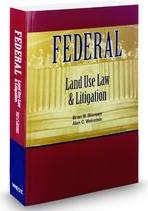
P13513986-160025L I’ve just received my copy of the 2010 revision of Federal Land Use Law & Litigation by Brian W. Blaesser and Alan C. Weinstein (West, $225).

Here’s the description of the book from West’s site:

Examines all federal, constitutional, and statutory limitations on local land use controls, discussing cases, regulations, liability, defense strategies, doctrines, and antitrust restrictions. Comprehensively reviews Supreme Court and lower federal court decisions that consider the constitutionality of land use regulations. Discusses complicated free speech issues affected by federal land use law, and municipalities exercising home rule powers. Examines issues such as: constitutional and statutory limits, First Amendment limitations on land use controls, federal remedies and attorney’s fees, liability and immunity issues, litigation guidelines, zoning, subdivision controls, growth management, model complaints, and selected constitutional and statutory decisions.

Federal Land Use Law & Litigation is an eminently useful single-volume research and reference guide. It’s well-organized, and although it

Continue Reading Book Review: Federal Land Use Law and Litigation, 2010 edition

The State of Hawaii has filed a brief responding to the amicus brief we filed in June in In re Trustees Under the Will of the Estate of James Campbell, No. 30006, an appeal now under review by the Hawaii Intermediate Court of Appeals. The issues in the case include the nature of “Torrens” title and the scope of the “public trust” in water resources.

Hawaii is one of the few remaining states retaining its Torrens system of title registration (two others are Massachusetts and Minnesota). We call it “Land Court,” a system in which the State guarantees indefeasible title to the rights and interests reflected in the title register. In Campbell, the State of Hawaii claims that title to property on Oahu’s north shore which was registered and confirmed to the Campbell Estate by the Land Court in 1938, is subject to the State’s ownership of “all

Continue Reading Final Brief In Torrens Title And Public Trust Appeal