


February 2011

Here’s an unusual takings case for you, and a decision that is worth reading, if only for its detail about wartime takings and clandestine contracts with the government. Besides, any court opinion that references “Maxwell’s Smart’s shoe phone” earns a spot on the to-read list, no?

In Doe v. United States, No. _______ (Nov. 22, 2010), the plaintiff, an unnamed citizen of Iraq, sued the federal government seeking just compensation for the occupation of his home by U.S. Marines during the Battle of Fallujah in 2004. The Court of Federal Claims held it had no subject matter jurisdiction over his claims for a taking and breach of contract.

The plaintiff “professes to be a sheik and a man of considerable education and influence.” Slip op. at 3. He asserted that before the Coalition invasion, “authorized representatives of the United States” contacted him and asked him to provide

Continue Reading CFC: No Jurisdiction Over Iraqi’s Claim That Marines Took His Home During Battle Of Fallujah

Readers: are you planning on attending tomorrow’s eminent domain conference at Fordham Law? Details here.

The agenda and faculty look very good. Speakers include Associate Justice James Catterson (N.Y. Appellate Division) (who wrote recently, “Unfortunately for the rights of the citizens affected by the proposed condemnation, the recent rulings of the Court of Appeals … have made plain that there is no longer any judicial oversight of eminent domain proceedings.”), Professors Steven Eagle and Ilya Somin (GMU), and Amy Lavine (Albany Law Gov’t Law Center).

We wish we could attend, but we are engaged elsewhere. If you do attend, might we prevail on you to provide a report? If you are so inclined, send it to us and we will post it (let us know whether you’d like attribution, or would prefer to remain uncredited).Continue Reading Fordham Conference – Taking New York: The Opportunities, Challenges, and Dangers posed by the Use of Eminent Domain in New York (2/22/2011)

Aliaba

There’s still time to register to attend either of the upcoming two courses of study, Eminent Domain and Land Valuation Litigation, and the sixth annual presentation of the basic-level Condemnation 101: Making the Complex Simple in Eminent Domain, both at the Hyatt Regency in Coral Gables (Miami), Florida. Both courses also are offered via live webcast, available either in their entirety or in segments. These programs will run concurrently from Thursday-Saturday, February 17-19, 2011.

I will be joining Nancy Myrland and Anthony Della Pelle (NJ Condemnation Law blog) leading a session on “The ‘Social’ Lawyer: New Media Strategies for Marketing Your Eminent Domain Practice,” about how eminent domain attorneys can use social media for business development or simply to keep up on the latest cases.

Here’s the agendas for the advanced course, and for the 101 course. As I’ve written before, both feature stellar


Continue Reading There’s Still Time To Register And Attend ALI-ABA’s Annual Eminent Domain Conferences

George Mason U. lawprof Steven J. Eagle is familiar to regular readers of this blog for authoring the seminal treatise Regulatory Takings, now in its fourth edition. Talk takings and you will invariably be dealing with his scholarship.

Here’s the latest: Professor Eagle has recently posted a new paper, “Urban Revitalization and Eminent Domain: Misinterpreting Jane Jacobs” on SSRN. The abstract:

This article reviews the implications for land use policy of Jane Jacobs’ The Death and Life of Great American Cities. Fifty years after its publication in 1961, Death and Life remains a clarion call for resistance to monolithic development and to the reigning paradigm of urban planning in the mid-20th century. The article asserts, however, that government officials and planners have learned the wrong lesson from Jacobs. Their emphasis on the top-down imposition of what purports to be varied development is evident in the growth

Continue Reading New Article: Urban Revitalization and Eminent Domain: Misinterpreting Jane Jacobs

More: Rick Rayl posts his thoughts on the case: “My Stipulated Eminent Domain Judgment Went Awry, and You’re Telling Me I Can’t Appeal.”

* * * *

When is a final judgment in a condemnation case not appealable? When the appellant agreed that the trial cout’s order resolved “all claims and issues” in the case and thus it reflected that no one could appeal, that’s when.

In City of Gardena v. Rikuo Corp., No. B217302 (Cal. Ct. App. Feb 7, 2011), the parties mediated the issues and entered into a settlement agreement, after which the trial court entered a final judgment. After entry of judgment, the trial court entered two additional orders awarding the City money from the deposit made to cover the costs of remediation. Although the City did not contest the appealability, the court of appeal asked for supplemental briefing on the jurisdictional issue.

The

Continue Reading Cal Ct App: No Appeal From Stipulated Condemnation Judgment

On Friday, February 18, 2011 from noon to 1:00 p.m., my Damon Key colleague Greg Kugle will be speaking to the Hawaii State Bar Association’s Real Property and Financial Services Section on Shoreline Issues. Greg chairs our firm’s real estate and construction law practice group, and has been representing property owners on shorelines issues across the State of Hawaii for many years.

The presentation is free for HSBA members and will take place at the HSBA Confrerence Room, 1100 Alakea Street, Suite 1000. HSBA members from the neighbor islands can call in to a toll-free conference line (contact us for the instructions). Continue Reading Greg Kugle To Speak To HSBA On Shoreline Issues (2/18/2011)

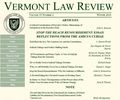
VTLREV_coverAs we noted here (when we posted our article), the latest issue of the Vermont Law Review deals with the U.S. Supreme Court’s “judicial takings” case, Stop the Beach Renourishment, Inc. v. Florida Dep’t of Environmental Protection, 130 S.Ct. 2592 (June 17, 2010). 

In eight essays, the authors of several of the many amicus briefs add their post-opinion thoughts. Authors include Ilya Shapiro (Cato Institute), Professor John D. Echeverria (Vermont Law), and Julia Wyman (Marine Affairs Institute). The groundwork is laid in the first article, by Professor L. Kevin Wroth:

If hard cases make bad law, bizarre cases may make no law at all. The recent Supreme Court decision, Stop the Beach Renourishment, Inc. v. Florida Department of Environmental Protection is a case in point. In the Essays that follow, the Vermont Law Review has brought together the reflections of seven lawyers, or teams of lawyers, for amici curiae

Continue Reading Vermont Law Review: Essay Reflections From The Amicus Curiae In The Judicial Takings Case

For anyone not watching the game, here’s your Sunday fix of items that do not involve football:

  • The Institute for Justice — the good people who represented Mrs. Kelo in Kelo v. City of New London, 545 U.S. 469 (2005) — have posted this short video entitled “Kelo v. City of New London: Judicial Abdication in Action.” Money quote: “What does Fort Trumbull look like today? Today, the Fort Trumbull neighborhood is a barren wasteland.”
  • The New York Times (itself the corporate beneficiary of eminent domain), posts the story “Blighted Area? These Business Owners Beg to Differ,” about the latest case of alleged “blight” and redevelopment in New York City, this time from East Harlem. Unless there is something here that we’re missing, New York’s law of blight and public use are so skewed in favor of the condemnor as recently reaffirmed in the


Continue Reading Super Bowl Sunday Links

The last chapter in the Ninth Circuit’s rent control saga has not been written. In Guggenheim v. City of Goleta, No. 06-56306 (Dec. 22, 2010), a sharply divided en banc Ninth Circuit concluded that Goleta’s mobile home rent control ordinance was not a taking under the three-factor regulatory taking test of Penn Central Transportation Co. v. New York City, 438 U.S. 104 (1978). Our resource page on the case is here (includes all opinions and merits and amicus briefs).

Mark Alpert (one of the attorneys for the property owners) reports on his blog California Property Rights Journal:

We are happy to announce that Dan Guggenheim has made the decision to file a cert petition. We are thrilled that Dan has been able to retain former Solicitor General Ted Olson and his appellate team at Gibson, Dunn to lead the effort along with myself and Rob Coldren at HKC.

With a panel

Continue Reading Cert Petition Coming In Ninth Circuit Rent Control Takings Case (Guggenheim)

In a case with “a lengthy procedural history spanning the past three decades and involving litigation in various federal courts,” in Innovair Aviation Ltd. v. United States, No. 2010-5025 (Jan. 25, 2010), the United States Court of Appeals for the Federal Circuit held that the Court of Federal Claims had no subject matter jurisdiction to consider Innovair’s takings claim because “Congress provided a comprehensive administrative and judicial system in the district courts to review the in rem forfeiture of property seized pursuant to 21 U.S.C. § 881.”  Slip op. at 18.

The case involves the government’s seizure of modified DC-3 airplanes sold to Air Columbia and allegations of drug smuggling, FAA regulations and the right to market turboprop conversion kits, and substitute res bonds. Relying on Vereda LTDA v. United States, 271 F.3d 1367 (Fed. Cir. 2001), the court concluded that a Tucker Act remedy was not available

Continue Reading Federal Circuit: Tucker Act Not Available When Congress Provides Other Relief