April 2011

Today, on behalf of the Manufactured Housing Institute, we filed this amicus brief (also available below) in the U.S. Supreme Court in Guggenheim v. City of Goleta, No. 10-1125 (petition for cert. filed Mar. 11, 2011). In that case, California mobile home park owners are asking the Court to review the decision of a sharply divided en banc Ninth Circuit which held that Goleta’s mobile home rent control ordinance did not work a regulatory taking under Penn Central.

The core of the majority opinion is based on the court’s supposition that the Guggenheims could not have “investment-backed expectations” because the rent control regulations were in place when they purchased their property. See Guggenheim v. City of Goleta, No. 06-56306 (9th Cir., Dec. 22, 2010) (en banc).

Our brief argues that the Ninth Circuit wrongly refused to apply the rule of Palazzolo v. Rhode Island, 533

Continue Reading SCOTUS Amicus Brief: Can A Post-Regulation Purchaser Bring A Takings Claim?

In City of Los Angeles v. Superior Court, No. B225083 (Apr. 12, 2011), the California Court of Appeal (2d District) held that the trial court erroneously entered summary judgment and awarded a property owner damages under an inverse condemnation theory against the city for inequitable precondemnation activities (aka “condemnation blight”). The owner showed that the city had been buying properties in the neighborhood, relocating the residents, demolishing the buildings and leaving the land vacant, and alleged that this was accomplished in order to make the city’s acquisition of his property easier.

The city conceded most of the facts (except the allegation of its intent) were correct, but the court concluded that in order to prove inequitable precondemnation activities, the city must have either instituted eminent domain proceedings, or be acting with the “firm intention” of doing so. Only then does the rule from Klopping v. City of Whittier

Continue Reading Cal Ct App: To Have An Inequitable Precondemnation Activities Claim, The Activities Must Be “Precondemnation”

In CCA Associates v. United States, No. 97-334C (Jan. 29, 2010), the U.S. Court of Federal Claims held that two federal statutes worked a taking under the three-part Penn Central test because it abrogated the rights of the owner of a Louisiana apartment building to prepay its way out of providing low income housing. The CFC held that the programs set up under the statutes in effect forced CCA to continue to provide low income housing — a public good — and that it was a taking.

The Government appealed, asserted the CFC missaplied the Penn Central test, and the property owner cross-appealed, argued the CFC wrongly dismissed a breach of contract claim. Penn Central, of course, refers to the multi-factored test for an ad hoc regulatory taking first announced in Penn Central Trans. Co. v. City of New York, 438 U.S. 104 (1978), and most recently reaffirmed

Continue Reading Of DIBEs, Rose Acre Farms IV, And Cienega X: Federal Circuit Considering Penn Central

Today’s post by our colleague Rebecca Copeland on her Record on Appeal blog, The Great Font Debate, got us to thinking. Inspired by an Above the Law post that argues that “Times New Roman = I don’t care,” Rebecca writes about the various recommended typefaces for use in briefs. Also, we are in the final stages of drafting a SCOTUS amicus brief, so things like fonts and brief formatting are on our mind.

The Hawaii Rules of Appellate Procedure do not contain any requirements beyond point size, but “deem” Times New Roman (the default font on word processing programs), Courier New (the one that looks like a typewriter), and Arial (the font we use on this blog since as a sans-serif font, it is easy to read on a computer screen) to qualify. We prefer New Century Schoolbook for briefs, since it is a highly readable font when printed.

Continue Reading Is Times New Roman For Losers?

Here’s Bettendorf v. St. Croix County, No. 10-1359 (Jan. 20, 2011) a 2-1 decision from the U.S. Court of Appeals for the Seventh Circuit, another regulatory takings opinion we’ve been meaning to post for a while. The case involves a property owner’s claim that the county’s changing the zoning on his land from commercial to agricultural-residential was a taking and a violation of due process. The county changed the zoning in response to a state court judgment holding that the commercial zoning was void because it contained a provision that it would revert to agricultural-residential upon the property owner’s death or a sale to a new owner. The owner sued to invalidate the condition, but the state court invalidated the entire zoning ordinance. Put that one in the “be careful what you ask for” department.

But before you get to the majority’s treatment of the merits (no taking, no

Continue Reading 7th Circuit Rejects Takings Claim On The Merits. But How?

We hesitated to post this opinion since it is way off-topic for the usual subjects of this blog, and the subject matter is something that has a tendency to flush out the extreme elements. But what the heck — it’s an interesting case, whichever side of this you might be on.

Besides, it’s a great case name.

In Justice v. Fuddy, No. 30176 (Apr. 7, 2011), the Hawaii Intermediate Court of Appeals concluded that Hawaii’s Uniform Information Practices Act (Haw. Rev. Stat. ch. 92), the law which requires the government to make its documents available to the public in certain circumstances, does not compel the State Department of Health to give up President Obama’s original birth certificate to someone who isn’t President Obama.

Read the opinion below if you want to find out why. Suffice it to say that it’s not enough that POTUS is the leader of the

Continue Reading HAWICA: No “Compelling Circumstances” Compelling Release Of Obama Birth Certificate

Dark-and-stormy-nightWe’ve had the U.S. Court of Appeals for the Fourth Circuit’s opinion in Henry v. Jefferson County Comm’n, No. 09-1546 (Mar. 3, 2011) near the top of our to-read list for a while, because it is a regulatory takings case. But after finally reading it, realized that the opinion is a must read for another reason.

For how often does a judicial opinion begin with the words, “We begin by begging the reader’s indulgence as we summarize the frequently litigated facts underlying Henry’s claims and the byzantine procedural history accompanying them.”

While we appreciate the court paying us this courtesy, the archaic phrasing reminded us of those godawful entries in the annual Bulwer-Lytton bad writing contest. You know, the ones that attempt to emulate the literary depths of the opening sentence of one of Bulwer-Lytton’s novels:

It was a dark and stormy night; the rain fell in torrents–except

Continue Reading The 4th Circuit’s Entry In The Bulwer-Lytton Contest

Here’s what we’re reading today:

  • Steven Greenhut’s op-ed in the Orange County Register “California GOP the party of numbskulls” about California Governor Jerry Brown’s (now failed) proposal to eliminate redevelopment agencies, and how “[s]ome Republicans sided with redevelopment because of their support for some favored local development projects. Others acted out of pure partisanship. Most Republicans offered lame excuses.”


Continue Reading Wednesday Round-Up

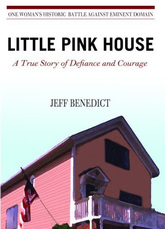
Little-pink-house

Little Pink House

, Jeff Benedict’s book about the Kelo v. City of New London case, looks like it is going to become a TV movie. According to this story in The Day (the New London paper):

Author Jeff Benedict has sold the rights to his book about the battle in New London over eminent domain to Lifetime. The network is gearing up to turn the piece into a TV movie.

Benedict said Wednesday that the contract hasn’t been signed, but all the terms have been agreed on and signing the papers is a formality at this point.

Details about the casting and where the movie will be shot weren’t being made public as of Wednesday.

Asked whether they might film “Little Pink House” in New London, Benedict says, “That, I have no idea. I highly doubt it. … I think it’d be really unusual.”

Our casting choices? Melissa Leo

Continue Reading Coming Attractions: Kelo’s Eminent Domain Fight Coming To TV

The April 2011 edition of the Zoning and Planning Law Report (West/Thomson Reuters) features my article Supreme Court Preview: Voting as Speech When a Government Official Has a Conflict of Interest – “Analogy Gone Wild” or First Amendment Right?, 34 Zoning & Planning L. Rptr. (Apr. 2011), which summarizes the issues in Comm’n on Ethics of the State of Nevada v. Carrigan, No. 10-568 (cert. granted Jan 7, 2011).

From the Introduction:

In late April 2011, the U.S. Supreme Court will hear oral arguments in Nevada Commission on Ethics v. Carrigan, reviewing a Nevada Supreme Court decision holding that a city councilman had a First Amendment right to cast a vote on a development proposal in which it appeared he had a conflict of interest. The Nevada court invalidated a state statute under which the state Ethics Commission censured the councilman because he did not recuse himself

Continue Reading New Article: Voting As Speech When A Government Official Has A Conflict Of Interest – “Analogy Gone Wild” Or First Amendment Right?