



September 2011

SLGN_cover_9_2011 The Fall edition of State & Local Law News features my article on the U.S. Supreme Court’s recent decisions in Carrigan and Guarnieri. From the Introduction: 

The U.S. Supreme Court decided two First Amendment cases this Term of special interest to attorneys practicing state and local government law. In Nevada Comm’n on Ethics v. Carrigan, the Court concluded Nevada’s Ethics in Government Law, which requires  elected and appointed government officials to recuse themselves from voting when they might have a conflict of interest, does not violate an official’s right to vote. By upholding Nevada’s ethics laws, the Court allowed state and local governments to continue to regulate the conflicts of interests of elected and appointed government officials and other government employees. In Borough of Duryea v. Guarnieri, the Court applied the long-standing balancing test applicable to government employee speech to government employee union grievances and held that
Continue Reading New Article: Local Govt and the First Amendment at the Supreme Court: Legislative Voting as “Speech” and Union Grievances as “Petitions”

In a cert petition filed yesterday, five Hawaii taxpayers argue that they have standing to challenge the constitutionality of property tax exemptions conferred on lessees of Hawaiian Homesteads. Only “native Hawaiians” are eligible to lease homestead land, and thus only those possessing the appropriate blood quantum are entitled to the tax exemptions.

The petitioners are not “native Hawaiians” and thus are not lessees, and paid their property taxes under protest. When they sought refunds in the Hawaii Tax Appeals Court and argued that they should also be exempt, that court concluded that “native Hawaiian” was not a racial classification and did not review the tax exemption with strict scrutiny. Instead, the court upheld the exemption under rational basis review.

The Hawaii Supreme Court vacated the Tax Court decision and dismissed for lack of jurisdiction, holding the petitioners lacked standing to challenge the exemption since they had not sought homestead

Continue Reading New Hawaii Cert Petition: Is Hawaiian Homes Property Tax Exemption Racial Discrimination?

Not hardly. Just check out the amici supporting her (NAACP, Jane Jacobs, et al.).

To drive the point home that many of the property owners on the business end of eminent domain are those who lack political power and influence, check out this brief filed on behalf of New York state Senator Bill Perkins in the Columbia/Tuck-it-Away case, where he argues that “blight removal” and “economic development” takings “disproportionately impact already marginalized groups, including tenants, the elderly, persons of low-income, and racial and ethnic minorities.” Br. at 7.

A post on a blog at Forbes, Liberals Should Be Upset by the Kelo Case makes the point well.Continue Reading Is Kelo A “Conservative” Issue?

Thanks to the Rocky Mountain Appellate Blog for pointing out the Colorado Supreme Court’s recent opinion in The Glenelk Ass’n, Inc. v. Lewis, No. 10SC275 (Sep. 12, 2011), an important decision about the standard of proof in private-way-of-necessity condemnations. The court concluded that a property owner who claimed to be “landlocked” could not condemn a private access corridor over a neighbor’s land without proof of a “concrete development proposal” showing that the access corridor is necessary.

Lewis owned a 334 acre ag-zoned parcel, and had the right to build one dwelling per 10 acres. Other access options were apparently not feasible, so Lewis and his neighbor Glenelk negotiated for purchase of an easement but failed to reach an agreement. Under Colorado law (like the law of many other jurisdictions) one private landowner may institute a condemnation action against a neighbor if necessary to gain access to a landlocked parcel

Continue Reading Colorado: Private Condemnor Must Prove Present Necessity

The Governor has filed his Answer to the Star-Advertiser‘s complaint in the case in which the Star-Advertiser is asking the circuit court to order the Governor to release to the public the list of judicial nominees presented to him by the Judicial Selection Commission, now that the Hawaii Senate has consented to the Governor’s appointment of Justice McKenna. The Governor refused the Star-Advertiser‘s multiple requests, notwithstanding the Office of Information Practices’ opinion that the list must be disclosed because any justification for withholding “would end once a nominee is confirmed by the Senate.”

Read the story in the Star-Advertiser here.

Disclosure: we represent the Star-Advertiser in this case.

Answer, Star-Advertiser v Abercrombie (filed Sep 12 2011)Continue Reading Governor’s Answer In JSC List Case

No, it’s not a takings claim, so Williamson County ripeness isn’t a part of the opinion. In Potrero Hills Landfill, Inc. v. County of Solano, No. 10-15229 (Sep. 13, 2011), the Ninth Circuit held that the Younger abstention doctrine did not prevent the district court from considering a § 1983 claim for declaratory and injunctive relief in a land use case involving an initiative ordinance that regulated the amount of solid waste that could be imported into the county.

After the county concluded the ordinance was unconstitutional under the dormant Commerce Clause and refused to enforce it, one of the county landfills began to reach its limits and its owner sought an expansion permit. Environmental groups eventually brought suit in state court to require the county to enforce the ordinance. Shortly thereafter, the landfill and other waste and recycling businesses filed a federal court action to invalidate the ordinance

Continue Reading 9th Cir: Federal Court May Consider A Land Use Civil Rights Claim


This is not what we normally do. We do land use, real estate, development law. Heck, I can get you zoning to be an airport if that’s what you want. But I don’t represent inmates, I don’t represent people charged with crime, I don’t represent criminals.”

                                     — Land use lawyer Joshua Safran

“Crime” and “land use lawyers” are phrases not usually heard together; in most cases, the worlds of criminal law and land use never intersect, and lawyers for developers and property owners don’t have much occasion to visit the “Attorney’s Room” at the state pen. But in the documentary film Crime After Crime, two land use lawyers including our ABA State & Local Government Law Section colleague Nadia Costa (Vice-Chair of the Section’s Land Use Committee), plunge into that unfamiliar milieu:

In 1983, Deborah Peagler, a woman brutally abused by her boyfriend, was

Continue Reading Review: “Crime After Crime” – A Movie That Makes You Feel Right About Being A Lawyer

Geysers08

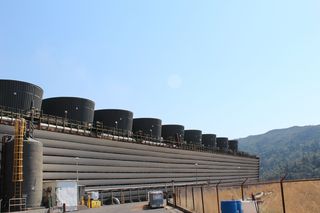
Today, we had the opportunity to take a tour of The Geysers geothermal dry steam field and one of its 16 electricity generation facilities, the McCabe 5 generation plant. The Geysers is the world’s largest energy production site fueled by geothermal.

Twelve miles up a country road from Sonoma County’s vineyards, the field was first discovered by western settlers when a hunter came across the steaming fumaroles and told his friends he had stumbled upon the gates to Hades. Soon thereafter, the site was developed as a resort, and from the 1850’s tourists would brave a treacherous stage ride to “take the waters” for health and recreation at the Geysers Resort Hotel.

The first geothermal well was tapped to generate electricity in the 1920’s, and today the plants in the field supply power to the coastal region of from San Francisco north to the Oregon border. Although output has

Continue Reading A Visit To The “Gates To Hades” – The Geysers Geothermal Field