December 2011

As we noted here, our practice isn’t limited to land and related issues, we also take appeals in other areas of law presenting unsettled or untested questions. Tomorrow, the Hawaii Supreme Court will be hearing one such case.

In Hamilton v. Lethem, No. 27580 (cert. accepted Oct. 14, 2011), we represent the Petitioner, and our Damon Key colleague Rebecca Copeland will be presenting oral arguments. In a published opinion, the Hawaii Intermediate Court of Appeals concluded that the family court correctly applied Hawaii’s civil TRO statute and held that a father actions were not appropriate parental discipline.

Here is the summary of the issues presented from the Judiciary web site:

Petitioner/Defendant-Appellant Christy L. Lethem (Petitioner) filed an Application for Writ of Certiorari seeking review of the September 21, 2011 judgment of the ICA, filed pursuant to its June 30, 2011 published opinion, affirming the Order

Continue Reading Oral Argument Preview: Evaluating Parental Discipline In Civil TRO Cases
A Warning

A bit of warning before we start: this is going to be a long post. Not because the issues in City & County of Honolulu v. Sherman, No. 28945, being argued on Wednesday, December 14, 2011 at 9:00 a.m. in the Intermediate Court of Appeals are particularly interesting, but because this case has been hanging around for years (the briefing was completed in 2008 — yes, you read that right: over three years ago) and this is the second time this case has been to the Hawaii appellate courts. The first trip produced a published opinion by the Supreme Court, City & County of Honolulu v. Sherman, 110 Haw. 39, 129 P.3d 543 (2006) (we analyzed that opinion here).

Thus, there’s a lot of background to cover. Besides, eminent domain appeals don’t crop up all that often in the Hawaii courts so when they

Continue Reading Oral Argument Preview: The Last Gasp Of Honolulu’s Condo Eminent Domain Law, And Damages For Failed Takings

Featured_exhib_brooklyn

A reminder: on January 3 and 4, 2012, at 1:00 and 7:30 p.m. each day, the Honolulu Academy of Arts Doris Duke Theater is presenting the Hawaii premiere of Battle For Brooklyn, the Academy Award-contending documentary about the Atlantic Yards eminent domain fight. We are lucky enough to have the exclusive Hawaii showing of this important, informative, and entertaining film. More information (and ticket purchase) from the Academy of Arts web site here.

There will be Q & A sessions following each screening with the filmmakers and (perhaps) a special guest, TBA.

The film has received fantastic reviews (a New York Times critics’ pick), and recently made the short list for films in the running for the Best Documentary feature Academy Award. We reviewed the film here, and highly recommend it.

Battle For Brooklyn is an especially timely film for Hawaii audiences: it chronicles one homeowner’s years-long

Continue Reading Exclusive Hawaii Premiere: Battle for Brooklyn, Academy Award Contending Documentary About Eminent Domain

Last year, we filed an amicus brief in

Download HEWITT.BRANDT113011

http://www.uscfc.uscourts.gov/sites/default/files/MEROW.MUSCOGEE120211.pdf

http://www.uscfc.uscourts.gov/sites/default/files/MEROW.ROSEBUD120211.pdf

http://www.uscfc.uscourts.gov/sites/default/files/BUSH.PRAIRIE112911.pdf

http://www.uscfc.uscourts.gov/sites/default/files/DAMICH.COEURDALENE11182011.pdf

http://www.uscfc.uscourts.gov/sites/default/files/DAMICH.IOWATRIBE11172011.pdfContinue Reading Court Of Federal Claims Clears The Decks

Today was the day we were to have found out whether the Supreme Court would review Corboy v. Louie, No. 11-336 (cert. petition filed Sep. 15, 2011). That’s the case seeking review of the Hawaii Supreme Court’s opinion which concluded that challengers to the property tax exemptions conferred on lessees of Hawaiian Homesteads lacked standing to bring suit. More from today’s Star-Advertiser report Court might hear case testing state benefits for Hawaiians.

Today, however, the Court released an order inviting the U.S. Solicitor General to express the views of the federal government, usually a sign that the Court has some interest in a case. No doubt the Court asked for the SG’s views because the cert petition draws into question the constitutionality of the Hawaiian Homes Commission Act and the constitutionality of a part of the Hawaii Admission Act. When federal laws are so questioned, the federal government

Continue Reading SCOTUS Asks For Fed Input In Case Asking Whether Hawaiian Homes Property Tax Exemption Is Racial Discrimination

Einstein460x276No less a light than Albert Einstein is reported to have said that the “definition of insanity is doing the same thing over and over again and expecting different results.” That quote has always seemed more apocryphal than accurate to us, but it’s a good definition regardless of who first uttered it.

Exhibit “A” appended to that definition might be New York City’s “emergency” housing Rent Stablization Law, adopted for the first time in 1969 and renewed eleven times since. The RSL controls how much rent the owners of rent-stablized apartments may charge their tenants (you know, to keep poor folk like Faye Dunaway in their apartments). The city’s justification for the RSL is to deal with a series of housing “emergencies” (initially, the “effects of war and the aftermath of hostilities,” and then any rise in the city’s vacancy rate above 5%), and to allow a “transition from regulation

Continue Reading What’s That Definition Of “Insanity” Again?

So you think you’ve seen accretion (the growth of new land on littoral or riparian property)? Check out the above video (also here), showing the latest dramatic lava flow on the Big Island of Hawaii. Now that’s accretion.

Is there a legal angle to this? Of course there is. To start you off, here’s a multiple choice test.

Who owns the new land created when lava flows over private property and into the sea and hardens into fast land:

A.  The property owner over whose land the lava flowed.

B.  The United States.

C.  The State of Hawaii Office of Hawaiian Affairs.

D.  The State of Hawaii.

(And you thought weird hypotheticals only occurred in law school exams.) A hint: the issue was resolved by the Hawaii Supreme Court in 1977, in an opinion authored by Chief Justice William Richardson.

Seriously, do you need to know anything

Continue Reading “Accretion,” Hawaii Style

The old adage is that a waterway is “navigable” for purposes of federal law if it is deep enough to float a Supreme Court opinion. Seriously, though, the less cheeky test of navigability is whether a waterway is capable of being used in its natural state as an avenue of commerce, meaning whether it was actually navigable at the time of a state’s admission into the Union. Really, that’s the test.

But as the Supreme Court reminded more than 30 years ago, when applying this general test for navigability, you must keep in mind the purpose  

T

Wednesday’s oral arguments in PPL Montana v. Montana, No. 10-218 (cert. granted June 20, 2011) started off on familiar territory with Justice Kennedy breaking the ice quickly, asking Petitioner’s counsel Paul D. Clement whether his point is “that there should be a Federal rule of — laches or estoppel, or are

Continue Reading What Does It Mean To Be “Navigable?” – Supreme Court

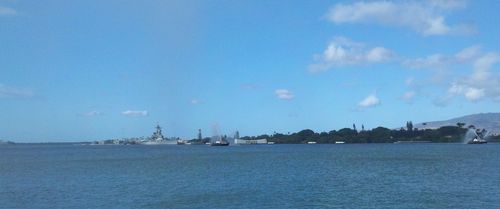
Pearl_harbor_12_7_2011

USS Missouri, USS Arizona Memorial, the Battleship Row moorings,
and two tugs rendering honors. Ford Island in the background.

“Sacrifice,” “courage,” and “service” were words repeated many times today at the ceremony to commemorate the 70th anniversary of the attack on Pearl Harbor. I was fortunate enough to be invited to attend, to bear witness in person. While this post isn’t related to the topics I usually blog about (except in a most tangential way — we filed a brief on behalf of several retired admirals in a Supreme Court environmental case a couple of years ago that referenced the December 7 attack*), this was a milestone event, so I thought a short report might be of interest to readers; we will return to regularly scheduled programming tomorrow.

Those who live or who grew up in Hawaii are perhaps reminded of the attack more than others. Many of us had

Continue Reading Pearl Harbor, Remembered

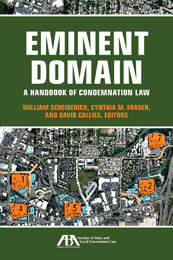
5330215_big To those who were able to join us this evening for the celebration of the publication of Eminent Domain – A Handbook of Condemnation Law, thank you.

The University of Hawaii Law School sponsored the reception, and it was good to see so many colleagues and friends in attendance. U.H. put the event together since Professor David Callies was one of the book’s editors, and six U.H. alums contributed chapters.

I was privileged to author two chapters (Prelitigation Process and Flooding & Erosion), and my Damon Key colleagues Mark Murakami and Christi-Anne Kudo Chock co-authored the chapter Damages Resulting from a Taking: An Overview.   

A complete Table of Contents is available here. This book is an overview of the law from folks who have been practicing in that area for a long, long time. It is intended as a “deskbook” — a quick and

Continue Reading Book Report: Eminent Domain – A Handbook of Condemnation Law