2011

Here is the Petitioner’s Reply Brief in Colony Cove Properties, LLC v. City of Carson, No. 11-189 (cert. petition filed Aug. 11, 2011). We posted the cert petition and the amici and BIO here

The cert petition is asking the Supreme Court to revist and discard the ripeness rules of Williamson County Regional Planning Comm’n v. Hamilton Bank of Johnson City, 473 U.S. 172 (1985). It poses two Questions Presented:

1. Should Williamson County be overruled, to the extent that it arbitrarily denies a federal forum to regulatory takings claimants seeking just compensation for the violation of their rights under the Fifth Amendment, contrary to the intention of Congress in enacting Section 1983?

2. Should this Court recognize an exception to Williamson County’s “state procedures” requirement for takings claimants like Petitioner, whose Fifth Amendment claims will otherwise be relegated to a California state court system that

Continue Reading Final Cert Brief In Williamson County Challenge
As I travel to Beijing today for the Brigham-Kanner Property Rights Conference, I’m drawn back thirty-three years to my first (and only prior) visit to the People’s Republic of China.

It was a different China in 1978. Just emerging after nearly thirty years of isolation and mostly closed off to the western world, it indeed emphasized the “People’s Republic” part of its name. Chairman Mao was less than two years dead and Hua Gofeng, Mao’s successor, had only recently ended the Cultural Revolution. Most people still wore the zhongshan (aka Mao suit), carried their copy of the “little red book” (Quotations From Chairman Mao) in a pocket, and the only contact they’d ever had with foreigners was perhaps with visiting Soviet officials. Beijing was a flat city with very few structures taller than the Great Hall of the People.

To enter the PRC

Continue Reading Brigham-Kanner Conference In Beijing: Reflections On A Three-Decade Absence

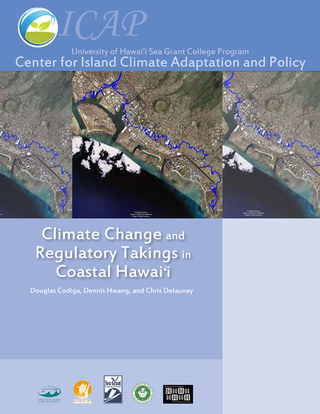
Climatechangemongraphpage

“There is strong consensus in the international scientific community that climate change is occurring and that greenhouse gas emissions from human activities contribute to climate change.”

So begins Climate Change and Regulatory Takings in Coastal Hawaii, a monograph by Douglas Codiga, Dennis Hwang, and Chris Delaunay, published by the University of Hawaii Sea Grant College Program’s Center for Island Climate Adaptation and Policy

We’re not entering into the debate about whether global warming/climate change is or isn’t happening. But the one certain thing is that every regulatory entity from the U.N. on down to your local neighborhood board believes it is real, and seems to want to do something about it. Thus, the question is how property owners may be affected by those actions, and what they can do in response. This report doesn’t really resolve anything, but it does establish the framework and makes some recommenations. From

Continue Reading Climate Change And Regulatory Takings In Coastal Hawaii

12.WATHIWe’ve just finalized the agenda and faculty for the Hawaii Water Law conference, to be held in Honolulu on January 11, 2012. I am the planning co-chair along with Jesse Souki, Director of the State of Hawaii Office of Planning.

In addition to Jesse and me, we’ve assembled a diverse and talented faculty: UH lawprof David Callies will speak with Elijah Yip (Cades) on the latest developments in water law and public trust litigation. State Water Commissioner Lawrence Miike will update us on the latest goings-on at the Commission. My Damon Key partner Greg Kugle is speaking with Leo Asuncion, the Manager of the Coastal Zone Management Program at the State Office of Planning on coastal issues.

After lunch, we have a special guest, Ed Thomas (a lawyer and President of the National Hazard Mitigation Association, and a nationaly known expert in floodplain management and disaster

Continue Reading Mark Your Calendars: Hawaii Water Law Conference (Jan. 11, 2012)

Next week, power adapters and internet connectivity permitting, we’ll be blogging from the Brigham-Kanner Property Rights Conference at the Tsinghua University School of Law in Beijing, People’s Republic of China.

Admin note: We’ve added “Brigham-Kanner Conference” as a separate category to catalog the posts related to the Conference. In order to read all of the posts under this topic, go here.

A property rights conference in the PRC? Should be interesting.

Here‘s the agenda and the list of sessions.

The honoree this year is Justice Sandra Day O’Connor. The speakers include the past winners of the B-K prize, Frank Michelman, Richard Epstein, James Ely, Margaret Jane Radin, Robert Ellickson, Richard Pipes, and Carol Rose. In addition to these luminaries in the property law and property rights field, the speakers include the top property law scholars and practitioners in the U.S. (Alan Ackerman, Andy Brigham, Jim Burling, David Callies

Continue Reading Blogging From Beijing: The Brigham-Kanner Property Rights Conference

Hawaiiimmigrationlawyer.com

No, it’s not another land use blog as you can tell from the title.

But it is another blog by a law firm colleague, one of the best in the immigration and naturalization business, David McCauley.

David joins the other Damon Key bloggers, Mark Murakami (hawaiioceanlaw.com), Tred Eyerly (insurancelawhawaii.com), and Rebecca Copeland (Record on Appeal).

Pretty soon, we’ll have the entire firm blogging. Check it out here. Continue Reading New Blog To Follow: Hawaii Immigration Lawyer

Yes, you read that right.

Yesterday, we posted most of the amici briefs in Sackett v. EPA, No. 10-1062, the case in which Idaho property owners are asserting their right to challenge the EPA’s assertion that a portion of their land are “wetlands.” But we saved one for a separate post, because it was worth noting on its own. The State of Hawaii has joined eight other states and signed onto the amici brief authored by Alaska, and this brief has a distinct property rights flavor to it.

As the Alaska Governor’s press release (“Alaska Files Brief Supporting Property Rights”) notes, the signatories are “supporting the right of property owners to have access to the courts for meaningful judicial review of arbitrary federal compliance orders.” As regular readers of this blog surely must know, the Hawaii government isn’t exactly known as being property rights friendly. And the other

Continue Reading State Of Hawaii To SCOTUS: Protect Property Rights From “Overreaching Federal Regulation”

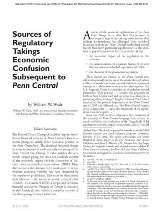
Wade-front-page-small Thanks to the folks at the Environmental Law Institute, who have allowed us to reprint an article from a recent Environmental Law Reporter by William W. Wade, Ph.D., a resource economist with the firm Energy and Water Economics (Columbia, Tennessee). Bill is a frequent author and speaker on the Penn Central issue, and he’s brought much needed clarification to an often confusing issue.

In Sources of Regulatory Takings Economic Confusion Subsequent to Penn Central, Mr. Wade writes:

The Federal Circuit Cienega X decision imposes insufficient financial analysis of Penn Central’s two economic prongs to satisfy either economic practice or the Penn Central test. The decision’s imposed change in value measurement evaluates only one prong of the Penn Central test. Change in value satisfies the economic impact prong but does not establish severity of the economic impact vis-à-vis frustration of distinct investment-backed expectations (DIBE). Mere diminution is well-known

Continue Reading Article: Sources of Regulatory Takings Economic Confusion Subsequent to Penn Central

Last week, the petitioners filed their merits brief in Sackett v. EPA, No. 10-1062, the case in which Idaho property owners are asserting their right to challenge the EPA’s assertion that a portion of their land are “wetlands.”

A multitude of amicus briefs have been filed to support the Sackett’s arguments. We haven’t had the time to review each brief yet, but here they are for your review:


Continue Reading Amicus Briefs In Sackett v. EPA: Judicial Review Of A Claim Of Regulatory Jurisdiction

Some day, the Court will grant cert in another eminent domain case.

But today is not that day.

The Court declined to review C & J Coupe Family Ltd. P’ship v. County of Hawaii, No. 11-75, the petition that asked, after Kelo, when is eminent domain pretextual? We represent the petitioner, and after the case did not show up on last week’s grant list the handwriting was on the wall. But today’s order list made it official.

This makes at least the third pretext petition denied by the Court, meaning the lower courts will continue to flounder about searching for clues in the Kelo majority opinion’s language for the correct standard to assess whether a condemnor’s asserted reason for a taking is a pretext to private benefit, and ask whether Justice Kennedy’s concurring opinion means much of anything. Until the Court establishes a standard, any hope of

Continue Reading Cert Denied In Pretext Case