


2011

MaheleComes the sad news that retired U.S. Bankruptcy Judge Jon J. Chinen has died. The Star-Advertiser obit noted that he served as Bankruptcy Judge and referee from 1976 to 1993 (I learned bankruptcy law from Judge Chinen, serving for a short time as a judicial extern in his chambers during law school).

There will be a private service, and in lieu of flowers, donations may be made to the Judge Jon J. Chinen Fund at the William S. Richardson School of Law at the University of Hawaii. The address is 2515 Dole St., Honolulu, HI 96822-2350.

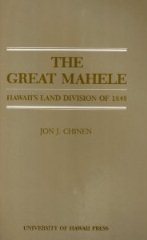
To Hawaii land users, Judge Chinen was best known for his seminal publication The Great Mahele: Hawaii’s Land Division of 1848 (U. Haw. Press 1958), which is available on the shelf of nearly every bookstore in Hawaii (and on-line here). It is a quick but detailed summary of the pre-contact system and the Mahele

Continue Reading Aloha, Judge Chinen

Update: Rick Rayl adds his thoughts about the case and how California state courts might approach the issue here.

++++++++++++++++++++++++++++++++++++++++++++++++++++++++++++++++++++

What does a property owner have to do in order to qualify as a “prevailing party” in a federal condemnation action, such that it triggers fee shifting under the Equal Access to Justice Act (EAJA)?

According to the Tenth Circuit in  United States v. Harrell, No. 10-2153 (Apr. 29, 2011), it’s not enough that “the defendant landowners won the judgment, and even though they won $3.8 million — much more than the government ever offered them for their property.” Slip op. at 1. No, in order to “prevail,”  the property owner’s valuation must be closer to the eventual judgment than the government’s, and that valuation must be the valuation you asserted during the proceedings, not some other figure you’d be willing to accept.

The eminent domain provision in

Continue Reading 10th Cir: Landowner Not “Prevailing Party” Even Though They “Won $3.8 Million — Much More Than The Government Ever Offered Them”

Here’s the recording of last week’s oral arguments in Comm’n on Ethics of the State of Nevada v. Carrigan, No. 10-568 (cert. granted Jan 7, 2011).

Stream the arguments below, or download the 25mb mp3 here.

The written transcript is available here. The merits and amici briefs are available here

We’re writing up a summary of the arguments, and we’ll post it soon.Continue Reading Oral Arguments In Ethics Case

5330213_big The ABA State & Local Government Law Section has just published a new book, Whose Drop Is It Anyway? Legal Issues Surrounding Our Nation’s Water Resources, edited by Megan Baroni. I just received my copy.

Skimming through the chapters, it looks worthy of a place on the bookshelf as a practical guide to a very wide range of issues related to water.

Here are the details:

Whose Drop Is It, Anyway? Legal Issues Surrounding Our Nation’s Water Resources, is a valuable resource and practical tool discussing the legal issues surrounding water resources and the current issues and trends that are influencing the legal regimes. Practical in use, this book can be used as a tool for developing effective water management strategies in your own jurisdictions.

As scarcity issues become more common and threats like global climate change loom with uncertainty over our water resources, water only stands to

Continue Reading New Book On Water Law And Water Resources

People can get passionate about their pets. We understand that. And, as we’ve mentioned before, we appreciate creative lawyering. We really, really do. But sometimes — to paraphrase Justice Holmes — seeing a taking lurking in everything can “go too far.”

Here’s the latest example. In Concerned Dog Owners of California v. City of Los Angeles, No.  B218003 (Apr. 29, 2011), the California Court of Appeal held that it was not a taking for the city to require pet owners to spay or neuter their animals. The pet owners raised a host of constitutional challenges, including a takings claim. The court rejected all of them:

CDOC argues that by threatening to cause a pet to be altered without the owner‘s permission, the City threatens an unlawful “taking” and that “sterilization reduces the value of the dog or cat, as well as takes the property right of the ability to

Continue Reading Cal Ct App: Taking Your Pet’s Family Jewels Is Not A “Taking”

As we predicted in a recent article, the Supreme Court’s latest takings decision in Stop the Beach Renourishment, Inc. v. Florida Dep’t of Environmental Protection, No. 08-11 (June 17, 2010) has been “a boon for academics who may continue the search for the ‘takings quark’ (if not woodchucks) in the pages of law journals.” Adding to the growing list of scholary takes on the case — sorry, we could not resist the pun — is Georgetown lawprof J. Peter Byrne who has posted Stop the Stop the Beach Plurality!, a forthcoming article to be published by the Ecology Law Quarterly.

Comparing Stop the Beach Renourishment to Bush v. Gore, the article — the tone of which is worthy of a Scalia dissent and is entertaining reading even if you don’t buy his analysis — makes no effort to hide his disdain for the plurality opinion. Professor

Continue Reading Article: “Plainly, the plurality’s textual argument is so much lipstick on a pig.” (Don’t Hold Back – Tell Us What You Really Think About Stop The Beach Renourishment)

This just in: the U.S. Supreme Court has ruled 7-1 that when a District Court lawsuit and a lawsuit in the U.S. Court of Federal Claims are based on the same operative facts, the CFC has no subject matter jurisdiction. United States v. Tohono O’odham Nation, No. 09-846, (cert. granted Apr. 19, 2010).

Although it involves claims of breach of trust on Indian land, the case is of interest to property lawyers, since the CFC is the court that has exclusive jurisdiction to consider claims for just compensation agains the federal government claims in excess of $10,000.

The opinion is available here.

Justice Kennedy authored the majority opinion, and only Justice Ginsburg dissented. Justice Kagan recused. Disclosure: we filed an amicus brief supporting the Nation.

More, after a chance to read the opinions.

United States v Tohono Oodham Nation, No. 09-846 (Apr 26 2011)

Continue Reading SCOTUS Opinion In Tohono: Court Of Federal Claims Has No Jurisdiction When District Court Suit Based On Same Facts

Tomorrow (April 27, 2011), the U.S. Supreme Court will hear oral arguments in Comm’n on Ethics of the State of Nevada v. Carrigan, No. 10-568 (cert. granted Jan 7, 2011). In that case, the Court is considering whether a state statute that requires elected officials to recuse themselves from considering matters on which they appear to have conflicts of interest impermissibly infringes upon a city councilman’s First Amendment rights.

The Court will confront the issue of whether an elected official’s vote in a quasi-judicial matter is protected “speech,” and what standards courts should apply when ethics laws are challenged under the First Amendment. The Nevada Supreme Court invalidated its state’s ethics law which required a Sparks, Nevada city councilmember to recuse himself from considering an application to develop a hotel/casino because the developer’s “consultant” was a “longtime professional and personal friend” of the councilmember, and had been his campaign

Continue Reading Oral Argument Preview: Supreme Court Reviewing Ethics Laws – Is An Elected Official’s Vote “Speech?”

The petitioners have filed their reply brief in Guggenheim v. City of Goleta, No. 10-1125 (petition for cert. filed Mar. 11, 2011), the case involving California mobile home park owners who are asking the Court to review the decision of a sharply divided en banc Ninth Circuit which held that Goleta’s mobile home rent control ordinance did not work a regulatory taking under Penn Central because the Guggenheims purchased their mobile home park after it was rent regulated. Disclosure: we filed an amicus brief in the case in support of the property owners.

The reply brief responds to the City’s BIO, and argues:

Instead of defending the Ninth Circuit’s decision on its own terms, the City rewrites it. According to the City, the Ninth Circuit conducted a fact-intensive Penn Central analysis that did not turn solely on the fact that petitioners had purchased the mobile-home park after the

Continue Reading Petitioners’ Reply In Guggenheim: “Instead of defending the Ninth Circuit’s decision on its own terms, the City rewrites it.”