


2011

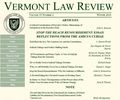
VTLREV_coverAs we noted here (when we posted our article), the latest issue of the Vermont Law Review deals with the U.S. Supreme Court’s “judicial takings” case, Stop the Beach Renourishment, Inc. v. Florida Dep’t of Environmental Protection, 130 S.Ct. 2592 (June 17, 2010). 

In eight essays, the authors of several of the many amicus briefs add their post-opinion thoughts. Authors include Ilya Shapiro (Cato Institute), Professor John D. Echeverria (Vermont Law), and Julia Wyman (Marine Affairs Institute). The groundwork is laid in the first article, by Professor L. Kevin Wroth:

If hard cases make bad law, bizarre cases may make no law at all. The recent Supreme Court decision, Stop the Beach Renourishment, Inc. v. Florida Department of Environmental Protection is a case in point. In the Essays that follow, the Vermont Law Review has brought together the reflections of seven lawyers, or teams of lawyers, for amici curiae

Continue Reading Vermont Law Review: Essay Reflections From The Amicus Curiae In The Judicial Takings Case

For anyone not watching the game, here’s your Sunday fix of items that do not involve football:

  • The Institute for Justice — the good people who represented Mrs. Kelo in Kelo v. City of New London, 545 U.S. 469 (2005) — have posted this short video entitled “Kelo v. City of New London: Judicial Abdication in Action.” Money quote: “What does Fort Trumbull look like today? Today, the Fort Trumbull neighborhood is a barren wasteland.”
  • The New York Times (itself the corporate beneficiary of eminent domain), posts the story “Blighted Area? These Business Owners Beg to Differ,” about the latest case of alleged “blight” and redevelopment in New York City, this time from East Harlem. Unless there is something here that we’re missing, New York’s law of blight and public use are so skewed in favor of the condemnor as recently reaffirmed in the


Continue Reading Super Bowl Sunday Links

The last chapter in the Ninth Circuit’s rent control saga has not been written. In Guggenheim v. City of Goleta, No. 06-56306 (Dec. 22, 2010), a sharply divided en banc Ninth Circuit concluded that Goleta’s mobile home rent control ordinance was not a taking under the three-factor regulatory taking test of Penn Central Transportation Co. v. New York City, 438 U.S. 104 (1978). Our resource page on the case is here (includes all opinions and merits and amicus briefs).

Mark Alpert (one of the attorneys for the property owners) reports on his blog California Property Rights Journal:

We are happy to announce that Dan Guggenheim has made the decision to file a cert petition. We are thrilled that Dan has been able to retain former Solicitor General Ted Olson and his appellate team at Gibson, Dunn to lead the effort along with myself and Rob Coldren at HKC.

With a panel

Continue Reading Cert Petition Coming In Ninth Circuit Rent Control Takings Case (Guggenheim)

In a case with “a lengthy procedural history spanning the past three decades and involving litigation in various federal courts,” in Innovair Aviation Ltd. v. United States, No. 2010-5025 (Jan. 25, 2010), the United States Court of Appeals for the Federal Circuit held that the Court of Federal Claims had no subject matter jurisdiction to consider Innovair’s takings claim because “Congress provided a comprehensive administrative and judicial system in the district courts to review the in rem forfeiture of property seized pursuant to 21 U.S.C. § 881.”  Slip op. at 18.

The case involves the government’s seizure of modified DC-3 airplanes sold to Air Columbia and allegations of drug smuggling, FAA regulations and the right to market turboprop conversion kits, and substitute res bonds. Relying on Vereda LTDA v. United States, 271 F.3d 1367 (Fed. Cir. 2001), the court concluded that a Tucker Act remedy was not available

Continue Reading Federal Circuit: Tucker Act Not Available When Congress Provides Other Relief

Remember Klumpp v. Borough of Avalon, 997 N.J. 390 (N.J. 2010)? That the case in which the New Jersey Supreme Court held that the six year statute of limitations on inverse condemnation claims did not begin to run until 2005, when the Borough began claiming that a taking occurred, even though it physically took the property in 1965. We detailed the opinion here.

The New Jersey Law Journal described the Appellate Division‘s opinion — which held that the government can assert inverse condemnation in order to take property without compensation — as the “bizarre condemnation.” How that argument came to be is a long story which we detailed in this post so we won’t recount it here.

It looks like the New Jersey Supreme Court’s opinion is not quite the last chapter in the story.

filed this cert petition, asking the U.S. Supreme Court

Continue Reading Cert Petition In New Jersey’s “Bizarre Condemnation”

According to this report, the Wisconsin Supreme Court has agreed to review Kelmm v. American Transmission Co., No. 2009AP2784 (Aug. 10, 2010) (a court of appeals’ decision we noted here). In that case, the court of appeals held that in order to obtain litigation expenses under a state statute which provides that a property owner may recover expenses if a condemnation award exceeds the “jurisdictional offer” by at least $700 and at least 15%, there must be a “jurisdictional offer” made.

Wisconsin eminent domain procedure has a two-fold path, one of which results in a “jurisdictional offer,” and the other a negotiated settlement. Either path can end up before the condemnation commission. ATC wanted to place an electricity transmission line across Klemm’s land. Rather than fight the taking, the Klemms “agreed to the $7,750 compensation ATC offered in negotiations, with the understanding they had the right to

Continue Reading Wisconsin Supreme Court To Consider Litigation Expenses In Negotiated Condemnation Cases

An opinion today from the U.S. Court of Appeals for the Ninth Circuit in Association of Irritated Residents v. Envt’l Protection Agency, No. 09-71414 (Feb. 2, 2011)

The case involves whether the EPA properly approved revisions to California’s State Implementation Plan for meeting air quality standards for ozone under the Clean Air Act. The court granted the petition and remanded the case to the EPA for further consideration. 

But what really grabbed us was the plaintiff: “Association of Irritated Residents.” Oh, we get it: AIR. How cheeky. Reminds me of those catchy names plaintiff’s groups often use (see, e.g., United States v. SCRAP (Students Challenging Regulatory Agency Procedures), 412 U.S. 669 (1972)), and the acronyms that float around the land use arena to describe motivation (e.g., NIMBY, BANANA), which we discussed in this post.

But I think “Association of Irritated Residents” Continue Reading Best Plaintiff Group Name: Association of Irritated Residents

On Friday, February 4, 2011, starting at 10 a.m. HST, we will be live blogging the Hawaii Senate Committee on Judiciary and Labor’s hearing on the appointment of Judge Sabrina McKenna as an Associate Justice of the Hawaii Supreme Court. Our Damon Key colleague Rebecca Copeland will be in the room covering it.

We live blogged the Governor’s announcement of Judge McKenna’s appointment here. This is Governor Abercrombie’s first appointment to the court, and breaking from past tradition, he did not publicly announced the list of candidates transmitted to him from the Judicial Selection Commission. We’re guessing this confirmation hearing will not generate much opposition, so the hearing will be more like Justice Recktenwald’s, and not like Judge Leonard’s

Go here to find out more how to submit testimony (due 24 hours prior to the hearing).

If you can’t make it to the hearing, come join the

Continue Reading Live Blog Of Judiciary Committee Hearing On Appointment Of Judge Sabrina McKenna To HAWSCT

Zipler Since this is the season for self-congratulatory industry awards, we can’t overlook one of our industry’s highest honors, the Zoning and Planning Law Report Land Use Decision Awards (aka the “ZiPLeRs”). For those of you who do not subscribe to the Zoning and Planning Law Report, the “strangest, or at least more dramatic” land use cases each year are eligible for nomination for a ZiPLeR.

Our colleage Dwight Merriam recently announced the 2010 Awards in the January 2011 issue of ZPLR, and what do you know, a case we nominated “won” the “Home Business Of The Year” Award. We use the term “won” quite loosely, since if you read the facts of the 11th Circuit case, Flava Works, Inc. v. City of Miami, No. 09-11264 (June 25, 2010), involving a South Florida “voyeur/porn dorm” and whether it qualifies as a “business,” this isn’t exactly something we’re going to

Continue Reading What’s An Oscar, Emmy, Or Tony When Compared To A ZiPLeR?