2011

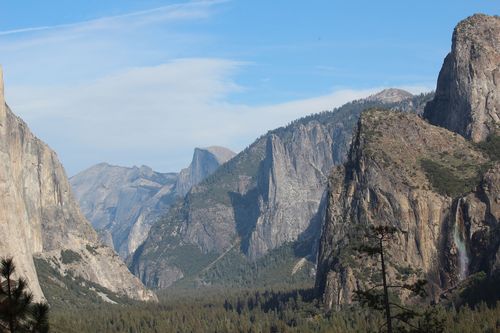
IMG_6999

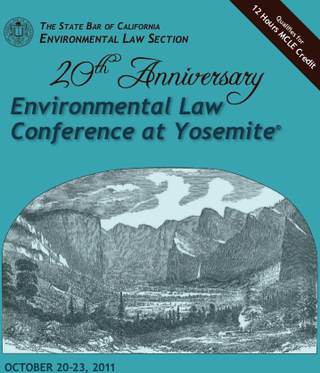
“Yosemite,” according to California Place Names, Erwin Gudde’s seminal work on the origins of (surprise) California place names, means “they are killers.” It was “[e]vidently a name given to the Indians of the valley by those outside it.”

I raise this historical tidbit because I must admit to feeling a little like “those outside it” when I was invited to speak about regulatory takings at the California State Bar’s Environmental Law Conference at Yosemite. I figured as a conference devoted to environmental law, it was a going to be a decidedly skeptical audience, given my advocacy for property owners and property rights. I accepted the invitation nonetheless, heartened that this conference wasn’t going to be an echo chamber and that they were at least open to hearing competing ideas.

It turns out that my prediction about “they are killers” was not accurate — the audience, while not exactly

Continue Reading Yosemite Seminar Summary – Regulatory Takings: Looking Back And Looking Forward
The City of Hayward, California, was concerned that residential rentals within its borders were “decent, safe, and sanitary,” and by ordinance required the owners or tenants of such units to allow city officials to inspect them. If an owner or tenant refused, the “Enforcement Official” was authorized to procure an “inspection warrant” and levy a monetary fine on the property owner.

An association of rental owners sought a writ of mandate, challenging the ordinance because it violated the Fourth Amendment, among other reasons. The trial court granted the writ and held the ordinance facially invalid because it compels a property owner to provide access to a tenant’s residence without tenant consent, and violates the substantive due process rights of the property owners because it levies a monetary penalty on a property owner even when the tenant is the one refusing to allow inspection.The court enjoined enforcement of the ordinance.

The

Continue Reading Cal App: City May Enter Rental Property To Make Inspections

The Natural Resources Section of the Hawaii State Bar Association has kindly asked me to speak to its members at their monthly lunch meeting, next Tuesday, November 1, 2011, from noon to 1:00 p.m. at the HSBA conference room, located on the 10th floor of Alakea Corporate Tower, 1100 Alakea Street.

I’ll be discussing the case currently pending in the U.S. Supreme Court about the ability of property owners to challenge a jurisdictional determination by the U.S. Environmental Protection Agency, Sackett v. United States, No. 10-1062 (cert. granted June 28, 2011).

The issue now before the Court is whether the Ninth Circuit correctly concluded that property owners who contested the EPA’s Clean Water Act jurisdiction could do so only in the course of an EPA enforcement action, and could not seek immediate judicial review of whether their property was even subject to the EPA’s authority. Sackett v. EPA, 622

Continue Reading Upcoming Hawaii State Bar Association Presentation: Sackett v. EPA – Immediate Judicial Review Or Death By A Thousand Days?

Law professor Richard Epstein was a featured speaker (and past Brigham-Kanner prize winner) at the recent B-K Property Rights Conference in Beijing. He’s summarized his thoughts and insights in “Going Red on Property Rights,” posted at the Hoover Institute’s site. He writes:

Earlier this month, I attended a Chinese-American Conference in Beijing on property rights co-sponsored by the William and Mary Law School and the Tsinghua University Law School.  One purpose of the conference was to award in absentia the Brigham-Kanner Prize to retired Justice Sandra Day O’Connor for her contributions to understanding the law of property. The intensive two-day discussions on property rights were open, animated, and cordial. They also revealed deep ironies in both the Chinese and American approaches to property rights.

The entire piece is well worth reading. All of our posts on the B-K Conference are collected here. I’m writing my wrap-up of the Conference and will post it shortly.

In the meantime, I offer this little story.

A few of us are walking the 15 minutes from the hotel to the moot courtroom at the Tsinghua Law School, through the university campus. We cross the lightly traveled road, and most of us step up onto the opposite sidewalk. Professor Epstein, engrossed in conversation with another lawprof, doesn’t notice they are walking down the middle of the road, blocking traffic.

A few seconds later, a car comes up behind them.

In Beijing, pedestrians decidedly do not have the right of way.

“Get out of the road!” we call out.

Epstein slowly turns around, looks at the car, looks at us, and says with a smile, “sidewalks are for mere mortals.”

(But he does get out of the road.)
Continue Reading Brigham-Kanner Property Rights Conference – “Mere Mortal” Professor Richard Epstein on “Going Red on Property Rights”

George-clooney-descendants-set-photos-04032010-15-400x470

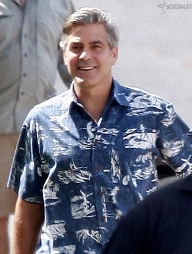
A note to our Mainland colleagues: when next you are called to Hawaii on business, if you emulate His Georgeness, you can’t go wrong.

In our Bishop Street Fashion Guide, we commented upon the unwritten rules for the unique haberdashery in Honolulu, and what is considered appropriate business wear for lawyers when not appearing in court.

In that vein, the recent showing of The Descendants featuring Geo. Clooney at the Hawaii International Film Festival is an example of how to play it right down the center: a reverse print, button-down, half-placket, no-poly aloha shirt, most likely of the Reyn Spooner variety. Tucked in for the formal look, or untucked for the casual Friday look or pau hana time.

However the film is otherwise in the accuracy department, we can say this: the technical advisor and the wardrobe department got it 100% right. Clooney dresses like a Hawaii businessman.Continue Reading Clooney Sports The Aloha Shirt…Like A Boss!

Here’s the latest in the lengthy West Linn Corporate Park tale from Oregon. After having bounced from federal court, to the Oregon state courts, then back to federal court, the case is now in the hands of the U.S. Supreme Court.

The issue in the case is whether the Ninth Circuit was correct when it held in an unpublished memorandum opinion that “[t]he Supreme Court has not extended Nollan and Dolan beyond situations in which the government requires a dedication of private real property. See Lingle v. Chevron USA, Inc., 844 U.S. 528, 547 (2005). We decline to do so here.” Slip op. at 4-5.

Weak, Ninth Circuit, weak. Is the issue of whether Nollan and Dolan‘s nexus and rough proportionality requirements apply only to exactions of land — but do not govern exactions of other types of property such as money — so settled that you blow

Continue Reading New Cert Petition: Are Nollan And Dolan Limited To Exactions Of Land?

Yosemite_conference Here are the links to the cases and other items discussed today at the session Regulatory Takings – Looking Back and Looking Forward at the Cal State Bar’s Environmental Law Section’s Environmental Law Conference at Yosemite.

These cases are also in your written materials.


Continue Reading Links From “Regulatory Takings: Looking Back And Looking Forward” (Cal. State Bar Yosemite Conference)

Earlier, we posted Justice Scalia’s assertion at a recent conference that Kelo ranked among the top all-time blown calls by the Supreme Court. While the Kelo majority opinion is decidedly foul, does it really sink to the level of Dred Scott, the opinion in which the Court concluded that Africans could never be U.S. citizens?

Well, one writer doesn’t think so. In the Atlantic, Garrett Epps writes “Can Eminent Domain Be as Bad as Slavery?” While there is much we agree with in Mr. Epps’ piece, especially his conclusion (we’re sorry, eminent domain abuse, as bad as it is, is not quite as bad as concluding that a class of people are simply incapable of being citizens because they are somehow lesser humans — that’s just repugnant), we don’t buy in wholly to his reasoning.

He outlines three reasons why Justice Scalia’s dislike of Kelo is

Continue Reading More On Scalia, J.’s, Assertion That Kelo = Dred Scott

Cover_42_3_ The Urban Lawyer, the law review produced by the ABA Section of State & Local Goverment Law has published my article Recent Developments in Condemnation Law: Public Use, Private Property, 43 Urban Lawyer 877 (2011).

The article “summarizes recent cases in which the issue was the power of condemnors to take property, including challenges under the Public Use Clause, as well as other challenges on the power to take” (from the Introduction).

This volume of The Urban Lawyer contains this and other articles with updates on environmental law, regulatory takings, land use and zoning, and municipal bond financing. For those of you who are SLG Section members, your copy is undoubtedly in the mail, and the pdf version will soon be available on the Section’s web site. For those of you who are not Section members you get a freebie, at least of my article.

If you are

Continue Reading New Article – Recent Developments in Condemnation Law: Public Use, Private Property

The Pacific Legal Foundation, the Cato Institute, Professor Paul M. Sullivan, The Grassroot Institute of Hawaii, and the Goldwater Institute have filed this amicus brief, supporting the cert petition filed last month in Corboy v. Louie, No. 11-336 (cert. petition filed Sep. 15, 2011).

That’s the case seeking SCOTUS review of the Hawaii Supreme Court’s opinion concluding that challengers to the property tax exemptions conferred on lessees of Hawaiian Homesteads lacked standing. Only “native Hawaiians” are eligible to lease homestead land, and thus only those possessing the appropriate blood quantum are entitled to the tax exemptions, and the Hawaii court dismissed the case for lack of jurisdiction, holding the petitioners lacked standing to challenge the exemption since they had not sought homestead leases (leases for which they were ineligible because they are not native Hawaiians).

The petition asks this question:

Whether the Hawaii courts erred in failing to recognize

Continue Reading Amicus Brief In Hawaii SCOTUS Case: Is Hawaiian Homes Property Tax Exemption Racial Discrimination?