


July 2012

When does a party who loses a petition for rehearing actually win it?

In Bywaters v. United States, No. 2011-1032 (Fed. Cir. Mar. 1, 2012) an opinion we detailed here, a 2-1 panel of the Federal Circuit held that the property owner’s request for attorneys fees under the Uniform Relocation Assistance and Real Property Acquisition Policies Act was reasonable, but halved it because the amount of compensation sought and awarded was not that large. The majority, in an opinion by Judge Dyk, remanded the case to the Court of Federal Claims for additional calculation.

Judge Plager dissented, asserting that remand was pointless because there was nothing left for the CFC to do but apply the lodestar (reasonable rate x reasonable time), and since the panel majority did not disturb any of the CFC’s findings on those two issues, the result, absent the halving, should be the same. Small

Continue Reading Fed Circuit: En Banc Petition Denied, But Kind Of Granted
Remember the case from late last year in which the Honolulu Star-Advertiser brought a freedom of information/open records lawsuit against the Hawaii governor to force him to disclose the names of judicial nominees? Abandoning the practice of his two predecessors, the Governor refused to release the list of names of nominees transmitted to him by the Judicial Selection Commission.

The circuit court ruled that under Hawaii’s Uniform Information Practice Act the Governor should not have kept the names secret, and that disclosure is required. [Disclosure: we represent the Star-Advertiser in that case.]

Following the ruling, three things happened. First, the Governor released the names on the lists for the vacancies on the Hawaii Supreme Court (eventually filled by Justice McKenna) and on the circuit bench. Second, the Judicial Selection Commission amended its rules to allow for the release of the lists when they are transmitted to the governor. Third, UIPA

Continue Reading State Appeals Attorneys’ Fees Award In JSC List Case

No, not another case from the Hawaii courts, but from an island further afield, Saipan in the Northern Mariana Islands.

We were going to do a write-up of Commonwealth v. Lot No. 353 New G, No. 2012-MP-06 (CNMI June 28, 2012), but Gideon Kanner beat us to it. Read the opinion, and his summary of what happens in the CNMI when the government takes property but doesn’t pay for it for 15 years.

Commonwealth v. Lot No. 353 New G, No. 2012-MP-06 (June 28, 2012) Continue Reading Eminent Domain, Island Style

Today, on behalf of Owners’ Counsel of America, we filed this amicus brief in Arkansas Game & Fish Comm’n v. United States, No. 11-597 (cert. granted Apr. 2, 2012), the case in which the Federal Circuit held that flooding caused by the Corps of Engineers was only temporary, and did not result in a compensable taking merely because it eventually stopped, and “at most created tort liablity.” The dissenting judge concluded that temporary flooding was no different in kind than more permanent flooding that occurs in other inverse condemnation cases, and regularly results in awards of compensation. We posted the Federal Circuit’s opinion here.

Our brief argues:

This case presents the court with an opportunity to bring a measure of long-absent clarity to one part of takings law. A physical invasion of property – even that which is deemed “temporary” – is a taking and triggers the

Continue Reading Amicus Brief: Any Physical Invasion That “Directly And Substantially” Interferes With Use Is A Taking

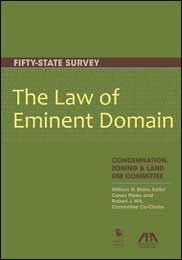
5310412_bigJust published: the ABA Section of Litigation (Condemnation, Zoning, and Land Use Committee) has released The Law of Eminent Domain — A Fifty State Survey (First Chair Press 2012). This book is a “single resource for eminent domain practitioners … a reference for questions about eminent domain and condemnation procedure in every state and the District of Columbia.” It’s a handy desk reference for how common issues in eminent domain are handled in each jurisdiction. Each state chapter covers the same topics:

  • Who is Eligible to Condemn?
  • What can be Condemned?
  • The Condemnation Proceedings
  • Procedure to Challenge Condemnation
  • Inverse Condemnation
  • Just Compensation Issues
  • How are Various Ownership Interests Treated?
  • Abandonment
  • Attorney’s Fees and Costs

We authored the Hawaii chapter. Our Owners’ Counsel of America colleague Bill Blake served as the editor, and many of our friends and colleagues from across the nation authored their state’s chapter. It’s a great reference

Continue Reading New Book: The Law of Eminent Domain (A Fifty State Survey)

Those disappointed by the Supreme Court’s decision in the ACA cases have searched for a silver lining in an otherwise devastating defeat: five justices would prohibit the Commerce power from reaching inaction, a Machiavellian CJ Roberts took the long view, that this is the Chief’s Marbury v. Madison moment. Yeah, other than that, Mrs. Lincoln, how was the play?

Others have suggested, quite correctly, that the fate of Obamacare now rests in the hands of the people. Opponents have vowed to repeal it, citing the nearly universal popular revulsion with the Court’s majority decision in Kelo v. City of New London as an example where one side lost the battle, but might have secured the upper hand in the long run.

Here’s our thoughts on why that’s unlikely, or at least why the comparisions to Kelo are inapt:

  • In Kelo, the property owners were


Continue Reading Is The Obamacare Decision The New Kelo?

In Eminent Domain and the Obamacare Decision, Gideon Kanner also looks for the eminent domain angle in the recent opinions on the legality, vel non, of the ACA. In particular, he challenges the casual assetion in Justice Ginsburg’s opinion that eminent domain an “unwanted sale,” that there is such a thing as an “inactive landowner,” and that necessity has anything to do with a federal condemnation action.

Check it out, if you haven’t had your fill of Obamacare news. On second thought, belay that order: check it out even if you have had your fill. Continue Reading Professor Kanner On Justice Ginsburg’s Eminent Domain Illiteracy