


October 2012

The three-part Penn Central test for an ad hoc regulatory taking tasks courts with evaluation of the economic impact of the regulation on the property’s use, the property owner’s distinct investment-backed expectations, and the character of the government action. Throw all of these “factors” into a pot, stir, and voila, the answer of whether the regulation goes “too far” is supposed to emerge. But try as they might, many courts don’t really have a good idea of how to apply this test, even though in Lingle, the Supreme Court affirmed that it remains the “default” analysis to evaluate most takings claims.

The latest regulatory takings opinion from the Ninth Circuit, Laurel Park Community, LLC v. City of Tumwater, No. 11-35466 (Oct. 29, 2012) is another example of a court applying the test, in this case to evaluate property owners’ claims that the enactment of a new zoning

Continue Reading 9th Cir: No Facial Penn Central Taking In Ordinance Creating Mobile Home Zoning
We love any opinion that begins with “[t]his case’s story started in 1942…” A typical long-fact-pattern takings case, perhaps? Well, not quite. This case, which we’ve been meaning to post for a while, deals with who is entitled to intervene in a takings case.

In Wolfsen Land & Cattle Co. v. United States, No 2011-5113 (Sep. 21, 2012), the U.S. Court of Appeals for the Federal Circuit affirmed the Court of Federal Claims’ denial of a motion to intervene by an environmental organization in a takings case. In an earlier separate case, the organization and others had sued the federal government over the operation of a dam. To settle that case, the government and the organizaitons entered into an agreement that “obliged the government to release water from the dam for the purpose of restoring and maintaining fish populations downstream[.]” Slip op. at 4.

As a result of the

Continue Reading Federal Circuit: Federal Gov’t Adequately Represents Enviros’ Rights

You can take the Justice out of the Court, but you apparently can’t take the Court out of the Justice. Retired Justice John Paul Stevens has added the “ninth vote” (his words, not ours) in Stop the Beach Renourishment, Inc. v. Florida Dep’t of Environmental Protection, No. 08-11 (June 17, 2010), the case is which the other eight Justices all agreed that the Florida Supreme Court had not changed the law, so there had been no “judicial taking.” Four Justices, however, opined that if a court declares that what was once an established right of private property no longer exists, it has taken that property in violation of the Takings Clause.

Justice Stevens sat that one out, recusing himself because news stories had noted his wife owned a beachfront condo in Ft. Lauderdale. But the lure of adding his reaction to Justice Scalia’s opinion has proven too much to

Continue Reading Justice Stevens, Recused In The “Stop The Beach Renourishment” Case, Weighs In On The “Stop The Beach Renourishment” Case

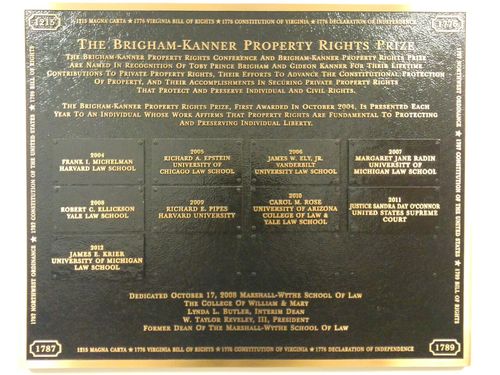
Here are my remarks from last week’s Brigham-Kanner Property Rights Conference at the William & Mary Law School in Williamsburg, Virginia. Our panel spoke on “Property Rights in Times of Economic Crisis,” and included lawprofs James W. Ely (Vanderbilt), William Fischel, (Dartmouth), and Eric Kades (William & Mary). See the complete faculty list and agenda here.

+++++++++++++++++++++++++++++++++++++++

Aloha, I bring you greetings from the land of Midkiff, the land of Lingle.

I practice in the jurisdiction that believed it would cure our economic ills to use eminent domain to bust up the legacy land trusts, and make sure that everyone who owns a home could also own the fee simple interest.

Which they may now do, provided they can afford our median price for a single-family residence, $637,000.

I practice in the jurisdiction that believed that it would be a good idea to try and bring

Continue Reading Professor Ely, You Magnificent Bastard, I Read Your Book!

In July, we posted the opening brief in Ladd v. United States, the case in which the Court of Federal claims dismissed the property owners’ Fifth Amendment takings claim stemming from a rail conversion. The CFC held that the claim was filed past the six-year Tucker Act statute of limitations even though the government did not provide the owners notice of the action that they assert was a taking.

The appeal, now pending in the Federal Circuit, asks whether the federal government can take an owner’s property without providing any notice to the landowner, and avoid its constitutional obligation to pay compensation because the statute of limitations began to run when the government issued the order, not when the landowner had notice of the government’s order taking their property? Our colleague Thor Hearne has sent along the recently-filed Reply Brief. which argues:

The government defends the CFC’s dismissal

Continue Reading Reply Brief In Fed Cir Rails-to-Trails Appeal: Statute Of Limitations Doesn’t Start To Run Until Gov’t Gives Notice Of The Taking

Ever since the U.S. Supreme Court’s infamous decision in Kelo v. City of New London, 545 U.S. 469 (2005), the focus of eminent domain scholarship and the public have been on the public use side of the condemnation equation.

However interesting those issues are (and they truly are), practitioners of eminent domain law understand that a vast majority of the issues in litigation still revolve around just compensation and valuation. The Supreme Court has even shown an interest, with the Justices asking questions about compensation in at least two oral arguments where the issue was not directly presented (here and here for example). While the ABA has recently published books about eminent domain generally (see here and here), it has not produced one devoted to just compensation.

But it soon will. The section on State and Local Government Law has decided to publish a book on current

Continue Reading Call For Authors: American Bar Association Book On Just Compensation Issues

The Oyez Project has posted the recording in Arkansas Game & Fish Comm’n v. United States, No. 11-597 (cert. granted Apr. 2, 2012), the takings case argued earlier this week in the U.S. Supreme Court.

Check it out here. We posted our summary of the petitioner’s arguments here, and will be posting our thoughts on the government’s arguments shortly. But in the meantime, listen along. Continue Reading Oral Argument Recording In SCOTUS Flood Takings Case

There’s still time to join us later this week at William & Mary Law School in Williamsburg, Virginia for the 2012 Brigham-Kanner Property Rights Conference, and the award of the B-K Prize to University of Michigan lawprof James Krier for his lifetime contributions to property law scholarship.

The Conference includes a day-long series of discussions on property rights, featuring leading scholars and practitioners. Topics include “The Impact of a Leading Property Scholar,” “The Judiciary’s Role in Shaping Constitutionally Protected Property,” “Property Rights in Times of Economic Crisis,” and “Property’s Moral Dimension.” The day will wrap with a roundtable discussion, “How Fundamental are Property Rights?” The complete agenda is available here.

I will be speaking on the panel about “Property Rights in Times of Economic Crisis,” discussing why property rights are even more important when times are tight.

Register on-line here. If you can’t join us, I will

Continue Reading 2012 Brigham-Kanner Property Rights Conference