


2012

Today, on behalf of Owners’ Counsel of America, we filed this amicus brief in Arkansas Game & Fish Comm’n v. United States, No. 11-597 (cert. granted Apr. 2, 2012), the case in which the Federal Circuit held that flooding caused by the Corps of Engineers was only temporary, and did not result in a compensable taking merely because it eventually stopped, and “at most created tort liablity.” The dissenting judge concluded that temporary flooding was no different in kind than more permanent flooding that occurs in other inverse condemnation cases, and regularly results in awards of compensation. We posted the Federal Circuit’s opinion here.

Our brief argues:

This case presents the court with an opportunity to bring a measure of long-absent clarity to one part of takings law. A physical invasion of property – even that which is deemed “temporary” – is a taking and triggers the
Continue Reading Amicus Brief: Any Physical Invasion That “Directly And Substantially” Interferes With Use Is A Taking

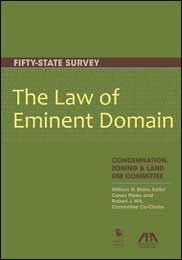
5310412_bigJust published: the ABA Section of Litigation (Condemnation, Zoning, and Land Use Committee) has released The Law of Eminent Domain — A Fifty State Survey (First Chair Press 2012). This book is a “single resource for eminent domain practitioners … a reference for questions about eminent domain and condemnation procedure in every state and the District of Columbia.” It’s a handy desk reference for how common issues in eminent domain are handled in each jurisdiction. Each state chapter covers the same topics:

  • Who is Eligible to Condemn?
  • What can be Condemned?
  • The Condemnation Proceedings
  • Procedure to Challenge Condemnation
  • Inverse Condemnation
  • Just Compensation Issues
  • How are Various Ownership Interests Treated?
  • Abandonment
  • Attorney’s Fees and Costs

We authored the Hawaii chapter. Our Owners’ Counsel of America colleague Bill Blake served as the editor, and many of our friends and colleagues from across the nation authored their state’s chapter. It’s a great reference

Continue Reading New Book: The Law of Eminent Domain (A Fifty State Survey)

Those disappointed by the Supreme Court’s decision in the ACA cases have searched for a silver lining in an otherwise devastating defeat: five justices would prohibit the Commerce power from reaching inaction, a Machiavellian CJ Roberts took the long view, that this is the Chief’s Marbury v. Madison moment. Yeah, other than that, Mrs. Lincoln, how was the play?

Others have suggested, quite correctly, that the fate of Obamacare now rests in the hands of the people. Opponents have vowed to repeal it, citing the nearly universal popular revulsion with the Court’s majority decision in Kelo v. City of New London as an example where one side lost the battle, but might have secured the upper hand in the long run.

Here’s our thoughts on why that’s unlikely, or at least why the comparisions to Kelo are inapt:

  • In Kelo, the property owners were


Continue Reading Is The Obamacare Decision The New Kelo?

In Eminent Domain and the Obamacare Decision, Gideon Kanner also looks for the eminent domain angle in the recent opinions on the legality, vel non, of the ACA. In particular, he challenges the casual assetion in Justice Ginsburg’s opinion that eminent domain an “unwanted sale,” that there is such a thing as an “inactive landowner,” and that necessity has anything to do with a federal condemnation action.

Check it out, if you haven’t had your fill of Obamacare news. On second thought, belay that order: check it out even if you have had your fill. Continue Reading Professor Kanner On Justice Ginsburg’s Eminent Domain Illiteracy

The Courrt has denied certiorari in Corboy v. Louie, No. 11-336, the case asking the Court to review the Hawaii Supreme Court’s dismissal of a challenge to the property tax exemptions conferred on lessees of Hawaiian Homesteads. The petitioners claim this is an unconstitutional race-based classification, but the Hawaii Supreme Court dismissed for lack of standing (the petitioners had not applied for Hawaiian Homestead leases because they are ineligible to receive them).

Here’s the order, in the event you want to see it for yourself.

This case had been kicking around on the docket since December 2011, and it was only on the Term’s last day that the Court finally said no. Continue Reading Supreme Court Declines To Review Challenge To Native Hawaiian Property Tax Exemptions

We haven’t followed the Obamacare cases except as interested observers, and have largely avoided digging deep into the opinions, preferring to allow minds immeasurably superior to ours to provide the high-altitude view. However, we naturally scanned the majority opinion for any tie-in to our favorite topic, eminent domain.

Starting on page 33, the Chief Justice writes about the “functional” approach to legislative labeling, pursuant to which the majority concluded that the requirement to purchase insurance (the “mandate”) was a constitutional exercise of Congress’ taxation power, even though Congress did not call it a “tax,” and indeed packaged and sold it as anything but a tax. The majority concluded, “[t]hat constitutional question [is] not controlled by Congress’s choice of label.” Slip op. at 34. The opinion then provides examples where the Court held that particular exactions “not labeled taxes nonetheless were authorized by Congress’s power to tax,” because the Court

Continue Reading Does The “If It Looks Like A Tax And Walks Like A Tax, It Is A Tax” Rule Apply To Public Use?

Here’s the petitioner’s merits brief in Arkansas Game & Fish Comm’n v. United States, No. 11-597 (cert. granted Apr. 2, 2012), a case from the Federal Circuit that we’ve been watching.

In a 2-1 decision, the Federal Circuit held that flooding caused by the Corps of Engineers was only temporary, and did not result in a compensable taking merely because it was temporary and eventually stopped, and “at most created tort liablity.” The dissenting judge concluded that temporary flooding was no different in kind than more permanent flooding that occurs in other inverse condemnation cases, and regularly results in awards of compensation. We posted the Federal Circuit’s opinion here.

The Question Presented is straightforward:

Whether government actions that impose recurring flood invasions must continue permanently to take property within the meaning of the Takings Clause.

The Supreme Court’s docket report is here.

Petitioner’s Brief on

Continue Reading Petitioner’s Merits Brief In SCOTUS Takings Case: Even Temporary Flooding Requires Compensation

Here’s a key amicus brief in support of the cert petition in CCA Associates v. United States, No. 11-1353 (cert. petition filed May 8, 2012). In that case, the Court of Federal Claims concluded that it was a taking for Congress to prohibit a property owner from prepaying a government-issued mortgage, which required it to continue to allow use of its property as low-income housing. But the Federal Circuit reversed, and then denied en banc review.

The amicus brief of the National Federation of Independent Business Small Business Legal Center, the Cato Institute, and the Center for Constitutional Jurisprudence addresses three Questions Presented:

1. In conforming to the “parcel as a whole rule” propounded in Penn Central Transportation Co. v. New York City, 438 U.S. 104 (1978), does Tahoe-Sierra Preservation Council, Inc., v. Tahoe Regional Planning Agency, 535 U.S. 302 (2002) require conflation

Continue Reading Amicus Brief: A Temporary Regulation Can Work A Penn Central Taking

Lost in all the excitement over today’s ruling in the the Obamacare case that turned out not to be today, is this little tidbit for those from Hawaii. The Court yet again did not make a decision whether to grant cert in Corboy v. Louie, No. 11-336, which had been scheduled for last Thursday’s conference. This is the case asking the Court to review the Hawaii Supreme Court’s dismissal of a challenge to the property tax exemptions conferred on lessees of Hawaiian Homesteads. The petitioners claim this is an unconstitutional race-based classification, but the Hawaii Supreme Court dismissed for lack of standing (the petitioners had not applied for Hawaiian Homestead leases because they are ineligible to receive them).

This case was originally scheduled for the Court’s December 9, 2011 conference, but that was put off when the Court asked the Obama Administration to file an amicus brief, which

Continue Reading SCOTUS Delays Consideration Of Challenge To Hawaiian Homes Property Tax Exemption (Yet Again)