


2012

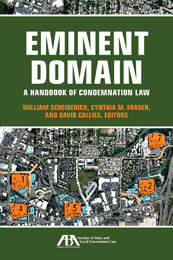
5330215_big Last year, the American Bar Association published “Eminent Domain – A Handbook of Condemnation Law,” a one-volume deskbook with an overview of condemnation and inverse condemnation law.

I authored two chapters in the book, one on Prelitigation Process, the other on Flooding and Erosion. (My Damon Key colleagues also co-authored the chapter on Damages Resulting from a Taking, so our firm’s fingerprints were all over this book.)

Anyway, as you know, the U.S. Supreme Court recently issued its decision in in Arkansas Game and Fish Comm’n v. United States, No. 11-597 (Dec. 4, 2012), in which a unanimous Court held that government-induced flooding could be a taking, even if temporary. The Sandy superstorm also raised some takings by flood issues.

As a consequence, takings liability for inundation damage is on every dirt lawyer’s mind, so the ABA Publications office has posted an excerpt of


Continue Reading Flood Takings Primer

Earlier, we wrote about what Hawaii law requires when one of its U.S. Senate seats becomes vacant: the remainder of the term is eventually filled by the vote of the people, but unitl the election is held, the Governor makes a temporary appointment to fill the seat and must appoint from a list provided by the political party of the Senator who caused the vacancy.

But how did Hawaii’s statute — a minority rule, but not a complete outlier — come to be? And is a rule that cabins a governor’s discretion by limiting the picks for a temporary appointee to those selected by a political party even constitutional, or democratic? (For more on the latter issue — do the Hawaii Democratic Party’s rules allow for a transparent selection process — see here.)

In “Senate Vacancies, And Why Governors Must Pick Temporary Appointees Chosen By Political Parties,”

Continue Reading Senate Vacancies, And Why Governors Must Pick Temporary Appointees Chosen By Political Parties

The Hawaii Supreme Court recently accepted cert in two cases worth watching. Our colleage Rebecca Copeland has summaried both and posted the relevant documents over at Record on Appeal.

  • Kanahele v. Maui County Council, No. SCWC-29649. It looks like the court will be wading into the nuances of Hawaii’s “Sunshine Law,” and what it means for public hearing notices.

Continue Reading Two Hawaii Supreme Court Cases To Watch

DrhouseA quick one from the California Court of Appeal (Third District), holding that a trial court in an eminent domain case should not have granted the condemnor’s motion in limine, but should have allowed the property owner’s appraisal expert to testify regarding comparble sales. County of Glenn v. Foley, No. C068750 (Nov. 26, 2012, published Dec. 21, 2012).

Our friends over at the California Eminent Domain Report have a great write-up on the opinion here, so instead of doing our own analysis, we commend it to you.

Be sure to read the opinion and check out the name of the property owner’s appraiser. Pretty appropriate for a property appraiser.

Continue Reading Cal App: Court Should Not Have Excluded Evidence Of Comparable Sales

Check out New York Central Lines, LLC v. State of New York, No. 2011-03494 (Dec. 19, 2012), a short opinion from the New York Supreme Court Appellate Division (Second Department) (if you didn’t know that in New York, the trial court of general jurisdiction is the “Supreme Court,” and the intermediate court of appeals is the “Appellate Division” of the Supreme Court, you have not been watching enough Law & Order).

Both the state’s and the property owner’s valuation experts testified that the highest and best use of the property was its current use, a rail corridor. But the two experts differed on the proper method of valuation.

The State’s expert advocated a cost, or reproduction cost less depreciation, approach to valuation, which is employed in valuing “specialty” properties (see generally Matter of Allied Corp. v Town of Camillus, 80 NY2d 351, 357; Matter of Al

Continue Reading NY Appellate: How To Value A Rail Corridor

Insurancelawhawaiififthanniversary

Our Damon Key colleague and fellow blogger Tred Eyerly has marked the fifth anniversary of his blog, Insurance Law Hawaii.

Doing a law blog for any length of time — as any blogger can tell you — is a second job, and Tred keeps at it with regular posts on the latest developments in coverage and bad faith issues. We realize that insurance may not be the most, you know, exciting issue (some might say the same thing about takings law, so hush your mouth!), but come on, doesn’t everyone need to know about insurance these days? The questions of proximate causation in Palsgraf were fun and all, but weren’t the real issues who was paying for the lawyers and who would pay if the Long Island Railroad were held liable? Tred covers them all (pun intended), nationwide. A Lexis-Nexis Top Blog year-after-year, and our one-stop shop for all

Continue Reading Congratulations To Insurance Law Hawaii On A Blogging Milestone

While we were perusing the Federal Circuit’s RSS feed for the latest and greatest opinions on takings law, we came across this gem, In re Marsha Fox, No. 2012-1212 (Dec. 19, 2012), a case about trademarks. 

Trademarks? Why pray tell, are you wasting our time posting this case, then?

Because in Fox, the court upheld the trademark examiner’s rejection of registration of “C**K SUCKER” for a line of “rooster-shaped lollipops.” The opinion is a classic, destined for future Intellectual Property casebooks, and deals with “double entendres,””scandlous meanings,” and the various definitions of the term in dictionaries. More on the case here. We can’t wait for the cert petition.

For more, be sure to listen to the oral argument recording:

Stream the oral arguments here

Our “straight-face of the year” award collectively goes to the judges and counsel. They almost got through the entire oral argument without a guffaw. Almost (see 19:30 mark).
Continue Reading The Law, In All Its Majesty

Here’s the latest election law case from the Hawaii appellate courts. In Kawauchi v. David, No. CAAP-10-0000066 (Dec. 13, 2012), the Hawaii Intermediate Court of Appeals held that the time deadlines in Haw. Rev. Stat. § 12-8 are mandatory, and that a constitutional challege to the Hawaii County Charter was not timely decided. The ruling emphasizes that in election cases under Hawaii law, the often-short repose periods must be followed precisely, even by courts, and even if the delay is the result of an understandable error. Failure to adhere to these deadlines will deprive a trial court of jurisdiction.

The case involved a challenge to the charter’s requirement that a candidate for public office be a resident of the district in which she intends to run for at least 90 days before the primary election. Section 12-8 establishes the procedures for challenging nomination papers and contains a 30-day repose

Continue Reading HAWICA: In Election Cases, Time Deadlines Matter

If it’s hard to remember a time when the State of Hawaii was not represented in Washington, D.C. by Daniel Inouye, the state’s senior Senator who died earlier today, that’s because until today, there has never been a time since statehood that Hawaii hasn’t been represented by Inouye, first as a Congressman, and then as a Senator. For the first time in its history as a state, Hawaii faces a future without Dan Inouye. This is a radically different political landscape.

Tributes are pouring in, and I haven’t the requisite chess skills to play the political guessing game, but I thought I’d share this one memory for whatever it’s worth.

Back in the day, when I was growing up, Inouye and Sparky Matsunaga (when Matsunaga was a Congressman, before he became Hawaii’s second Senator), used to come by theDisabled American Veterans’ hall at Keehi Lagoon to visit their old100th

Continue Reading A Small Lesson In Perspective

Updates:

————————————————————————

Hawaii’s senior U.S. Senator, Daniel K. Inouye died today. We can’t add much to the remembrances pouring in about this war hero, trailblazer, and political icon, so we’ll just address what we know, the law regarding how the vacancy in the U.S. Senate will be filled. Mark Murakami and I did some quick research, and here is what we came up with.

The starting point is the Seventeenth Amendment to the U.S. Constitution, which provides, in relevant part:

When vacancies happen in the representation of any State in the Senate, the executive authority of such State shall issue writs of election to fill such vacancies: Provided, That the legislature of any State may empower the executive thereof to make temporary appointments until the people

Continue Reading Now What?