2012

Here’s the transcript of Wednesday’s argument in Arkansas Game & Fish Comm’n v. United States, No. 11-597 (cert. granted Apr. 2, 2012).

BLUF (Bottom Line Up Front): we’re predicting the property owner win with a minimum six-Justice majority (perhaps more), with a narrowly drawn opinion vacating the Federal Circuit’s conclusion that temporary flooding can never be a taking. Whether the Court adopts a new test to determine whether a taking occured when the government purposefully floods land, however, is up in the air.

The petitioner was represented by James Goodheart, who led off the argument by attacking the Federal Circuit’s conclusion, arguing for a rule that a taking occurs whenever a “direct physical invasion” results in a “substantial intrusion” on a property interest, and that the duration of the invasion is not relevant. That’s a restatement of the existing per se rule that any physical invasion that

Continue Reading SG Doubles Down: Transcript Of Arguments In SCOTUS Flood Takings Case, Part II
Later today the Supreme Court will hear oral arguments in Arkansas Game & Fish Comm’n v. United States, No. 11-597 (cert. granted Apr. 2, 2012), to review the Federal Circuit’s conclusion that  flooding caused by the Corps of Engineers was only temporary, and even thought it destroyed trees owned by Arkansas, it was not a compensable taking merely because the flooding eventually stopped, and “at most created tort liablity.” The dissenting judge concluded that temporary flooding was no different in kind than more permanent flooding that occurs in other inverse condemnation cases and regularly results in awards of compensation. The Federal Circuit’s opinion is here.

We filed an amicus brief in the case supporting the property owner/petitioner, which argues that as long as the water releases by the Corps “directly and substantially” resulted in damage to petitioner’s trees it’s a taking for which just compensation is required and

Continue Reading SCOTUS Arguments In Flood Takings Case

If you need another reminder of what land use and zoning law looks like on Kauai in practice (and, in turn, in Hawaii generally), see this article, Hanalei vs. Hanalei in The Garden Island newspaper. It’s about a proposal to develop a new resort that (not surprisingly) is “meeting staunch opposition from a rapidly growing group of people.”

The developer side has its own view, touting the proposed resort as “the most environmentally and culturally responsible visitor-oriented project ever to be proposed in the state.” The story reports that one of the project’s backers is “billionaire and eBay founder Pierre Omidyar,” so that could make this a very interesting development instead of the usual enviros vs developer scenario, since Omidyar, according to at least one of the project’s opponents “has the right mind,” and “right heart” to donate at least part of the land to preserve a viewplane.

The

Continue Reading A Microcosm Of Hawaii Land Use Law

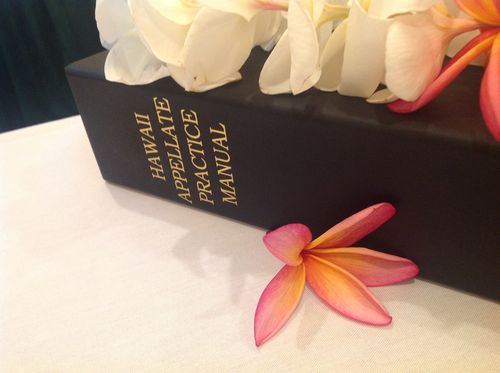
HSBA-appellate-manual

Introducing the recently-published Hawaii Appellate Practice Manual, your one-stop source for everything you need to know about appeals in Hawaii’s Supreme Court and the Intermediate Court of Appeals.

Our Damon Key colleagues contributed much to this work, with Rebecca Copeland serving as the editor and point person, and several DK attorneys authoring or contributing to chapters: Tred Eyerly (Appellate Mediation); Matthew Evans (Perfecting the Appeal; Civil Appeal Docketing Statement); Bethany Ace (Standards of Review; Prerequisites to Filing An Appeal). I wrote the chapter on Appellate Briefing (Practice Tip: Times New Roman font is horrible, but if the page limit is a concern it is the most readable of the smaller 12 point typefaces, and can save you several pages over a longer brief).

This is a great addition to any Hawaii lawyer’s bookshelf, whether you are an appellate maven or taking your first case on up the food chain.

Continue Reading Introducing The Hawaii Appellate Practice Manual (2012)

If you understand that headline, congratulations: you are officially a takings geek.

Here’s another piece worth reading, to prepare yourself for next week’s oral arguments in Arkansas Game & Fish Comm’n v. United States, No. 11-597 (cert. granted Apr. 2, 2012): Is the federal government shifting the focus in Arkansas Game & Fish Commission? by my PLF colleague Brian T. Hodges.

Somewhat surprisingly, the central question in this case—whether a physical invasion of private property must continue permanently to take property within the meaning of the Takings Clause—seems to be the least controversial of the questions posed by the parties’ merits briefs.  The question that is drawing the most attention is whether a temporary flood invasion should be treated like all other temporary physical takings (for which the Court has already established a test as set out in the PLF/Cato Institute/ALF amicus brief), or whether the Court should

Continue Reading Shifting Gears In SCOTUS Takings Case: Are Floods Treated As Physical Invasions, Or Analyzed Under Penn Central?

Greenwire’s Lawrence Hurley has posted his preview of next week’s Supreme Court arguments in Arkansas Game & Fish Comm’n v. United States, No. 11-597 (cert. granted Apr. 2, 2012).

In Ark. girds for showdown with Army Corps over forest flooding, Hurley writes:

The Supreme Court’s job is to decide whether temporary flooding of the type that occurred at the Black River site can constitute a “taking,” which is generally viewed as a permanent loss of property.

Or as Ilya Shapiro, a legal scholar at the libertarian Cato Institute in Washington, rephrased the question: “When a tree falls in a forest due to temporary flooding, does it make a sound for which you can recover under the takings clause?”

The story details some of the personalities on the property owner side, and is worth reading. Continue Reading Greenwire Previews SCOTUS Takings Case

Rice-cookerCheck out this complaint, filed last week in federal court in Honolulu by a Kauai councilmember against the County of Kauai, a Planning Department Official, and the Kauai prosecutor. The councilmember claims the defendants maliciously prosecuted him for a zoning violation.

And just what was the alleged zoning violation?

While the Planning official was conducting a warrantless search of the councilmember’s home supposedly to respond to a complaint about an alleged zoning violation, she “allegedly observed a rice cooker and a refrigerator in the addition/family room in the family home.” Complaint para 44. 

The addition/family room was a permitted structure in which no kitchen was allowed. The Planning official apparently concluded that the presence of the rice cooker and the fridge turned this room into a kitchen, and the councilmember received a Zoning Notice Violation.

The complaint goes on to explain how the case was dismissed by a State

Continue Reading Allegations Of Zoning Enforcement Outrages On Kauai (Part II) – A Rice Cooker Is A Kitchen?

Here’s a follow up to our earlier brief post about the opinion in Lavan v. City of Los Angeles, No.11-56253 (Sep. 5, 2012), in which a 2-1 Ninth Circuit panel held that the Fourth and Fourteenth Amendments protect the homeless against the City of L.A.’s seizure and destruction of their “momentarily unattended” property. The city undertook these efforts to clean up the “skid row” section of downtown.

Honolulu has an ordinance that has a similar purpose and design (to prevent the homeless from clogging up the parks and sidewalks with their “stuff”), but it is constructed quite differently. Instead of prohibiting property from being left unattended, it prohibits the “storage” of property in public spaces, with “storage” being defined as being left somewhere for more than 24 hours. Leave it unattended for more than that time, the city will scoop it up and store it at the owner’s

Continue Reading More On The Ninth Circuit’s Ruling That Homeless Have Property Rights, Too

Here are links to worthwhile reads, all with a takings flavor:

  • A


Continue Reading Takings Tuesday

In or near Sacramento this week? You may want to attend this free program, sponsored by the American Action Forum:

The American Action Forum will host a panel discussion at the Hyatt Regency in Sacramento on the devastating downturn of the housing market and painful recovery currently facing our nation. There’s no question California’s housing markets and greater economy have been among the hardest hit, yet a comeback seems to be underway. What can California’s story teach the rest of us? Is using eminent domain really a solution to our housing woes?

Join us for a complimentary breakfast as we hear from an exciting group of experts including Douglas Holtz-Eakin, former Director of the Congressional Budget Office, Daren Blomquist, Vice President of RealtyTrac, Richard Green, Director and Chair of the USC Lusk Center for Real Estate, Jed Kolko, Chief Economist at Trulia, Paul Herrera, Government Affairs and Communications Director, Inland

Continue Reading Upcoming Program – The U.S. Housing Recovery: Lessons From California