


January 2013

Update: the briefs are posted here.

In a case we’ve been following involving the Koa Ridge Makai residential housing project on Oahu, the Hawaii Supreme Court yesterday issued an order accepting the Sierra Club’s application for a writ of certiorari in Sierra Club v. Castle & Cooke Homes Hawaii, Inc., No. SCWC-11-0000625.

In the opinion being reviewed, the Intermediate Court of Appeals held that the Hawaii Senate’s failure to confirm a sitting Land Use Commissioner for a second term did not disqualify him from office under Haw. Rev. Stat. § 26-34(a).

Oooh, quo warranto. Stay tuned.Continue Reading Quo Warranto Fu: HAWSCT To Review Whether Holdover Land Use Commissioner Disqualified
William W. Wade, Ph.D., a resource economist with the firm Energy and Water Economics (Columbia, Tennessee) is a frequent author and speaker on the topic of regulatory takings and is familiar to readers of this blog. (His next gig is a talk on Penn Central and inverse condemnation at the 12th Annual Texas Eminent Domain SuperConference February 11-12, 2013, in Austin.)

Bill fills us in on the Texas Supreme Court’s decision in EdwardsAquifer Authority v. Day, 274 SW.3d 742, (Tex. 2012). The court issued the opinion in February 2012, but recently denied a motion to rehear the case, thus making it final. 

++++++++++++++++++++++++++++++++++

Regulatory Takings, Texas Groundwater, and Hydrofracking

by William W. Wade, Ph.D.

Texasmay have created the takings and condemnation lawyer full-employment act. 

TheTexas Supreme Court in February 2012 reversed a hundred years of water law,changing groundwater ownership rights from a “rule of capture” to ownership of”groundwater

Continue Reading Guest Post: Regulatory Takings, Texas Groundwater, And Hydrofracking

In 2009, in the “Superferry” case, the Hawaii Supreme Court, after years of hinting (but not finding a suitable vehicle), formally adopted the “private attorney general’ doctrine allowing attorneys’ fee shifting in certain select circumstances. See Sierra Club v. Dep’t of Transp., 202 P.3d 1226 (Haw. 2009). Under that doctrine, a court evaluating a claim for fees and costs evaluates three “factors” —

  • The strength or societal importance of the public policy vindicated by the litigation.
  • The necessity for private enforcement and a magnitude of the burden on the plaintiff.
  • The number of people standing to benefit from the decision.

The first two factors are pretty vague and have not been further defined except in the initial instance in the Superferry case, in which the court held that when a case establishes a legal principle, it might qualify as “public policy” vindicated by the litigation, and when a plaintiff

Continue Reading HAWICA Rejects “Private Attorney General” Fee-Shifting Doctrine In Land Court Case

In “When Government Takes You Hostage,” lawprof Richard Epstein weighs in on the issues in Koontz v. St Johns River Water Mgmt Dist., No. 11-1447 (cert. granted Oct. 5, 2012). In that case, the U.S. Supreme Court will address whether the “essential nexus” and “rough proportionality” standards of Nollan and Dolan are applicable only to exactions for land, or whether they are generally-applicable tests for all exactions.

Professor Epstein writes:

The situation that is now before the Supreme Court in Koontz shows the folly of the current law, which rejects the long-established common law baselines between neighbors. No longer does the state have to take (and pay just compensation) to satisfy its environmental goals. Rather, the entire mitigation doctrine amounts to nothing more than a form of grand theft larceny by which the state first claims for nothing a state-wide environmental easement, which it will then sell

Continue Reading Epstein On Koontz: “Grand Theft Real Estate?”

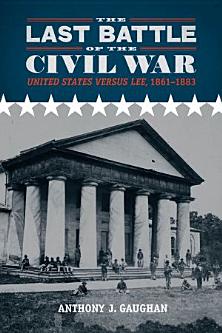
LastbattlebookYou know how we’re always saying that the provisions in the Takings Clause are “self-executing,” that even in the absence of a waiver of sovereign immunity, the Tucker Act, and section 1983, property owners would still be able to maintain a claim for compensation? Well here’s an article that explains that how that rule was first articulated, and not in a dry academic way, but with a fascinating historical story.

It’s the tale of United States v. Lee, 106 U.S. 196 (1882). We knew the land that is now Arlington National Cemetery was once owned by Robert E. Lee, but we can’t say that we gave much thought to how it became public property. We always assumed that it had simply been seized as war booty from Lee during the Civil War, and that was that.

In The Arlington Cemetery Case: A Court and a Nation Divided, 37

Continue Reading Arlington National Cemetery And The Takings Clause