


August 2013

Update: More here from the Star-Advertiser.

Courts, as “temples of justice” can be intimidating places, especially for the advocates who appear there. And when you make it a federal court, the level goes up. And when you are in a storied courthouse such as the Ninth Circuit’s headquarters in San Francisco surrounded by corinthian columns, cherub statues, and a ceiling full of stained glass, it certainly can be a heady experience.

Today was no different as a three-judge panel of the Ninth Circuit heard oral arguments in the federal environmental challenge to Honolulu’s multi-billion-dollar heavy rail project. The panel, comprised of Judges Stephen Reinhardt and Andrew Hurwitz, and Senior Judge Mary Schroeder, was “hot,” and for the most part kept firing questions at the three advocates over the course of the nearly hour-long arguments. As we noted in our initial post-argument report, the panel spent
Continue Reading Some Further Thoughts About The 9th Circuit’s Oral Arguments In Honolulu Rail Appeal

Here’s the latest from William W. Wade, Ph.D., a resource economist with the firm Energy and Water Economics (Franklin, Tennessee). Bill is a frequent author and speaker on the regulatory takings issue, and he’s brought much needed clarification to an often confusing issue about how to apply the Penn Central test. He has authored several guest posts for the blog, and we’re glad to have him back with a short piece on regulatory takings.Here, he responds to a recently-published article on the “economic impact” prong of the Penn Central test for a regulatory taking.

++++++++++++++++++++++++++++++++++++

A Note on Economic Impacts andAverage Reciprocity of Advantage

William W.Wade, Ph. D.

Daniel L. Siegel, SupervisingDeputy Attorney General, California Department of Justice, published anarticle, Evaluating Economic Impact in Regulatory Takings Cases in the summer 2013 West NorthwestJournal of Environmental Law & Policy.[1]Perhaps a brief rejoinder by an economist is suitable

Continue Reading Guest Post: A Note on Economic Impacts and Average Reciprocity of Advantage

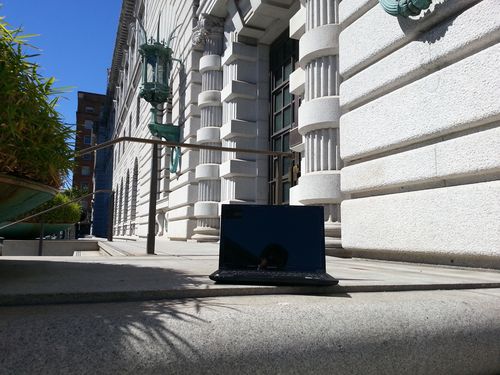
20130815_153930

We just finished up with the oral arguments at the Ninth Circuit courthouse in San Francisco. We’ll have a more detailed report later today, but our initial reaction is that it looks like at least two of the three judges are very skeptical whether there was an appealable final order in the case, and thus may be ready to dismiss the appeal for lack of jurisdiction. One judge seemed to understand and accept the appellants’ jurisdictional arguments, so if the court dismisses, we may see a dissent.

Of course, with appellate arguments it’s always a fool’s errand to predict the outcome based on oral argument (but that doesn’t stop us from doing it, does it?), so we may be totally off the mark. But when the court spends 95% of the time talking jurisdiction and not the merits, if you are the appellants’ lawyer, you must have your doubts.

More

Continue Reading Honolulu Rail Federal Appeal: Dismissed For Lack Of Appellate Jurisdiction?

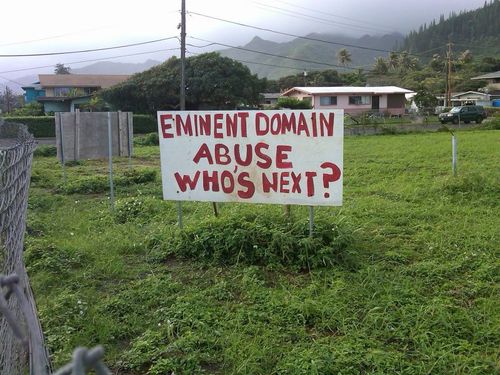
EM Hauulaeminent_domain_abuse

Here’s the Complaint, filed yesterday in U.S. District Court in Honolulu in which a windward Oahu property owner challenges the City and County of Honolulu’s removal of her protest signs on her property. 

The rub? She’s protesting the City’s condemnation of her property back in 2010. Her complaint alleges that the city “neither owns, manages nor maintains” the property, and that the owner continues to pay both property taxes and for the maintenance of the land. It also alleges there are other signs on nearby property with other messages that have not been touched. This seems similar to other cases in which property owners claim that the government is retaliating against them for their anti-eminent domain messages.

The complaint alleges that a few months ago, the City went on the property and posted a “removal notice” under the City’s newly-adopted “Bill 54,” an ordinance allowing the City to seize

Continue Reading New Federal Court Complaint Challenges Honolulu Grabbing Anti-Eminent Domain Signs Under “Stored Property” Ordinance

Here is a deeper look at the two lawsuits filed lastweek in U.S. District Court in San Francisco against the City ofRichmond, California, for the city’s Mortgage Resolution Partners-backed plan to condemn underwater mortgages, specifically those held by out-of-state securitizedbonds, residential mortgage-backed securitization (RMBS) trusts. The first Complaint was brought by Wells Fargo and a number of mortgage holders onbehalf of their trusts (“Wells Fargo” suit). The other, filed concurrently, was brought Wednesday bythe Bank of New York Mellon for its trusts(“Bank of NYM suit”).

My Damon Key colleague Bethany C.K. Ace has digested the complaints and provides us with her thoughts on the cases below. She joined me and Mark M. Murakami as the co-author of Recent Developments in Eminent Domain: Public Use, which is forthcoming in the next edition of the Urban Lawyer.

++++++++++++++++++++++++++++++++++

More On The Two Federal Lawsuits Challenging The Underwater Mortgage Taking Scheme

Continue Reading Guest Post: More On The Two Federal Lawsuits Challenging The Underwater Mortgage Taking Scheme

Update: More thoughts from Rick Rayl and Brad Kuhn (California Eminent Domain Report) here.

++++++++++++++++++++++++++++++++

Here’s a decision at the intersection of eminent domain valuation and unconstitutional exactions from the California Court of Appeal (Fourth District). In City of Perris v. Stamper, No. E053395 (Aug. 9, 2013) the court held that in a condemnation action, “issues surrounding the dedication requirement are essential to the determination of ‘just compensation’ and therefore must be “ascertained by a jury.'” Slip op. at 1.

First, some background. The city condemned a portion of Stamper’s industrially-zoned vacant land in order to realign and widen an adjacent road. Its deposit was based on the use of the land for agricultural purposes. But wait you say, the land was zoned industrial and even though it was vacant, when calculating compensaton, land is valued at its highest and best use. But get a load

Continue Reading Cal App: Nollan/Dolan Issues Impacting Eminent Domain Valuation Are Decided By The Jury

Whoa, that was fast: in a case argued on August 2, 2013, and decided on August 9, 2013 (that’s one week from orals to opinion, folks), the U.S. Court of Appeals for the Sixth Circuit in Village of Maineville v. Salt Run, LLC, No. 12-4379 (Aug. 9, 2013), held that the property owner/plaintiff forfeited* its argument that a facial takings challenge to municipal impact fees is not subject to Williamson County‘s state procedures requirement because the argument was not raised in the District Court.

You know the drill: Williamson County tells us that a property owner cannot raise a federal takings claim in federal court unless it has first sought and been denied compensation via available state procedures. “And they agree that Salt Run has not invoked this procedure.” Slip op. at 5.

In the normal course, that would be the end of the case. Having failed to

Continue Reading 6th Cir: Takings Plaintiff Forfeited Argument That Facial Challenges Not Subject To Williamson County’s State Procedures Requirement

Today’s the first day of the ABA Annual Meeting in San Francisco, so we haven’t had time to do more than scan the Complaint for Declaratory and Injunctive Relief, filed yesterday in San Francisco federal court, challenging the plans of Mortgage Resolution Partners and the City of Richmond, California to take underwater mortgages by eminent domain.

We’ll have more, but here are two initial reports:

Complaint for Declaratory and Injunctive Relief, The Bank of New York Mellon v. City of Richmond, No. 13-36…


Continue Reading The Other Shoe Drops: Banks Sue Richmond, California Over Mortgage Eminent Domain Scheme

Our friend and colleague Paul Schwind has been keeping us up to date with the latest in the dual legal challenges to the Honolulu rail project. His last post focused on the state court happenings.

Here’s the latest on the federal court action, now awaiting oral argument in the coming weeks in the Ninth Circuit. Here’s Paul’s most recent update in the federal lawsuit, when in December 2012 the court imposed a remedy for the defendants’ violations of section 4(f) of the Transportation Act. Paul now provides us with a preview of the arguments in the Ninth Circuit.

Programming notes. We’ll most likely be attending the arguments in San Francisco, and will have a report following. Also, Paul and I will be presenting a session on the latest in the rail project (including happenings in both state court and the Ninth Circuit) at the upcoming Eminent Domain and

Continue Reading Guest Post: Ninth Circuit Rail Appeal Preview

Here’s the latest from the New Jersey Supreme Court on the power of railroads to take property, and when land is already being put to a “prior public use” and thus immune from being taken.

In Norfolk Southern Railway Co. v. Intermodal Properties, LLC, No. A-117-11 (Aug. 6, 2013), the court held that the railroad had the power to condemn an adjacent parcel already used as a parking facility to expand its rail facility to, among other benefits, provide more parking space. It’s a long opinion (42 pages) so we won’t go into it in great detail, so here’s the short version.

The court held that the statutory requirement that a railroad’s condemnation be “not incompatible with the public interest” was met. Although the taking was for parking and the property taken was already being used for parking by its owner, this did not qualify as a prior public

Continue Reading New Jersey Explains Prior Public Use And Railroad Takings