September 2013

Here’s what we’re reading today:


Continue Reading Must Read Monday: RLUIPA Ripeness, “The Taking Issue,” Oysters In The Wilderness, Precondemnation Damages

The federal government has filed its brief responding to the cert petition which asks the Supreme Court to review a Tenth Circuit decision and resolve a lower court split about the meaning of the term railroad “right of way” as used in an 1875 federal statute and federal land patents subject to the 1875 Act.

The issue is whether the federal government retained an “implied reversionary interest” when it issued these patents, or whether these grants were subject only to a railroad easement. The difference is that easements may be extinguished, while reversionary interests cannot. In this case, the railway abandoned its use, after which the federal government instituted a quiet title action in federal court asserting it owned the right of way, and that it did not revert to the property owner.

Disclosure: we filed an amicus brief in the case supporting the petition. Our brief argues that the

Continue Reading SG’s Brief Not-In-Opposition In Railbanking Case: Court Should Resolve Circuit Split

Every now and then, we post an update from the rails-to-trails arena. But we’ve never provided a “big picture” look at the issue. Well, law.com has saved us the effort. In “Rails-to-Trails Program Costly to Taxpayers,” Jenna Greene provides an overview of how a law the Congressional Budget Office said “wouldn’t cost the federal government a thing,” ended up costing the taxpayers $49 million in the last year alone. Worth reading.

For our latest foray into this area, see our amicus brief urging the Supreme Court to review a Tenth Circuit case about the meaning of the term railroad “right of way” in an 1875 federal statute. We argue that the case, if left unreviewed by the Court, is an effort to undercut rails-to-trails takings cases. Continue Reading A Summary Of Rails-to-Trails Takings Cases

Here’s the cert petition filed earlier this week, asking the Supreme Court to review the Ninth Circuit’s decision in MHC Financing Ltd. P’ship v. City of San Rafael,714 P.3d 1118 (9th Cir. 2013).

That’s the case in which the Ninth Circuit overturned the District Court’s ruling (after two trials) that MHC had proven a Penn Central taking and was entitled to just compensation for the City’s mobilehome rent control ordinance. The panel’s rationale was that MHC purchased the mobilehome park with the oppressive regulations already in place, so it had no “investment backed expectations” of operating free of the regulations.

We posted our thoughts on the Ninth Circuit’s ruling here, so we won’t go into the details of the cert petition, except to note two things:

  • We didn’t get how the Ninth Circuit just ignored Palazzolo. We still don’t.
  • The second Question Presented (below) is particularly fasinating.


Continue Reading New Regulatory Takings Cert Petition: 9th Circuit Made Hash Of Penn Central

Here’s the latest case involving the TransCanada pipeline, a 2,151 mile petroleum pipline from Hardisty, Alberta in Canada, to Port Arthur, Texas, via Illinois and Oklahoma. In an earlier case (Rhinoceros Ventures Grp., Inc. v. TransCanada Keystone Pipeline, L.P., 388 S.W.3d 405, 408 (Tex. App. 2012), a Texas court of appeals held that the statute delegating eminent domain power to pipeline companies did not limit that delegation only to those operating within Texas. The court rejected the property owner’s argument that TransCanada was without power to take its property. See also this ruling by another Texas court of appeals (Ninth District) which also upheld TransCanada’s power to take property by eminent domain even though it is not a governmental agency.

Another court of appeals has joined them. In Crawford Family Farm P’ship v. Transcanada Keystone Pipeline, L.P., No. 06-12-00113-CV (Aug. 27, 2013), the Sixth District, echoed

Continue Reading Tex App (Again): TransCanada Keystone Pipeline Is Common Carrier With Eminent Domain Power

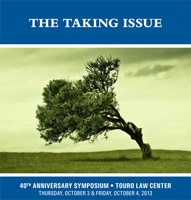
Taking_coverimage_webIf you are anywhere within striking distance of Touro Law School (Central Islip, Long Island), you should make plans to attend a conference that promises two days of fantastic programming on October 3 and 4, 2013.

The Taking Issue – 40th Anniversary Symposium” is dedicated to the memory of the legendary Professor Fred Bosselman, and lead author of The Taking Issue, a 1973 report to the President’s Council on Environmental Quality. While the themes in the book have been overtaken by the Supreme Court’s takings cases, it remains a touchstone work for anyone interested in the subject.

Conference co-Chairs Dean Patricia Salkin and Professor David Callies (a co-author of The Taking Issue) have assembled an excellent faculty and agenda. There will be panels on partial takings, the Nollan/Dolan/Koontz issue, the relevant parcel question, and one on ripeness which we’ll be moderating

Continue Reading Conference Announcement: The Taking Issue – 40th Anniversary Symposium

In a 2-1 decision (en banc next?) in a case we’ve been following with some interest in which a Marin County oyster farming operation in the National Seashore sued the Interior Department for its decision to not renew the farm’s permit, in this opinion, a Ninth Circuit panel held that courts have jurisdiction only to review the limited question of whether the Department understood its authority to renew or not renew the permit. The majority held that the statute pretty much gives the Department total discretion whether or not to do so, and thus the courts could not review its decision that wilderness legislation prohibited any extension of the permit.

In the majority’s words, “[t]he choice was the Secretary’s to make.” Slip op. at 27 (footnote omitted). 

The panel held that the farm was unlikely to prevail on the merits, and thus affirmed the District Court’s refusal to

Continue Reading 9th Cir: Courts Have No Jurisdiction To Review Discretionary Decision To Not Issue Permit

DK_Film_banner_2013

We had such a blast last year putting on a film festival highlighting some of our favorite legal movies, we decided to do it again.

From Saturday, September 14 through Friday, September 20, 2013, we are again teaming up with the Honolulu Museum of Arts’ Doris Duke Theatre to sponsor screenings of three law-related films:

  • Hannah Arendt – The Hawaii premiere of a critically-acclaimed film about the controversial New Yorker reporting of the war crimes trial of Adolf Eichmann.
  • 12 Angry Men – The #2 film on the ABA Journal listing of the favorite law films, this classic takes you into a world where most attorneys will never go: a jury room. With an instantly-recognizable cast of stars led by Henry Fonda.
  • My Cousin Vinny – A new classic, #3 on the ABA Journal‘s list and a subtle comedic take on To Kill a Mockingbird, this fish-out-of-water tale


Continue Reading “Let’s Film All The Lawyers” – Our Second Law Film Festival

It’s true: as you get older, you forget birthdays. Thus, it only occurred to us today that three days ago, this blog’s “birthday” passed without notice. It hardly seems like seven years ago that we posted here for the first time. In law blog years, that’s quite a while.

Because doing this in a vacuum would not be worthwhile, I’d like to recognize those who send us items, who make comments, who gently prod with suggestions. I’d also like to hail my fellow law bloggers who, like me, make the time to share thoughts about the legal issues of the day. Although you’re not quite “Real Men [and Women] of Genius,” today we salute you, Mr. Law Blog Blogging Guy (and Gals):

  • Anna Oshiro’s Hawaii Construction Law


Continue Reading Starting Our Eighth Year

Here’s a case, set for argument today before the North Carolina Supreme Court, asking whether a series of takings cases can be heard as a class action.

The Court of Appeals, in Beroth Oil Co. v. N.C. Dep’t of Transportation, No. 10 CVS 6926 (N.C. App. May 15, 2012), held that common issues of fact and law would not predominate in takings cases based on NCDOT’s designation of multiple properties for future acquisition for a road corridor (but failure to actually take the properties). The property owners argue that the common legal and factual issues predominate, because even though to prove a taking, each property owner must show how the DOT’s actions impacted their property (and property is, by nature, unique), the singluar focus of each of the cases is the DOT’s action, which is the same in each case.

Here are the briefs in the appeal:


Continue Reading NC Supreme Court Considering Takings Class Action