October 2013

text

In this eminent-domain case, a jury determined that the City of Laredo’s condemnation was
not for an authorized public use and awarded attorney’s fees and expenses to the property owner
under Texas Property Code § 21.019(c).  This fee-shifting statute authorizes the trial court to “make
an allowance to the property owner for reasonable and necessary fees” and expenses to the judgment
date, when condemnation is denied.  The City appealed the award, complaining about deficiencies
in the property owner’s attorney’s fees proof under the fee-shifting statute.  The court of appeals
reformed the award in part and, as reformed, affirmed.  ___ S.W.3d ___, ___ (Tex. App.—San
Antonio 2012).  Because we conclude that deficiencies remain in the property owner’s proof of

City of Laredo v. Montano, No. 12-274 (Tex., Oct. 25, 2013)


Continue Reading Texas: “A Lot Of Legal Research” Isn’t Good Enough To Support Eminent Domain Fees

Civil pro wonks, get ready: we all know that under the Full Faith and Credit Clause, states are required to give the judgments of another state the same respect that those judgments would receive in the courts of the other state. That principle remains the same whether the judgment is issued by a state court, or a federal court exercising diversity jurisdiction. The Supremacy Clause also reinforces the notion that a state court must respect and enforce a federal court’s judgment, and can’t simply blow it off.

But what does a litigant do when she claims that a state court isn’t giving full faith and credit to an earlier federal court judgment that she claims settled a dispute? Is her remedy limited to an appeal to a state appeals court and ultimately the U.S Supreme Court by way of certiorari review? Or can she bring an original jurisdiction action

Continue Reading New Cert Petition: How Do You Enforce The Full Faith And Credit Clause (And What Is A Judicial Taking)?

Here’s the Response to Application for Writ of Certiorari by the State of Hawaii, which opposes the State’s cert app asking the Hawaii Supreme Court to review for grave error the Intermediate Court of Appeals’ opinion in In re Trustees Under the Will of the Estate of James Campbell, No. 30006 (June 13, 2013).

That’s the case in whic the ICA held that the intent of the land court registration provisions (Torrens title) in Chapter 501 of the Hawaii Revised Statutes is to “preserve the integrity of titles,” slip op. at 11, and “a certificate of title is unimpeachable and conclusive except as otherwise provided by law.” Id. That seems straightfoward enough, as any dirt lawyer in a state with a Torrens registration system knows. These systems, in which the state guarantees indefeasable title to the rights and interests reflected in the register, remain active in a

Continue Reading Response To Cert Application In Land Court Registration Case

image from www.osborneink.com
Here’s the latest on the Hawaii Democratic Party’s federal court challenge to Hawaii’s “open primary” election system, a case we’ve covered earlier.  Both the Party and the defendant State of Hawaii have sought summary judgment, but according to this report (“Judge hints at ruling in Democratic Party’s lawsuit“), it may be too early in the case for either side to win as a matter of law.

The issue at the heart of the case is whether Hawaii’s mandatory open primary system of choosing a party’s standard-bearer to run in the general election is a “severe burden” on the Party’s right to association.  As this story by Ian Lind in Civil Beat (“Is ‘Open Primary’ a ‘Severe Burden’ on Democrats?“) notes:

That question of whether or not the “open primary” is a “severe burden” on the party will likely determine the eventual outcome of the

Continue Reading Latest On Democrats’ Challenge To Hawaii’s Open Primary

Rent control cases rarely thrill us. They’s often long, the ordinances and rules being challenged are usuallylabyrinthian, and from our point of view, the results are mostly unsatisfying. 

The California Court of Appeal’s recent opinion in Colony Cove Properties, LLC v. City of Carson, No. B227092 (Oct. 21, 2013) doesn’t deviate from that pattern: it’s 50 pages long, the city’s mobilehome rent control system for determining a “fair” return for the park owner will make your head hurt, and in the end, the court held that the property owner was not entitled to make a profit after the payment of debt service. So we’ll leave it to you to read the details in the case itself if those issues interest you.

But what did catch our eye was the final few pages, in which the court reversed the lower court’s determination that the property owner reserving its federal takings

Continue Reading Cal App: Rental Owner Makes “Enough,” But Can Go To Federal Court Later

Remember the case from late last year in which the Honolulu Star-Advertiser brought a freedom of information/open records lawsuit against the Hawaii governor to force him to disclose the names of judicial nominees? Abandoning the practice of his two predecessors, the Governor refused to release the list of names of nominees transmitted to him by the Judicial Selection Commission. The trial court ruled in favor of the newspaper and ordered disclosure, and assessed the Governor attorneys fees and costs. Hawaii law makes an assessment mandatory in open records cases. [Disclosure: we represent the Star-Advertiser in this case.]

Well, last week, the Hawaii Intermediate Court of Appeals, in this Summary Disposition Order, rejected the Governor’s appeal of the assessment. The court found no merit in most of his appeal. Judge Ginoza dissented. We won’t comment since we’re in the case, but here is the report on the decision (“Ruling

Continue Reading HAWICA: Attorneys Fee Award In JSC List Case Was Reasonable

Before we get to the California Supreme Court’s opinion in Sterling Park, L.P. v. City of Palo Alto, No. 204771 (Oct, 17, 2013), here’s what we think is the money quote:

For these reasons, we believe Fogarty and Williams correctly interpreted [Cal. Cov’t Code] section 66020. The statute governs conditions on development a local agency imposes that divest the developer of money or a possessory interest in property, but not restrictions on the manner in which a developer may use its property. [Cal. Gov. Code] Section 66499.37 governs the latter restrictions.

Slip op. at 17.

The court backed into defining “exaction,” since the case involved the choice of which statute of limitations applied to the plaintiff’s challenge to the city’s requirement that developers who want to build (in this case, a 96 unit condominium project) must either set aside a certain percentage of units for sale

Continue Reading Cal Supremes: “Exaction” Includes Demand For Land Or Money

DSCF1078

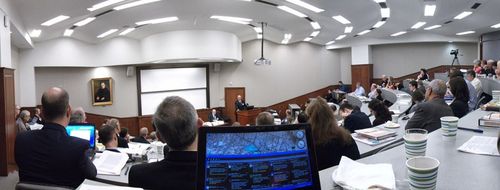
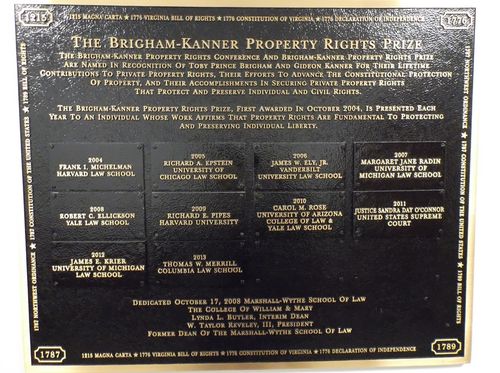
The last couple of days, we’ve returned to Williamsburg, Virginia to attend the annual Brigham-Kanner Property Rights Conference at the William and Mary Law School.

The Conference is the annual gathering of legal scholars and practitioners who focus on property law and property rights to celebrate the award the B-K Prize to “an individual whose scholarly work and accomplishments affirm that property rights are fundamental to protecting individual and civil rights.” The list of past winners is a who’s who of property scholars and includues James Ely, Richard Epstein, Carol Rose, and Frank Michelman.

This year’s prizewinner is Columbia Law’s Thomas Merrill. The Conference panelists have thus far focused on his scholarship, including his landmark article on the right to exclude, titled, not surprisingly, Property and the Right To Exclude, 77 Neb. L. Rev. 730 (1998).

DSCF1087

Our Owners’ Counsel colleage Mark Savin speaking about “Defining the Essence of

Continue Reading 10th Annual Brigham-Kanner Property Rights Conference And Prize – Thomas Merrill

Remember that “audaciouscase filed in the Court of Federal Claims by überlawyer David Boies on behalf of Starr International seeking $35 billion in just compensation for the federal takeover of AIG?

Well, it’s moving along, and apparently is in discovery (every lawyer’s favorite part of the case). Boies sought the deposition testimony of Fed Chair Ben Bernanke about his “personal involvement in the Government’s decision to bail out American International Group, Inc. (‘AIG’) in September 2008, and his knowledge of the specific governmental actions taken to implement the bailout.” Mr. Bernanke didn’t want to testify, claiming that as a “high-level government official,” the plaintiffs had to show that the information sought was not merely relevant under the usual discovery rules, but essential to the case, not not obtainable elsewhere. I’ve got better things to do, so stop bothering me and get this information from someone else, argued

Continue Reading Fed Cir: On Further Review, No, You Can’t Depose The Fed Chair, Even If You Are An Uberlawyer

Preamble

Last week, we posted the personalized license plates of two land use lawyer colleagues, and invited our readers to send in their own, real or imagined, promising to post the best submissions.

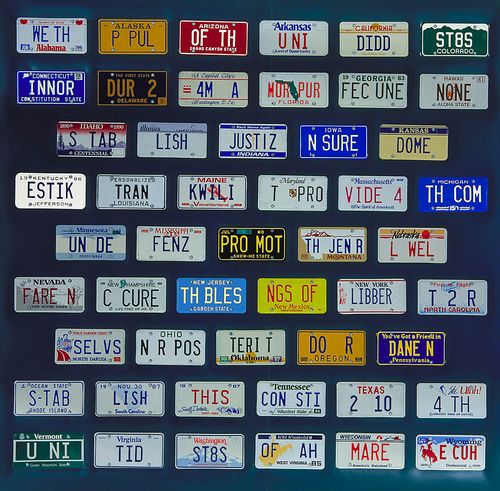
Before we get to those, we note the above, perhaps our favorite work of modern art, a piece titled “Preamble,” which hangs in the Smithsonian American Art Museum in Washington, D.C. Yes, those are real license plates, and when read together spell out the preamble to the Constitution. We like the piece so much, we’ve got a print hanging in our office.

Beat that, Captain Kirk!

And now, the best of the submissions from you, our readers.

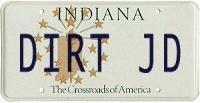
License_20131011125132_65271From a condemnation lawyer, naturally.

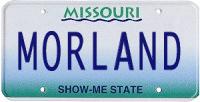
MorelandA condemnor’s attorney?

RLUIPA
A lawyer who really appreciates the Religious Land Use
and Institutionalized Persons Act. As do we all.

License_20131016004554_32614
Straight up the middle. We like.

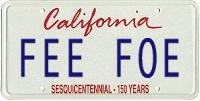
License_20131011173647_90009Fi Fum? A lawyer who doesn’t like

Continue Reading Land Use License Plates Revisited