


2013

Here’s one that’s coming up for the Supreme Court’s consideration at its conference next week, but which we haven’t noted until now. A Texas property owner has filed this cert petition asking the Court to review the Texas Supreme Court’s decision in Hearts Bluff Game Ranch, Inc. v. State of Texas, 381 S.W.3d 486 (Tex. 2012). 

The Texas court held that the ranch did not make out an inverse condemnation claim against the State when it alleged that a state agency’s action resulted in a federal agency denying a federal permit. The petition contains a single Question Presented:

Whether state action that purposely prevents a permitted and beneficial use of land by its owner, but undertaken with the intent to reserve that land for a future beneficial State use, requires compensation under the takings clause of the Fifth Amendment.

The Texas Supreme Court held that “[i]t is not prudent
Continue Reading Cert Petition: Texas Liable For A Taking Because It Caused The Feds To Deny A Permit

oral Several justices (Justice Acoba, Justice Pollock) appeared quite hostile to the DLNR’s position. Their questions went beyond the usual “devil’s advocate” type questions where the questioner is testing a theory, or speaking through counsel to the other justices.

The Judiciary’s web site summarized the issues argued:

On January 11, 2008, Respondents Craig Dobbin and Wagner Engineering Services, Inc. filed a shoreline certification application with the Department of Land and Natural Resources (the DLNR) to certify the shoreline location on property owned by Dobbin. The DLNR approved the shoreline, and Petitioners Caren Diamond and Beau Blair appealed the certification to Respondent Board of Land and Natural Resources (the BLNR). The BLNR subsequently denied Petitioners’ appeal and certified the shoreline. Petitioners appealed the certification to the circuit court of the fifth circuit. The court held in favor of Petitioners, and remanded the case to the BLNR with instructions to give due

Continue Reading Hawaii Supreme Court Gets Into The Weeds On Shorelines

In “Why big development is so difficult in Hawaii,” Hawaii Business magazine tackles an issue first raised by U. Hawaii lawprof David Callies in recently-published law review article (and follow-up interview), where he labeled the record of the 1993-2010 Hawaii Supreme Court on property issues “appalling” (80% overall success rate for environmental and native Hawaiian litigants, 65% of cases reversing the Intermediate Court of Appeals). As Callies said in an earlier presentation, “ninety percent of the time, government and the private sector are wrong? Give me a break.” (Remember, this is the court that concluded that “western concepts” of property law such as exclusivity are “not universally applicable in Hawaii.”)

Callies’ conclusions sparked reaction from his academic colleague environmental lawprof Denise Antolini, who defended the court’s environmental jurisprudence in an article on the grounds that it wasn’t so much focused on outcome, but on process.

Continue Reading Hawaii Business Mag Story Misses The Big Issue On Development, Environmental Law, And Land Use

Here’s the amici brief of the International Municipal Lawyers Association and the National League of Cities, which urges the U.S. Supreme Court to review the Ninth Circuit’s decision in Lavan v. City of Los Angeles, 693 F.3d 1022 (9th Cir. 2012).

In that case, a 2-1 panel held that the city could not presume that property owned by homeless people in the Skid Row area of downtown was abandoned, and enjoined the city from seizing and destroying it when the owner was “momentarily away” from it.

The city filed a cert petition, arguing that the panel decision resulted in an invasion of vermin and other public health hazards in the area. IMLA’s brief argues:

The Ninth Circuit’s Opinion distorts that balancing act and jeopardizes local governments’ ability to act for the benefit of all their citizens. Like other citizens, homeless individuals have a right to use and enjoy

Continue Reading Amicus Brief In Ninth Circuit Homeless Property Case: No One Has Constitutional Right To Leave Unattended Property On The Street

You’d think the proposition in the title of this post, upheld today by the U.S. Court of Appeals for the Federal Circuit in Ladd v. United States, No. 2012-5086 (Apr. 9, 2013), would seem kind of obvious. That a landowner could not be charged with notice that a government act is a taking if the government admits to not even knowing about the event? But it wasn’t, and required a court of appeals’ opinion to lock it down. 

This case is the latest from our colleague Thor Hearne. Readers know Thor as our semi-regular updater of the latest from the Court of Federal Claims in “rails-to-trails” takings cases, and this appeal is from a Court of Federal Claims case on that subject.

The Federal Circuit has a “bright-line rule” that the six year statute of limitations begins to run on a physical takings claim in a rail-to-trail case

Continue Reading Federal Circuit: Statute Of Limitations In Tucker Act Doesn’t Start Running Until Govt Provides Notice Of The Taking

Here’s the amicus brief of the Coalition of Arizona/New Mexico Counties for Stable Economic Growth, supporting the petitioner City of Tombstone in City of Tombstone v. United States, No. 12-1069 (cert. petition filed Feb. 27, 2013). [Disclosure:we also filed an amici brief in the case in support of Tombstone.]

The case arose after the combination of a devastating forest fire and later heavy rains laid waste to Tombstone’s sources of muncipal water, deep in the Coronado National Forest. As the New York Times reported here:

Tombstone’s water system is as old as the city itself, and most of the parts that are functioning, which are few, were damaged last year by rocks and trees dragged downhill by runoff from the summer monsoons. The city set out to repair the system’s connections to three of the 25 springs to which it claims to have a right; connections to the

Continue Reading Another Amicus Brief In Tombstone Case: Property Clause Does Not Trump City’s Right To Maintain Right-of-Way

It’s been what — just over 90 years — since the U.S. Supreme Court recognized the modern regulatory takings doctrine in Pennsylvania Coal Co. v. Mahon, 260 U.S. 393 (1922)? And in that time, the Court still hasn’t quite hammered down the theory of what it means to “take” property when some other power besides eminent domain is being exercised. Oh, the Justices think they know what it takes for regulatory takings liabliity to attach, and most of the time they are right. But on the margins, it is apparent they still have not completely figured it out.

Nothing exemplifies this as well as the Court’s muddled questions during the oral arguments in Koontz v.

In neither Nollan nor Dolan did the property ownersaccept the permit. Both rejected the permit and the conditions. Yet the Courthad no problem finding that to impose the condition would be a taking. For

Continue Reading Some Additional Thoughts On Koontz And Horne And The Takings Muddle

Here’s a quick one from the Texas Supreme Court. Texas, Dep’t of Transportation v. A.P.I. Pipe and Supply, LLC , No. 10-1020 (Apr. 5, 2013) is an inverse condemnationut the issue isn’t really one of inverse condemnation, but who owns the property. If the City of Edinburg does, then TxDOT didn’t inversely condemn API’s property when it undertook a drainage project and removed soil from the parcel. If, as API claimed, it had title to the land, then TxDot was on the hook.

The issue was one of competing (and conflicting) recorded judgments from the same court, one year apart. The city condemned the parcel in 2003 from White, and the court entered a judgment vesting ownership of the parcel in “fee” to the city. The following year, however, the same court entered a “Judgment Nunc Pro Tunc” which “purported to render the 2003 Judgment ‘null and void,'” and

Continue Reading Texas: Which Judgment Rules In An Inverse Case?

Film critic Roger Ebert, whose death was announced yesterday, was a huge fan of our favorite eminent domain movie, Australia’s The Castle. Not so much a fan in the four-star-auteur-director-Fellini-Malick-Herzog mode, but a fan in the sense that when it came time for programming for his personal film festival and others, he selected it more than once and dubbed it “the funniest film in the history of Ebertfest.”

And so life spins along at 3 Highview Crescent in Melbourne, where the Kerrigan home sits surrounded by its built-on rooms, screened-in porch, greyhound kennel, big-dish satellite and carport. For Darryl, it is not so much a house as a shrine to one of the best darn families in the universe, and he proudly points out the plastic Victorian gingerbread trim and the fake chimney to an inspector–who is there, as it turns out, to condemn the property under

Continue Reading Ebert On “The Castle”

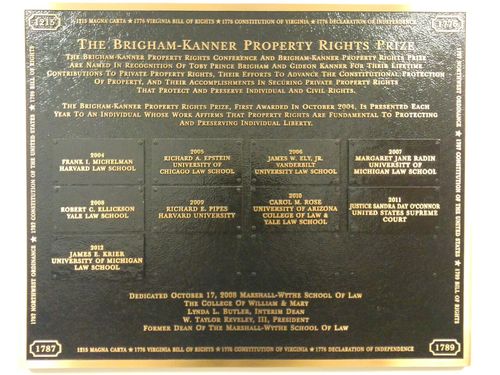
IMG_20121012_135714

William & Mary Law School, host of the annual Brigham-Kanner Property Rights Conference, has announced that Columbia Law School Professor Thomas W. Merrill will receive the 2013 B-K Prize at the conference (October 17-18, 2013, Williamsburg, Virginia). The photo above is of the plaque on the wall at the William & Mary Law School listing B-K Prize winners.

The Conference agenda and speakers have yet to be finalized, but here’s the tentative list of topics:

  • The Impact of a Leading Property Scholar: Defining the Essence of Property
  • Promoting Government Forbearance
  • The Implications of the Court’s Recent Takings Cases
  • Property Rights in Times of Transition

We spoke at the 2012 Conference in Williamsburg, and attended the 2011 Conference in Beijing. The 2013 lineup sounds pretty good, so mark your calendars. Continue Reading 2013 Brigham-Kanner Property Rights Prize: Professor Thomas Merrill