



2013

PICT1501

PICT1471

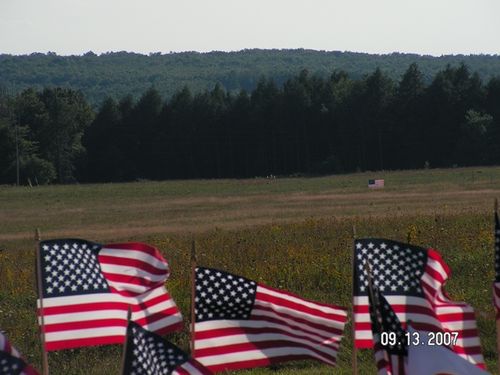
According to this story (“Eminent domain panel values Flight 93 crash site at $1.5 million“), a three-person panel of commissioners appointed by the U.S. District Court has settled on the amount of compensation owed the landowner for the taking of the site in middle Pennsylvania where United 93 crashed on September 11, 2001.

The above photos were taken during our visit a few years ago. The lower photo shows the impact site (the large solitary flag), in the middle of the field.Continue Reading PA Flight 93 Site Just Compensation – $1.5 Million

Usually, in disputes about who owns oceanfront property (in Waikiki, the really nice part of Waikiki, down on the Diamond Head side), each party claims ownership. Beachfront property, after all, is pretty valuable.

But sometimes, it can be a liability. 

So maybe “hot potato” is more accurate in this case, since it involves an old seawall that is badly in need of repair, and it seems everyone is claiming they don’t own it, and that it belongs to someone else. The seawall is located partly on private property and partly on state land, and no one wants to pay to fix it. The private landowners claim the seawall is a public thoroughfare, and argue it was surrendered to the State because they had not exercised ownership for at least five years.

The trial court agreed, and issued these findings of fact and conclusions of law. The most interesting part of

Continue Reading Hawaii Trial Court: Seawall No One Wants Belongs To State

The latest front has opened in the ongoing (and spreading) issue about Mortgage Resolution Partners’ efforts to convince municipalities to use their powers of eminent domain to take underwater mortgages.

Here’s the Complaint, filed today in the U.S. District Court for the Nothern District of California, which seeks public disclosure by the Federal Housing Finance Agency of its relationship with banks. As reported in this story, “[t]he agency has threatened legal action against Richmond [California] and other cities planning to use the eminent domain tactic and may deny credit to locals seeking mortgages[.]”   

The article quotes the Executive Director of New Jersey’s ACLU:

Using money from private investors, Ofer said towns would pay the mortgage holders’ fair market value and then restructure mortgages into lower principal payments that are more favorable for homeowners. About 700 to 1,000 homes in Irvington could potentially benefit from eminent domain takeovers

Continue Reading New FOIA Complaint Seeks Information About Underwater Mortgage Eminent Domain Issue

A key win for property rights today in the Minnesota Supreme Court’s decision in White v. City of Elk River, No. A12-0681 (Dec. 4, 2013). In that case, the court concluded that a municipality could not revoke a campground’s nonconforming use as penalty for alleged violations of the conditions of the conditional use permit. The court also held that a nonconforming use is an independent property right, not a mere privilege as a product of a CUP ordinance. 

The campground had been operating since 1973, well before the city adopted zoning. Seven years later, the city adopted an ordinance which banned campgrounds. Three years later, the city amended the ordinance to allow campgrounds as a conditional use (which required a CUP). But later, the city amended the ordinance yet again, to bar campgrounds entirely. During the time that a CUP was required, the campground got one from the city

Continue Reading Minn S Ct: Zoning Requirement To Obtain CUP Does Not Affect Nonconforming Use Owner’s Property Rights

Just in: the Federal Circuit today issued an opinion in Arkansas Game & Fish Comm’n v. United States, No. 2009-5121 (Dec. 3, 2013), concluding that the government must pay just compensation for a taking, because it caused the Commission’s land to be flooded.

This is the case that was up before the U.S. Supreme Court last year (and in which we filed an amicus brief).  The unanimous Court held that government-induced flooding could be a taking (rejecting the Federal Circuit’s per se rule that temporary flooding was never a taking, only a tort). The Supreme Court remanded the case to the Federal Circuit, and in today’s opinion, that court affirmed the Court of Federal Claims’ conclusion that the flooding was a temporary taking.

We’ll have more after a chance to review the opinion in depth. 

Arkansas Game & Fish Comm’n v. United States, No. 2009-5121 (Fed. Cir. Continue Reading Fed Cir: On Remand From SCOTUS, Arkansas Game Flood Is A Taking

Here’s the government’s Brief in Opposition in Mehaffy v. United States, No. 12-1416 (cert. petition filed June 3, 2013. 

In that case, the Federal Circuit, in an unpublished opinion, held that Mehaffy failed the Penn Central ad hoc takings test solely because he purchased the property alleged to have been taken after the governmentt adopted the Clean Water Act. As a matter of law, he could not have any “reasonable investment-backed expectations” because his land was subject to regulations that, as applied to his land, are alleged to take property.

That reasoning seems somewhat circular, and would seem to run smack-dab into the Supreme Court’s determination in Palazzolo v. Rhode Island, 533 U.S. 606, 626 (2001), rejecting a per se rule that “postenactment purchasers cannot challenge a regulation under the Takings Clause.”

But for some reason, the lower courts have applied (or, in some cases, have not

Continue Reading Govt’s BIO In Mehaffy: Preexisting Regulations Wipe Out Penn Central’s Reasonable Expectations

Here are the final two amicus briefs supporting the petitioner in Marvin M. Brandt Revocable Trust v. United States, No. 12-1173 (cert. granted Oct. 1, 2013). That’s the case in which the Court is considering the meaning of the term railroad “right of way” as used in an 1875 federal statute. As our amici brief argues, if the Court accepts the government’s theory in the case, it could wipe out an entire class of rails-to-trails takings cases.

Next up, the government’s merits brief.

Brief of Amicus Curiae New England Legal Foundation in Support of Petitioners, Marvin M. Brandt Revocable T…

Brief for the Northwest Legal Foundation as Amicus Curiae in Support of Petitioners, Marvin M. Brandt Revo…

Continue Reading Last Two Amicus Briefs In SCOTUS Rails-To-Trails Case

No one contests that when it condemned property in Norfolk, Virginia to expand the Federal courthouse, the federal government made unreasonable pretrial offers to the property owner. The owner’s appraisals valued the property at $36.1 and $30.7 million, but the government valuation resulted in a $6.175 pretrial offer. After the pretrial dance, the final offers were $9.4 million from the government, compared to $15.4 million by the property owner.

Fortunately, the property owner had the good sense to seek advice from our good friends at Waldo & Lyle, and the jury returned a verdict for $13.4 million. As one of the prevailing parties, the property owner sought attorneys fees under the Equal Access to Justice Act. The government objected on the basis that its final offer was substantially justified, even though its pretrial offer may not have been, and thus “the position of the United States” as used

Continue Reading 4th Cir: Govt’s Reasonable Trial Position On Just Compensation Doesn’t Get It Off The Hook For Its Unreasonable Pretrial Position

Here are two more amici briefs supporting the petitioner in Marvin M. Brandt Revocable Trust v. United States, No. 12-1173 (cert. granted Oct. 1, 2013). That’s the case in which the Court is considering the meaning of the term railroad “right of way” as used in an 1875 federal statute. 

The Cato, et al brief argues:

We doubt there is serious dispute that protecting individuals’ right to their property is a foundational purpose for which our national and state governments were established. But we begin from this point because the right landowners have to be secure in their property is undermined

Continue Reading More Amici Briefs In SCOTUS Rails-To-Trails Case