


2013

Didn’t the California Supreme Court already deal the final blow to California’s redevelopment agencies when it held that the state legislature could eliminate redevelopment agencies without violating the California Constitution because what the lege giveth, the lege may taketh away? In California Redevelopment Association v. Matosantos, No. S194861 (Dec. 29, 2011) the court upheld the statute dissolving redevelopment agencies.

Apparently, however, there are residual issues. In 2009, “the Legislature enacted Assembly Bill No. 26, requiring redevelopment agencies throughout the state to contribute portions of their property tax increment funding for the 2009-2010 and 2010-2011 fiscal years into supplemental educational revenue augmentation funds (SERAF‘s) to be used for financing K-12 education in redevelopment areas.” As a result, redevelopment agencies were forced to transfer funds to the state general fund to offset other state-funded local programs.

In the latest case, California Redevelopment Ass’n v. Matosantos, No. C064907 (Cal. App. Jan
Continue Reading Cal App: If Lege Can Eliminate Redevelopment Agencies, It Can Grab Redevelopment Money Too

This morning at the ALI-CLE Eminent Domain and Land Valuation Conference, we made a presentation (along with Cornell lawprof Robert Hockett and moderator Jim Burling) on the issue of the use of eminent domain to seize “underwater” mortgages.

Late breaking: it must have been something we said – the Joint Powers Authority (the agency formed by San Bernardino County and two county municipalities to study the issue) today announced it would not use eminent domain to take underwater mortgages, noting that “the group decided to give up on the idea due to a lack of public support. ‘We are taking that off the table,’ [the chief executive and chairman of the JPA] said Thursday.”

Here’s the video we mentioned, an interview with the chairman of Mortgage Resolution Partners for the views from the outfit that stands to benefit from the use of using eminent domain to take underwater mortgages.

Continue Reading Materials And Links From Today’s ALI-CLE Presentation On Condemnation Of Underwater Mortgages

Regulatory_takings-5th_edition

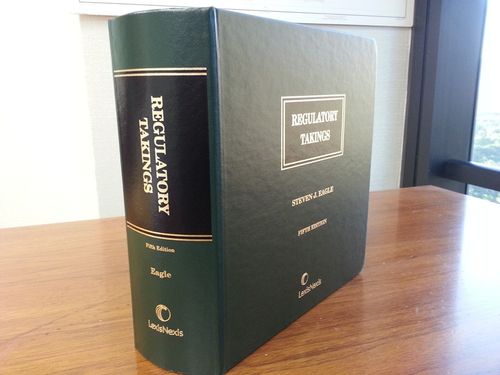
I just received my copy of the latest edition of of Professor Steven J. Eagle‘s definitive treatise Regulatory Takings (Lexis/Nexis 5th ed. 2012). It switched formats and is now a looseleaf and not a bound hardcover, which hopefully means it will be easier to update.

Like the earlier editions, this is a must-have for every land use and property law attorney’s back bookshelf. Chapters include “Property Rights and Their Sources,” “The Ascendancyof Land Use Regulation,” “Analytical Issues in Regulatory TakingsLitigation,” and “Regulatory Takings Remedies.” Get your copy here (oddly, the Lexis-Nexis web site only has the 4th edition for purchase, but I expect that to be remedied shortly).

I have the honor of counting Professor Eagle as a colleague, as he is my immediate past predecessor as the Chair of the Condemnation Committee of the ABA’s Section of State and Local Government Law.

Get this book. 

Continue Reading The Eagle Has Landed – Latest Edition Of “Regulatory Takings” Treatise

Here‘s what we think is the final top-side amicus brief in Horne v. United States Dep’t of Agriculture, No. 12-122 (cert. granted. Nov. 20, 2012), supporting the petitioner/property owner. Filed by the Chamber of Commerce of the United States, the brief argues that where “the government requires a direct transfer of funds, and where a party seeks equitable relief in resisting application of that statute in an enforcement action, that party need not seek ‘compensation’ in a duplicative second lawsuit under the Tucker Act.” Br. at 5.

In Horne, the question is whether farmers who assert that an agricultural regulations known as “marketing orders,” by which they are forced to surrender large percentages of their raisin crops to the USDA without payment or else face massive fines, can raise the argument that to do so would be a taking when defending against the fine, or if their

Continue Reading Final Amicus Brief In Cal Raisin Takings Case: Property Owner Can Raise Equitable Takings Defense

If you have followed the Atlantic Yards eminent domain abuse fight (so well captured in the docfilm Battle for Brooklyn), you know there are a handful of blogs that chronicle the situation in real time, often with great passion.

We checked in today with one of the leading blogs, noLandGrab today, only to find out that back in November it published its last post because, according to the New York Times, it was time “to hang up the keyboard.” SeeOpponents of Atlantic Yards Are Exhausted by a Long, Losing Battle.” Continue Reading No Land Grab Blog Rides Off Into The Sunset

Here’s the brief amici curiae submitted by five law professors who teach constitutional law, in Horne v. United States Dep’t of Agriculture, No. 12-122 (cert. granted. Nov. 20, 2012), supporting the petitioner/property owner. In that case, the Ninth Circuit held the District Court had no jurisdiction to hear a takings defense to the USDA’s imposition of a fine, and the only way to raise a takings claim was for the Hornes to institute separate litigation in the Court of Federal Claims for compensation.

Their brief makes two points. First, that Williamson County is “mistaken,” and there’s nothing standing in the way of the Hornes asserting a takings defense. Second, the Tucker Act does not require the Hornes to raise their takings claims only in the context of a suit for just compensation. 

Simply put, Williamson County’s second “ripeness” requirement is a mistake.

Williamson County’s constitutional ripeness rule

Continue Reading Lawprofs’ Amici Brief In California Raisin Takings Case: Williamson County “has prevented scores of litigants from raising perfectly valid Fifth Amendment claims in federal court”

We’re used to knee-jerk reactions by state and local governments to takings claims: whatever the circumstances, the property owner is wrong, and loses. So it’s nice to see a brief where a state government stakes out a more objective position.

Texas has filed an amicus brief in Horne v. United States Dep’t of Agriculture, No. 12-122 (cert. granted. Nov. 20, 2012), in support of the petitioner/property owner. In Horne, the question is whether farmers who assert that an agricultural regulations known as “marketing orders,” by which they are forced to surrender large percentages of their raisin crops to the USDA without payment or else face massive fines, can raise the argument that to do so would be a taking when defending against the fine, or if their only option is to pay the fine and file a lawsuit in the Court of Federal Claims to recover just compensation.

Continue Reading Texas’ Amicus Brief In California Raisin Takings Case: Y’all Don’t Need To Make This So Complicated

Does the editorial board of the New York Times really have the stones to start off its latest editorial about the Takings Clause, “Where Is the Taking?“, with this:

When a city condemns private property to make way for a public highway, that is a classic “taking” for which government must provide “just compensation” under the Constitution’s Fifth Amendment.

Seriously, Times? How about when it’s not a “classic” taking, and the city condemns an entire block of urban private property to make way for the 52-story office headquarters of a large corporation … say, for example, a newspaper with the initials “NYT?” Would it be a “classic” exercise of power to use emient domain to take property so that:

A high rise office tower would be built at Site 8 South providing the Times with a new headquarters, as well as providing 700,000 square feet of space

Continue Reading We Can Try To Understand The New York Times’ Effect On Man (When It Opines On Eminent Domain Law)

Here’s the amici brief of the Cato Institute, the NFIB, the Center for Constitutional Jurisprudence, and the Reason Foundation in support of the petitioner/property owner in Horne v. United States Dep’t of Agriculture, No. 12-122 (cert. granted. Nov. 20, 2012).

That’s the case in which the Supreme Court is considering whether a property owner who is being targeted by the federal government for a fine may assert a takings defense, or whether the sole approach is to pay the fine and then seek compensation later in the Court of Federal Claims. We know that sounds stupid, but that’s exactly what the Ninth Circuit held a property owner must do. See Horne v. United States Dep’t of Agriculture, 673 F.3d 1071 (9th Cir. 2011). And that’s the USDA’s argument, now too.

As the brief argues:

In the government’s view, property owners who have been wrongfully ordered to pay the

Continue Reading Amicus Brief In California Raisin Takings Case: 9th Circuit Has A “Rube Goldberg” Approach To Takings