January 2014

Next Monday, January 13, 2014, from noon to 1:00 p.m., I’ll be speaking — along with my Damon Key partner Greg Kugle — to the Hawaii State Bar’s Appellate Law Section about administrative appeals, in a session entitled “Administrative Appeals: How Do You Get There And How Do You Get Out Of There?” 

Because of the areas in which we practice, we’re going to be focusing on the issues in the context of land use cases, but the principles are generally applicable to any matter in which there is the possibility of agency appeal or contested case, followed by judicial review under the Administrative Procedures Act. Because most of the recent interesting decisions have come out of the Hawaii Supreme Court, we’ll be limiting our presentations to state law. 

Details: 

Date: Monday, January 13, 2014

Time: noon – 1:00 p.m.

Location: Damon Key offices, 1003 Bishop Street
Continue Reading Upcoming HSBA Program: Administrative Appeals – How Do You Get There And How Do You Get Out Of There?

For those who just can’t get enough of law school, here’s your chance to return. Each January, the University of Hawaii Law School holds its “J-Term” during which brings in legal scholars from across the nation (bet it’s not too hard to convince a few lawprofs to spend mid-January in Honolulu) to teach on selected topics. And some of the lectures are open to the public.

Here are the details of this year’s Saturday, January 11, 2014 public J-Term classes. If you are an “interested member of the community” (i.e., the public), you can attend.  Among the topics are a couple that reach out and grab us:

  • The Law of Elections, Democracy & Politics (Professor Richard Pildes, NYU Law), 3:00 – 5:00 p.m., Classroom 3.
  • Construing the Hawaii Constitution: Criminal Procedure Protections (Justice Simeon Acoba, Supreme Court of Hawaii), 5:10 – 7:10 p.m.

We’re going, for sure. The

Continue Reading Go Back To Law School: U. Hawaii’s “J-Term” Classes Open To The Public

14.AGRHI

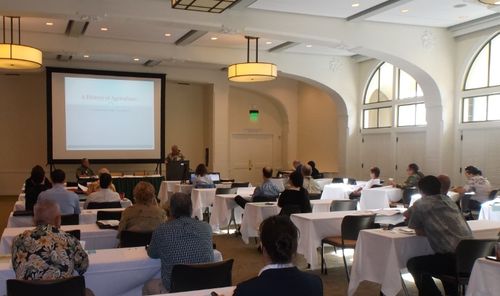
Here are links to some of the materials mentioned at our session today on the GMO issue at the Hawaii Agriculture Law Conference:

DSCF1529
My co-planning Chair, Dave Bateman (a lawyer and a coffee farmer), Continue Reading Links From Today’s Session On GMO Issues

Here’s the second of two amicus briefs filed in support of the petitioner in the judicial takings case we mentioned last week. This brief, filed by beverage distributors, who although they are respondents, urged the Supreme Court to take the case.

The brief argues that “Connecticut reached backwards in time to target and sweep a few private bank accounts into the general Treasury just because ‘the legislature wanted as much money as possible’ to redress a general budget deficit.” Brief at 1. “the Connecticut Supreme Court held that this retroactive seizure was not a taking because the distributors’ funds ceased being their property even before the funds were confiscated, at the moment the funds were deposited into special segregated acccounts. That court’s re-writing of Connecticut property law ‘contravene[d] the established property rights of’ the beverage distributors and thereby effected a taking.” Id. at 1-2 (emphasis original).

We’ll post

Continue Reading Brief: State Court’s Rewriting Of Property Law A Judicial Taking

DK_greenbag_1 We’ve been following the (mostly fruitless) efforts of a group called the “Save the Plastic Bag Coalition,” an association of plastic bag manufacturers and distributors, to push back against the growing tide of municipalities that have banned or otherwise highly regulated the use of bags at grocery stores and elsewhere. Despite one success story (later reversed by the California Supreme Court), it appears to us that the STPBC’s legal efforts have been quixotic (see here and here, for example). 

Add to those decisions the latest, this time from the California Court of Appeal, upholding San Francisco’s plastic bag ordinance against a challenge under CEQA (California’s environmental review law, for you offworlders), and a state law preemption challenge.

In Save the Plastic Bag Coalition v. City and County of San Francisco, No. A137056 (Dec. 10, 2013) (certified for publication Jan 3, 2014), the Court of Appeal

Continue Reading Cal App Doesn’t Save The Plastic Bag

Here’s the first of two amicus briefs filed in support of the petitioner in the judicial takings case we mentioned last week.

This brief, filed by the New England Legal Foundation, the Cato Institute, the National Federation of Independent Businesses, and the Southeastern Legal Foundation, urges the Court to take the case, arguing that the Connecticut legislature’s raiding of the bottle fund is a “classic case” of the type of burden-shifting that Armstrong tells us is a taking.  The judicial takings problem arose because in order to uphold the legislative action, the Connecticut Supreme Court had to blow by established property rights:

Amici’s interest in this case arises out of their commitment to the protection of private property rights and economic freedom. The case involves Connecticut’s assertion of the power to take private property (i.e., targeted funds of money) for public use without compensation, in violation of the U.S. Constitution. 

In the midst of

Continue Reading Amici Brief In Judicial Takings Case

Here’s the latest foray into the judicial takings arena. In this cert petition, a beverage distributor asserts that the Connecticut Supreme Court’s decision altering established property rights in unclaimed refund values in bottles resulted in a taking. 

Here are the Questions Presented:

For nearly 30 years, Connecticut beverage distributors had established property rights in socalled “unclaimed refund values” accumulated in conjunction with the State’s bottle return regulatory scheme. The Connecticut Supreme Court eliminated these rights in holding that a recent amendment to the regulatory scheme did not affirmatively vest distributors with an interest in the so-called unclaimed refund values, allowing the State to retroactively take the distributors’ property.

1.  Did the Connecticut Supreme Court’s opinion eliminating an established property right, and allowing the State to retroactively take the petitioners’ property, effect a “judicial taking” in violation of the Fifth and Fourteenth Amendments to the United States Constitution?

2.  Did the Connecticut Supreme Court’s opinion arbitrarily deprive distributors of their property in violation of the

Continue Reading New Cert Petition: State Court Altering Bottle Refund Rights A Judicial Taking