February 2014

Here’s the Opening Brief on the Merits, filed last month in a very interesting and important case now pending in the California Supreme Court, City of Perris v. Stamper

Update: Answering Brief posted here

We reported on the Court of Appeal decision here. The court held that that in a condemnation action, the jury gets to determine the reasonable probability that the City would successfully assert that its dedication of property requirement would mean that the property taken could be acquired essentially for free. The court concluded that even though Nollan/Dolan issues are involved, the jury determines this issue because “issues surrounding the dedication requirement are essential to the determination of ‘just compensation’ and therefore must be “ascertained by a jury.'” 

The city condemned a portion of Stamper’s industrially-zoned vacant land in order to realign and widen an adjacent road. Its deposit was based on the use of
Continue Reading Cal S. Ct. Brief: In Determining Compensation, Judge, Not Jury, Determines Reasonable Probability Of Nollan/Dolan Exaction

One portion of the federal Uniform Relocation Act, 42 U.S.C. § 4651, requires Federal agencies participating in projects requiring the acquisition of private property to be guided by certain policies that “assure consistent treatment for owners . . . and . . . .promote public confidence in Federal land acquisition practices,” such as (and we’re paraphrasing here), do it as quickly as possible, try to get it by negotation, don’t use condemnation to leverage a lower negotiated price, and so forth. 

These policies apply to state and local condemnors when their projects involve federal funding, and in Clear Sky Car Wash LLC v. City of Chesapeake, No. 13-1492 (4th Cir. Feb. 21, 2014), the owner whose property was being condemned by the Virginia Department of Transportation asserted VDOT was not following the rules. VDOT instituted a “quick take” eminent domain action in state court, and Clear Sky went to federal

Continue Reading 4th Cir: Uniform Relocation Act Requirements Are Like The Pirate’s Code – “More What You’d Call ‘Guidelines,’ Than Actual Rules”

Looks like they’re at it again, a solution in search of a problem: a bill has been proposed in the Hawaii Legislature to create an “Environmental Court,” whose mission would be to handle “environmental disputes” arising under a wide range of state statutes:

…administrative proceedings and proceedings for declaratory judgment on the validity of agency rules authorized under chapter 91, arising under chapters 6D, 6E, 6K, 54, 58, 128D, 128E, 201N, 205, 205A, 220, 269, 339, 339D, 340A, 340B, 340E, 340F, 342B, 342C, 342D, 342E, 342F, 342G, 342H, 342I, 342J, 342L, 342P, 343, 508C, and 664, and Titles 11 and 12.

(And the regulations promulgated by state agencies, and ordinances and regulations promulgated by the counties, no doubt.) The bill (SB 632) would task this new court with “maintenance and improvement” of the environment and with exercising “constant vigilence” to “promote and protect Hawaii’s natural environment through consistent

Continue Reading Does Hawaii Need An “Environmental Court?” (Part II)

The Hawaii Supreme Court has been on a roll lately, giving us a series of decisions clarifying appellate procedure. So in the past couple of months, we’ve got cases about appealability, dismissing appeals for a brief not conforming to the rules, and what is a final appealable order. Good stuff for those of us who practice a lot in the appellate courts. 

Here’s the latest (and bonus for us, it’s a land use case). It addresses what remedy should be applied by a court of appeals when a case becomes moot while on appeal, and what a court should do with the appealed-from judgment: leave it in place even though it has been rendered academic, or vacate it and wipe it off the books as if it never existed at all? 

The court framed the issue and its conclusion in Goo v. Arakawa, No. SCWC-30142 (Feb.

Continue Reading How Do You Solve A Problem Like … Appellate Mootness? More Process!

This is the second half of a post from the week before last, about the Hawaii Supreme Court’s opinion in Goo v. Arakawa, No. SCWC-30142 (Feb. 19, 2014).

In that case, the court was presented with two issues. First, what should an appellate court do with a trial court’s judgment when a case becomes moot while on appeal. The court held that there was no one-size-fits-all solution, but that in most cases, the appeal should be remanded to the trial court to see whether the facts that resulted in appellate mootness cut in favor of wiping out the judgment, or leaving it in place. 

Second, the court considered whether the plaintiffs were entitled to fee-shifting under the “private attorney general” doctrine, a doctine which the Hawaii Supreme Court first recognized formally in the “Superferry” case, The court applies a three-part test to determine whether :

  • The


Continue Reading HAWSCT’s Latest On The Private Attorney General Doctrine

Photo

On Tuesday, February 18, 2014, Hawaii Governor Neil Abercrombie named Judge Michael D. Wilson as his nomination for associate justice to the Supreme Court of the State of Hawaii to fill the upcoming vacancy when Associate Justice Simeon Acoba retires in March, having reached the mandatory retirement age. See Rebecca Copeland’s post on Record on Appeal for more details here.

Our Damon Key colleague Bethany C.K. Ace, currently the Chair of the Hawaii State Bar Association’s Section of Appellate Law, has authored for us the following guest post, with some background on Judge Wilson, and the few written opinions he has produced while on the trial bench (Hawaii state circuit judges may be called upon from time to time to sit on the court of appeals or the supreme court, if a Justice is disqualified or recuses him or her self.)

——————————————————————

Hawaii Supreme Court Associate Justice

Continue Reading HAWSCT Nominee Wilson’s Written Opinions

Ninth_circuit

Update 2/19/14: the Honolulu Star-Advertiser has this report (“The appellate court decision was an ‘overwhelming victory for the city from an ideologically diverse panel, said Robert Thomas, a Hono­lulu-and San Francisco-based attorney who attended the hearing in August. The panel comprised Judges Stephen Rein­hardt, Mary Schroe­der and Andrew Hur­witz. ‘All three of them agreed. They made pretty short work of the challengers’ arguments on the merits’ while spending much of the decision on the panel’s jurisdiction concerns, Thomas said.”). The Star-Advertiser also reported that the one issue remaining before the District Court was also (coincidentially) resolved yesterday against the challengers. Here is the court’s order (we will have a report on that issue shortly). 

++++++++++++++++++++++++++++

Okay, we’ve got the obligatory “rail” pun out of the way with the title. On to the opinion, which we posted earlier today, which we’ve now had a chance to review it in more

Continue Reading 9th Cir: Honolulu Rail Project On Track

Update: a deeper review of the opinion here.

The Ninth Circuit has affirmed the District Court’s decision upholding for the most part the environmental review of the Honolulu rail project. Here’s the summary from the court: 

The panel affirmed the district court’s dismissal of plaintiffs’ claims under the National Environmental Policy Act and Section 4(f) of the Department of Transportation Act arising from litigation challenging the construction of a highspeed rail project in Honolulu, Hawaii.

The panel held that it had appellate jurisdiction under either 28 U.S.C. § 1292(a)(1), as an appeal from the grant or refusal of injunctive relief, or 28 U.S.C. § 1291, as an appeal of a final judgment. The panel also held that the Environmental Impact Statement’s identification of the project objectives, and analysis of alternatives, satisfied the National Environmental Policy Act’s requirements. The panel further held the defendants did not violate Section 4(f) of the Department of Transportation Act where the defendants did not adopt a Managed

Continue Reading 9th Cir OK’s Environmental Review Of Honolulu Rail Project

fracknow

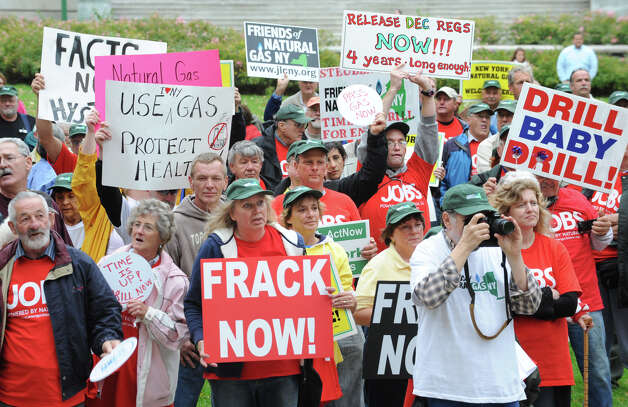
Here’s the Verified Petition and Complaint, filed last week, in which a coalition of New York landowners sued the governor, claiming that the state is dragging its heels in its environmental review of fracking. We’re interested because a bad on fracking may lead to takings problems, although this lawsuit does not raise such issues, but seeks an order forcing the state to stop delaying and allow drilling to go forward. Here’s the Memorandum of Law supporting the petition, which details the legal basis for the claims.

According to the plaintiffs’ press release, the lawsuit seeks the following:

  • An order compelling the New York state Department of Environmental Conservation to finalize the “Supplemental Generic Environmental Impact Statement.” 
  • A determination that the DEC referral of the SGEIS to the Department of Health was arbitrary and capricious, an abuse of discretion and an improper delegation of the DEC’s Lead Agency


Continue Reading Frack Now: NY Property Owners Sue To Halt Delays

Property

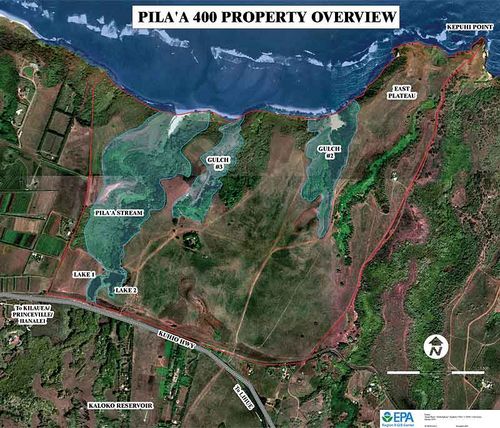
There’s not much doubt that the now-notorious large-scale unpermitted upland grading and grubbing by a Kauai property owner on its private land caused the runoff that catastrophically damaged the adjacent beach and the reef offshore. The damage was pretty bad, and resulted in the “largest storm water settlement [with the federal EPA] in the United States for violations at a single site by a single landowner.” See also the photo above (much larger version here).

The state also pursued the owner, and after a contested case, the Board of Land and Natural Resources assessed approximately $4 million in damages, and $70k for administrative costs. To reach this assessment, It did not apply a preexisting damage formula, but used a method it crafted for the case:

The value of Pilaa beach, bay and reef includes use value, option value, commodity value, existence value, bequest value, cultural values, including

Continue Reading HAWSCT: Damage To Unique Property Subject To Unique Rules