


October 2014

  DSCF2208

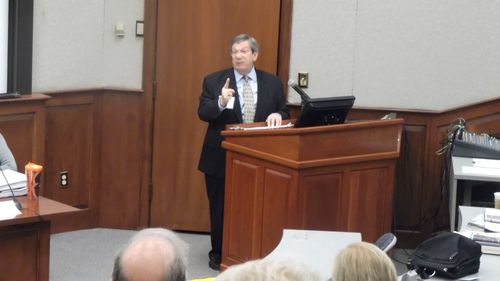
You can’t have rights without advocates.”

                              – Michael Berger

We’re at the William and Mary Law School in Williamsburg, Virginia today for the 11th Brigham-Kanner Property Rights Conference. As we’ve noted earlier, Michael Berger is this year’s B-K Prize honoree, for his career contributions to property law and his “scholarly work and accomplishments [which] affirm that property rights are fundamental to protecting individual and civil rights.”

The list of past recipients is an All-Star roster of property scholars and jurists, including lawprofs Frank Michelman, Richard Epstein, James Ely, Carol Rose, Thomas Merrill, and Supreme Court Justice Sandra Day O’Connor (the latter perhaps more for where she ended up in her Supreme Court career than where she started). See the plaque on the Law School’s wall for the complete list of

Continue Reading 2014 Brigham-Kanner Property Rights Conference Report: Honoring Michael Berger

Utah seized a failing bank without notice to the bank, and appointed the FDIC receiver. The bank owners sued for a bunch of things, including a taking under the state constitution. The trial court dismissed for failure to state a claim because the complaint did not contain sufficient factual allegations to support a takings claim.

In America West Bank Members LC v. State of Utah, No. 2012456 (Oct. 24, 2014), the Utah Supreme Court affirmed. Although the court confirmed that under the Utah Constitution, a taking occurs “when there is any substantial interference with private property which destroys or materially lessens its value, or by which the owner‘s rights to its use and enjoyment is in any substantial degree abridged or destroyed,” slip op. at 18, it concluded that the bank’s complaint did not clarify whether it was alleging a regulatory or a physical taking:

According to AWBM‘s complaint,”it

Continue Reading Utah: Complaint Must Allege Either A Physical Or Regulatory Taking To Avoid Dismissal

We’re tied up today and don’t have time to do any analysis, so we post this without comment: Bowman v. California Coastal Comm’n, No. B243015 (Oct. 23, 2014), wherein the court held:

In Kleiniecke v. Montecito Water District (1983) 147 Cal.App.3d 240, we held it would not be inequitable to apply the doctrine of estoppel as a defense to the statute of limitations. Here we conclude it would be inequitable to apply collateral estoppel to require a party to dedicate a coastal easement as a condition of obtaining a coastal development permit.

We reverse a judgment denying a property owner’s petition for a writ of administrative mandate to eliminate a public access condition from a coastal development permit.

Slip op. at 1  

Bowman v. California Coastal Comm’n, No. B243015 (Cal. App. Oct. 23, 2014)

Continue Reading Cal App: “There is no rational nexus, no less rough proportionality”

Update: San Francisco is going to appeal.

It cost a lot to live in San Francisco, these days. A whole lot, whether you own, or rent

If you’re a renter, however, you should hope and pray that your landlord wants out of the rental business. Because under a San Francisco ordinance, property owners who rent their properties but then decide they don’t want to continue to do so must get a permit from the City in order to quit. Another requirement of the ordinance is that the owner pay cash to a displaced tenant — a lump sum “relocation payment” of 24 times “the difference between the units’ current monthly rent and an amount that purports to be the fair market value of a comparable unit in San Francisco, as calculated by a schedule developed by the Controller’s Office.” 

The Levins wanted out of the rental business, and

Continue Reading Federal Court: San Francisco’s Housing Exaction Violates Nollan-Dolan-Koontz

Banner

If you haven’t already, please mark you calendars: the agendas and faculty lists for the February 5-7, 2015 ALI-CLE eminent domain programs in San Francisco have been finalized. Registration is ongoing, and there’s even a few more days left for the early registration discount. Substantial group discounts are also available. 

We’re talking, of course, about Eminent Domain and Land Valuation Litigation (the “masters” program, now in its 32nd year), and Condemnation 101: How to Prepare and Present an Eminent Domain Case (the boot camp or refesher course on eminent domain fundamentals).  We’re the co-Planning Chair of the Eminent Domain and Land Valuation Litigation program along with Joe Waldo, and we think we’ve assembled an exciting agenda, presented by a faculty comprised of the nation’s best-of-the-best in our field of law.

Some highlights:

  • Eminent Domain National Law Update – Amy Brigham Boulris, Gunster, Yoakley & Stewart, P.A.,


Continue Reading ALI-CLE 2015 Eminent Domain and Land Valuation Litigation & Condemnation 101 Agendas And Faculty Announced

When the Second Circuit issued its opinion in Kurtz v. Verizon New York, Inc., 758 F.3d 506 (2d Cir. 2014), our comments were rather harsh (“Which means that to reach the result, the court simply rewrote the plaintiff’s complaint and in the process blurred the distinction between a takings claim … and a procedural due process claim[.]”). We wondered aloud whether the Second  Circuit widening the split in the federal circuits over whether Williamson County ripeness applies outside of the Takings context is “enough of a circuit split to get the Supremes interested?”

Well, it was enough to get our colleagues over at the Insitute for Justice interested, for sure. Yesterday, they filed a cert petition asking the Supreme Court to review the following Questions Presented:

This Court, in Williamson County Regional Planning Commission v. Hamilton Bank, 473 U.S. 172 (1985), said that property owners bringing certain Takings Clause

Continue Reading New Cert Petition: Does Williamson County Ripeness Apply To Procedural Due Process Claims?

As we all understand, when valuing property in eminent domain, the highest and best use of not limited to the property’s existing use or its current zoning. The owner is entitled to prove that she could reasonably make a more intensive use of the property.

Rodman v. Commonwealth, No. 12-P-223 (Oct. 7, 2014) involved a partial taking of partially developed land (part of it was used as temporary parking lot for the Patriots’ stadium, across Route 1 from the property) for a road expansion by the Massachusetts Department of Highways. When at trial the property owner attempted to show that the land could be developed much more intensely before the taking than after, the court refused to let the jury hear evidence of the owner’s development plans, and evidence of the development approach to value. “Ultimately, the jury awarded damages of $600,800, the exact amount the Commonwealth’s expert testified

Continue Reading Mass App: Eminent Domain Jury Entitled To Consider Evidence Of Potential Development

We didn’t think the issue of whether a property owner is competent to testify about the value of his or her own property was unsettled, but apparently an Alaska trial court did. In an inverse condemnation action which claimed that the operation of a nearby airport diminished Mr. Briggs’ property value, the court granted the City summary judgment “because the property owner failed to submit any expert testimony regarding damages.” 

The Alaska Supreme Court reversed. In Briggs v. City of Palmer, No. S-14969 (Sep. 12, 2014), the court concluded that an inverse condemnation plaintiff does not need expert testimony to prove the value of damages, relying on established Alaska law. The court cited several of its own earlier decision which hold that property owners are competent to testify about the value of their own property. 

Given that precedent, what gives? What would make the trial court conclude otherwise? Maybe

Continue Reading Alaska: Owner Can Testify About Value Of Their Own Property

Here’s one for the regulatory takings mavens, because it has just about every conceivable issue: ripeness, res judicata (yes, arugment was that the complaint was filed both too early and too late), RookerFeldman, the Tax Injunction Act, and an analysis of whether the property owner’s complaint stated a claim for relief under the Takings Clause. 

At issue in Coleman v, District of Columbia, No. 13-1456 (D. D.C. Sep. 30, 2014) was the District’s statutory provision which allowed it to place a lien on properties whose owners do not pay their full property tax bill, and then sell the property at auction if the lien is not satisfied. So far so good – this scheme isn’t that much different from similar provisions in virtually every state. The problem with DC’s system is that “the law permits the taking of not only the amount of delinquent taxes, plus any

Continue Reading Federal Court: DC’s Tax Sale Statute May Be A Taking