


November 2014

To all who were able to join today’s ABA Section of Real Property, Trust and Estate’s Condemnation, Zoning and Land Use Committee’s call on the AIG takings trial, currently pending in the U.S. Court of Federal Claims, thank you for participating. I’ve posted the entire talk (minus questions) above.

Here are the links to the stories, analysis, and materials I mentioned: 

  • The original complaint, first filed in the CFC in November 2011. 
  • Second Amended Complaint in the CFC case, along with Mr. Boies’ quote that this will be “an easy case to litigate.” We described the case as “audacious,” if only because it seeks $25 billion in just compensation. 
  • Professor Gideon Kanner’s (who has been following this case more closely than we have) first thoughts on the complaint. 
  • The CFC’s Opinion and Order granting in part and denying in part the United States’ motion to dismiss.  


Continue Reading Links From Today’s ABA Talk On The AIG Bailout Takings Case
The Hawaii Supreme Court has issued a unanimous opinion in Friends of Makakilo v. D.R. Horton-Schuler Homes, LLC, No. SCAP-13-0002408 (Oct. 30, 2014), holding that there’s not really such thing as a “cross appeal” in administratve appeals (at least in the sense that “cross appeal” is usually used in appellate procedure).  

Quick facts: D.R. Horton petitioned the state Land Use Commission for a boundary amendment (aka a rezoning). Three parties intervened and sought and were granted a “contested case.” The LUC concluded that D.R. Horton was entitled to the boundary amendment. Thirty days later, two of the three intervenors filed a notice of appeal under the Hawaii Administrative Procedures Act, Haw. Rev. Stat. § 91-14, which gives circuit (trial) courts jurisdiction over appeals by any person aggrieved by an agency’s decision in a contested case. The HAPA gives those parties 30 days to file.

Thirteen days after the appeal

Continue Reading HAWSCT: No “Cross-Appeal” In Administrative Appeals

Ian Lind has an interesting piece in Honolulu Civil Beat, Hawaii Monitor: Ballot Issue Grew Out of Abercrombie’s Retreat Into Secrecy, about the consititutional amendment, recently approved by Hawaii voters, which requires the Hawaii Judicial Selection Commission to make public its list of judicial nominees at the same time that it transmits the list to the governor. Under Hawaii law, the governor is required to appoint his or her selection to fill judgeships from this list.

In some ways, the constitutional amendment, which the voters ok’d by an overwhelming margin (82% of those voting) was icing on the cake: after a Hawaii circuit court ruled that under state public records laws, the governor must release JSC lists once he makes his appointment (a case in which we represented the plaintiff-newspaper), the JSC amended its rules to require it to disclose the list once it transmits it to the

Continue Reading On Transparency In The Judicial Selection Process

Today, on behalf of the National Federation of Independent Business Small Business Legal Center, we filed this amicus brief in Kurtz v. Verizon New York, Inc., No. 14-439 (cert. petition filed Oct. 14, 2014). The cert petition, filed on Kurtz’s behalf by the Institute for Justice, is posted here

That’s the case in which the Second Circuit threw out a complaint on Williamson County ripeness grounds. Odd thing was that the court held that a procedural due process claim was not ripe under Williamson County‘s exhaustion of state remedies prong. But wait, you say, Williamson County is based on a takings-specific rationale: a federal takings claim is not ripe for federal court review until just compensation has been denied by the state (inclulding a state court). That’s what our brief says, too: 

For nearly 30 years, Williamson County’s state remedies requirement has required federal courts to

Continue Reading New Amicus Brief: Overrule Williamson County! (At Least The State Exhaustion Requirement)

So, the President today announced support of “net neutrality,” which Wikipedia describes as “the principle that Internet service providers and governments should treat all data on the Internet equally, not discriminating or charging differentially by user, content, site, platform, application, type of attached equipment, or mode of communication.”

President Obama has come out in support of reclassifying internet service as a utility, a move that would allow the Federal Communications Commission to enforce more robust regulations and protect net neutrality. “To put these protections in place, I’m asking the FCC to reclassifying internet service under Title II of a law known as the Telecommunications Act,” Obama says in a statement this morning. “In plain English, I’m asking [the FCC] to recognize that for most Americans, the internet has become an essential part of everyday communication and everyday life.”

Full story here. Sounds pretty good, right?

Maybe not

Continue Reading The Eminent Domain Angle In “Net Neutrality”

Here’s what caught our eye today:

  • Last evening, we attended lawprof Gregory S. Alexander‘s talk at the U. Hawaii Law School, “Five Easy Pieces: Recurrent Themes in American Property Law.” You know it’s not a real academic talk until the speaker uses the words “normative” and “neologism,” and Professor Alexander did not disappoint. But seriously, it was a thought-provoking hour, focused on our favorite topic, property law. A video was made, and hopefully the law school will post it on line so you can watch. We’ll link to it when they do. 
  • Va. high court to look at Beach eminent domain appeal,” from the Hampton Roads newspaper, about a case which the Virginia Supreme Court just accepted. The case was triggered when the trial court refused to allow the jury to hear evidence of the DOT’s first appraisal and deposit, which was higher than its final appraisal


Continue Reading Thursday Round-Up: “Five Easy Pieces” Talk, Re-appraisals, Foie Gras Ban Lives, Kelo In China, Kelo Movie

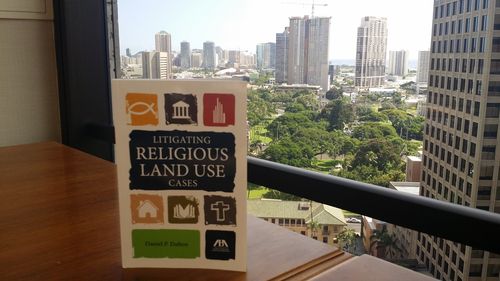
20141104_135324

A big thank you to our friend and colleague from Detroit, Dan Dalton, who sent us a recently-published book which he authored, “Litigating Religious Land Use Cases.” 

This book discusses how to litigate such a religious land use case on behalf of a religious entity pursuant to the Religious Land Use and Institutionalized Persons Act (“RLUIPA”)  and the First Amendment. While the First Amendment dates to the founding days of the United States, RLUIPA is a much more recent federal law that can serve as an effective tool in protecting the property interests of religious organizations.

A must-have for any land use lawyer (even if you don’t focus on religious land use cases, or don’t represent religious organizations in such cases), Dan’s book is a great overview of the applicable law, and a primer on the various causes-of-action that can pop up in these type of controversies.

Continue Reading New Book: Litigating Religious Land Use Cases (Dan Dalton)

Remember that 11th Circuit decision we posted earlier, in which the court concluded that riparian rights, although recognized by Florida as property rights, are not “fundamental rights” protected by the Due Process Clause? There, the court held that the City’s ban on the construction of docks and piers (except, apparently, city-owned docks and piers) was not subject to due process review because the plaintiffs’ riparian rights are not fundamental rights because they are merely “state-created” rights. 

Well, as we posted here, it resulted in a cert petition. Yesterday, an amici brief was filed by the National Federation of Independent Business Small Business Legal Center, the Cato Institute, Owners’ Counsel of America, and the Rutherford Institute in support.

Here’s the Summary of Argument, to give you a flavor of what the brief is arguing:

The Eleventh Circuit’s exclusion of property rights from the substantive protections of the Fourteenth Amendment’s

Continue Reading Amici Brief Asks: Aren’t Property Rights “Fundamental” Rights?

If you are in the neighborhood on Wednesday, November 5, 2014 from 4:30 – 5:30 p.m., you may want to come by the University of Hawaii Law School to listen to the 2014 Distinguished Gifford Lecture in Real Property by Cornell lawprof Gregory S. Alexander, “Five Easy Pieces: Recurrent Themes in American Property Law.”

Details hereContinue Reading Real Property Lecture By Gregory Alexander At U.H. Law School Nov. 5, 2014: “Five Easy Pieces: Recurrent Themes in American Property Law”