2014

We just wrapped a post on an appellate argument seemingly gone wrong. But as Gideon Kanner rightly pointed out oral argument most of the time is not dispositive.

On that note, we attended a wonderful CLE session at the recent ABA Midyear meeting, “Preparing an Effective Appellate Brief: The Judicial Advocate Perspective,” put on by the Council of Appellate Lawyers. The panel, comprised of seasoned appellate lawyers (Timothy S. Bishop and Michael A. Scodro), and two judges (Hon. Catharina Haynes – 5th Circuit, and Hon. Barbara Jackson – N.C. Supreme Court), ably moderated by David H. Tennant, provided do’s and don’t’s, pet peeves, and other tips on preparing the most important element in appellate advocacy. 

We and others tweeted highlights of the event as it was happening, and rather than repeat those 140-character soundbytes in narrative form, we’ve decided to simply cut-and-paste them below. A bit jumpy

Continue Reading A Report On The ABA Program “Preparing an Effective Appellate Brief”

A couple of weeks ago, we posted about the Supreme Court oral arguments in Brandt, where Justice Scalia interrupted counsel and asked whether he was reading off his notes. That got us and a lot of others talking about what works and what doesn’t in appellate oral advocacy.

Now comes this report from the ABA Journal, “Posner tells BigLaw chief, ‘stop babbling,’ threatens to end argument in contraception mandate case.” The case involves Notre Dame University’s objections to the provision in the Affordable Care Act requiring health care providers to provide contraception services, but allowing religious institutions to opt-out and allow a third-party to provide those services. The 90-minute arguments were difficult for the University’s lawyer, who was on the receiving end of Judge Posner’s ire nearly right out of the box. As the ABA Journal reported:

“Don’t interrupt,” Judge Richard Posner told Jones Day partner Matthew

Continue Reading Mortal And Venial Sins In Appellate Advocacy

We must say that we’re a touch conflicted about the Hawaii Supreme Court’s 4-1 decision in Lopez v. State of Hawaii, No. SCWC-11-0000512 (Feb. 12, 2014), issued yesterday.

On one hand, we like the idea that the fruits of your labor are your “property,” and cannot be taken away from you by the state without due process, compensation, and the like. Thus, when a lawyer is impressed into service by the state, it is a taking of property to limit her fee to the artificially low number the legislature established in appointed counsel cases. Thus, we have mild dissonance when we say that we think the majority opinion in Lopez got it right when it rejected a lawyer’s claim that his statutory lien on his client’s personal injury judgment was not protected by due process from the effects of a state statute that gives the state’s child support lien

Continue Reading HAWSCT: Lawyers’ Contingency Fee Lien On Judgment Is Not Due Process “Property”

Looks like eminent domain and Hawaii are in the news today. Here’s what we’re reading:

Continue Reading Tuesday Round-Up: Hawaii In The Eminent Domain Spotlight

BadspockReading the Alabama Supreme Court’s decision in City of Alabaster v. Shelby Land Partners, LLC, No.1120677 (Jan. 24, 2014), we are reminded of that episode of Star Trek where the gang accidentally ends up in a parallel universe, where things are all backwards. That’s the episode that probably started the meme that in order to portray someone as “evil,” just give ’em a Van Dyke, like mirror Mr. Spock. Well, to an outside observer like us, nearly every party in the City of Alabaster case may need a beard, because the situation, with the exception of the final result, seemed so backwards from the situation that we’re used to in zoning cases.

Here, the developer wanted to make less intensive use of its property — it asked for a downzoning to allow a senior residence in a commercial district — and asked the City for a change in designation

Continue Reading The “Alternate Universe” Of Alabama Land Use

DSCF1665

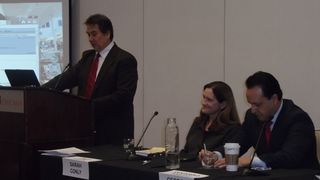
Here are the links from today’s session on “They’ll Take My Big Gulp From My Cold Dead Hands – Public Health, the Police Power, and the Nanny State” at the ABA Midyear meeting in Chicago.

Joining me was Sarah Conly, Professor of Philosophy at Bowdoin College, author of “Against Autonomy: Justifying Coercive Paternalism;” Alderman George Cardenas, who represents Chicago’s 12th Ward; and Walter Olson, Senior Fellow at the Cato Institute’s Center for Constitutional Studies, and guru of the “Overlawyered” blog. 

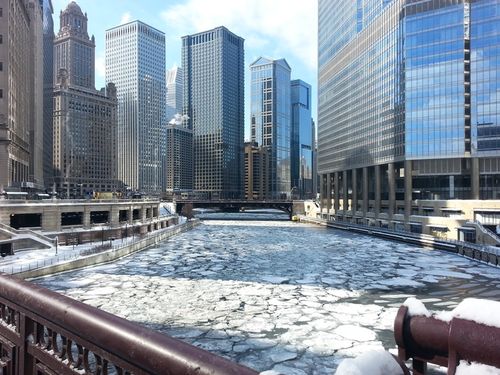
And was it cold out today, you ask? Affirmative.


Continue Reading Three Cheers For Our ABA Program On “Coercive Paternalism” And The Nanny State

Mich Ave 2-6-2014

We’re at the ABA Midyear meeting in sunny Chicago, so we have our to-read links posted today instead of a new case digest. Our fingers are too frozen to post anything more:

  • No well. No way (from The Garden Island, Kauai’s daily newspaper, a story that just sums up how some decisions get made in one little corner of paradise).


Continue Reading Things To Read In Chicago When You’re Freezing

DSCF1585

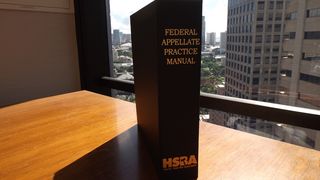
It has been published for a couple of months, but we finally got our hands on an author’s copy of the Hawaii State Bar Association’s Federal Appellate Practice Manual. We authored the chapters on “Briefing – Merits and Amicus” and “Supreme Court Review.”

Our fellow Damon Key lawyers Bethany Ace, Mark Murakami, and Kumau Pineda-Akiona also contributed chapters (“Requisites to Filing an Appeal” (Ace, Murakami, Pineda-Akiona), and “Other Appellate Court Practice” (Ace)).

It’s a compact deskbook, and a worthy supplement to the Federal Rules and the big-volume appellate practice treatises, with a special focus on how Hawaii-based lawyers do appeals in the federal court system.

To get your own copy, use this form, or contact Bethany (currently the Chair of the HSBA’s Appellate Law Section) if you have problems, or just want to do it the semi-old fashioned way and

Continue Reading Hawaii State Bar Association’s Federal Appellate Practice Guide

http://msnbcmedia.msn.com/j/MSNBC/Components/Photo/_new/g-cvr-130318-bloomberg-1130a.photoblog600.jpg

Next Thursday, February 6, 2014, we’ll be in Chicago to moderate an American Bar Association discussion/debate on a topic that’s not our usual takings-eminent domain-land use stuff, but is still one of the hotter topics around. “They’ll Take My Big Gulp From My Cold Dead Hands” is an hour-and-a-half with three experts in “Public Health, the Police Power, and the Nanny State,” to quote our subtitle. (Yes, we realize that New York City’s ban actually exempted Big Gulps® but hey, it’s a catchy title.)

Joining me for the discussion:

  • Walter Olson, Senior Fellow at the Cato Institute’s Center for Constitutional Studies. While his list of accomplishments is long, we lawyers perhaps love him best for his “Overlawyered” blog. 
  • Sarah Conly, Professor of Philosophy at Bowdoin College. Author of “Against Autonomy:  Justifying Coercive Paternalism,” forthcoming from Cambridge University Press.
  • Alderman George


Continue Reading Upcoming Program: “They’ll Take My Big Gulp From My Cold, Dead Hands – Public Health, the Police Power, and the Nanny State”

We were all set to write up the latest case from the Federal Circuit, Banks v. United States, No. 12-5067 (Jan. 24, 2014), when our colleagues at Pacific Legal Foundation beat us to it with this post, “Federal Circuit revives Lake Michigan takings case.”

The Federal Circuit agreed, holding that the property owners’ awareness of that some erosion was occurring before 1952 was not sufficient for their takings claims to accrue. Indeed, the Court held that it was “unreasonable” for the trial court to “assume that a property owner should have been able to discern the difference between the naturally occurring erosion and that caused by the jetties.” The Court sent the Banks case back for a determination on its merits.

Read it if statutes of limitations are your thing. 

Banks v. United States, No. 12-5067 (Fed. Cir. Jan. 24, 2014)

Continue Reading Fed Cir: Takings Claim Did Not Accrue Until Property Owner Had Reason To Notice Permanent Damage