


July 2015

There’s nothing new in the California Court of Appeal’s opinion in Rancho de Calistoga v. City of Calistoga, No. A138301 (July 7, 2015), which is probably why the court didn’t designate it for publication. 

But read it anyway, since there’s some interesting bits. Nothing in the details, mind you, but in the overall vibe of the opinion. 

It’s a mobile home rent control case, so you shouldn’t expect much from a California court, and this decision certainly meets those low expectations: it goes through the usual analysis dealing with the park owner’s argument that the city — at the northern end of the Napa Valley — didn’t agree to increase the rent to $625 per month from the $471 average which tenants were paying. The city permitted an increase of only $60, so the owner sued, asserting among other things that the failure to increase the rent to $625 was

Continue Reading Cal App: No Takings Claim, Because Property Owner Makes “Enough”
Here’s the Complaint, filed late last week in an Oklahoma federal court, challenging the EPA and Corps of Engineers’ new “waters of the United States” rule under the Clean Water Act.

According to the lawsuit, the new WOTUS rules are an attempt to expand the regulatory authority of the agencies well beyond what the Clean Water Act allows. 

This lawsuit joins two others recently filed. The first was a complaint in a South Dakota federal court filed by 13 states, and the other a complaint by the State of Oklahoma, filed in federal court in the Northern District of Oklahoma.

All three make the same general allegations: the EPA and the Corps of Engineers went too far under both the Clean Water Act and the Commerce Clause, and are attempting to regulate property well beyond the reach of “navigable water of the United States” or “waters of

Continue Reading New Clean Water Act WOTUS Rule Challenged: “The Agencies Drastically Expand Their Jurisdiction by Redefining ‘Waters of the United States’”

Even though the defendant in Martinez v. California Dep’t of Transportation, No. G048375 (June 12, 2015, ordered published July 7, 2015) was Caltrans, this was not an eminent domain case, but rather a tort case about whether the agency negligently designed a roadway which caused Mr. Martinez to crash his motorcycle.  

But no matter. Eminent domain lawyers — those who represent either condemnors or property owners — need to read this opinion, because it is about how we conduct ourselves in court.

It starts off with a bang:

This is a case of egregious attorney misconduct. That word – egregious – is difficult to write, but nothing else seems adequate. Blessed with a trial judge who allowed it, trial counsel ran roughshod over opposing counsel and the rules of evidence. We have no choice but to reverse.

Generally, what happened is this: Defendant‟s attorney Karen Bilotti would ask

Continue Reading Cal App Calls Out Trial Judge And DOT Trial Counsel: “This is a case of egregious attorney misconduct. That word – egregious – is difficult to write, but nothing else seems adequate.”

There’s apparently a huge backlog in California of liens which workers’ comp medical providers file to seek payment for services they’ve provided to injured workers.

These are liens possessed by service providers for workers whose employers declined to provide treatment on the ground it is not work related. In those cases, the worker may seek treatment on her own, and if the injury is later determined to be covered by workers’ comp, the employer is liable for payment. The service provider cannot seek payment from the injured employee, and is limited to filing a lien on the workers’ comp case. The lien filing gives the provider standing in the workers’ comp case to protect its interests. The rights of a lien holder are contingent on the worker prevailing on her claim that the injury is work-related.  

In response to the huge backlog in processing such liens, the legislature adopted

Continue Reading 9th Circuit: Fee To “Activate” Workers’ Comp Lien Not A Taking – The Liens Are Not Property

6a017616c47f03970c017617465b53970c-800wi

Nobody’s perfect, as much as we may want them to be. Least of all fictional characters. But Atticus Finch, the Alabama lawyer portrayed in the novel “To Kill a Mockingbird” and the celebrated film, seemed above reproach. 

The first year we sponsored the Law in Film festival, we had to feature “To Kill a Mockingbird,” because, as our colleague Mark Murakami wrote in his review of the film, “[s]tanding alone against a lynch mob armed only with words and his abiding morality, Atticus represents what author Scott Turow calls the ‘paragon’ of lawyer morality: a champion willing to make a stand even if his client, as an African-American accused of raping a white woman, is the most reviled man in their rural Deep South community.”

The book is loved equally, if not more than the film.

Well, get ready. The New York Times reports in its

Continue Reading Et Tu? In The “To Kill A Mockingbird” Sequel, The New York Times Reports That Atticus Finch Has Feet Of Clay

In North Carolina, a property owner has a right to direct access to adjacent highways, and “[i]f the State’s action eliminates all direct access to the abutting road, then the action is ‘a taking as a matter of law.'” Dep’t of Transportation v. Harkey, 301 S.E.2d 64, 71 (N.C. 1983). And it doesn’t matter if the parcel has alternative access to the road. Id. at 65.

Unless the abutting highway moves, according to the North Carolina Court of Appeals in Dep’t of Transportation v. BB&R, LLC, No. 14-1185 (July 7, 2015). 

In that case, there was no dispute that the DOT’s road project took a portion of BB&R’s land on which a convenience store/gas station was located, and that before the taking, the property enjoyed direct access to Dowdle Mountain Road along the property’s northern side.

However, the court concluded the DOT was not liable for a

Continue Reading NC App: No Taking Even Though DOT Cut Off All Of Property’s Northern Access Because Parcel Gained Eastern Acess

Here’s an article by IJ’s Dana Berliner, a retrospective on public use in eminent domain and where the decade since Kelo has left us.  

It is a sign of the constitutional damage Kelo caused that these two related features of the opinion—blind deference and the refusal to engage with facts—have marked post-Kelo jurisprudence.

Berliner, Looking Back Ten Years After Kelo, 125 Yale L.J.F. 82 (2015). 

A quick and worthy read. 

Continue Reading Worth Reading: “Looking Back Ten Years After Kelo”

ALI-CLE-2016-masthead

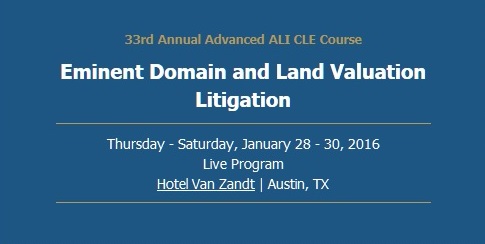
ALI-CLE has posted the registration page for the 2016 ALI-CLE Eminent Domain and Land Valuation Conference, in Austin. Register now for a $200 discount off the tuition. Or you can sign up for notification when the full brochure is published. 

Save the spot on your calendar so you can join us in Austin. 

We’re still working on the agenda and faculty, but here are the details thus far:

Date: January 28-30, 2016 (Thursday – Saturday)

Location: Hotel Van Zandt, Austin Texas

Reserve your hotel room here. [link updated 7/8/2015]

More about the annual conferences — the premiere CLE programming on the subject, in our opinion — here

Stay tuned for more information. We’ll continue to keep you posted. 

Continue Reading 2016 ALI-CLE Eminent Domain Conference (Austin) Early Registration Available

Donald Trump is garnering a lot of press these days for things not related to eminent domain. And there’s a lot of awareness of the high-profile eminent domain battle in New Jersey, in which he was the “B” in an attempted “A to B” taking. But not everyone is as aware of a later, similar controversy. 

So we dusted off our review of the 2011 documentary You’ve Been Trumped, and post it below. The film focuses on the property owners whose land is in the shadow of Trump’s golf course and luxury residential project in Aberdeenshire, on the west coast of Scotland. Compulsory Purchase Orders were threatened (but ultimately not issued), but the scenario presented the film will be familiar to anyone who follows eminent domain and property rights issues.

The film is available on DVD and streaming from a variety of sources. Definitely worth your time. Especially if

Continue Reading If You Are Even Thinking About Voting For Trump …

Remember the Roca Solida case? That’s the follow up to the Supreme Court’s recent decision in United States v. Tohono O’odham Nation, 131 S. Ct. 1723 (2011), highlighting the jurisdictional problem in takings cases which that case left open. We labeled it a “jurisdictional ambush” that awaits any property owner who has a takings claim against the federal government.   

The question presented by the cert petition in Roca Solida is whether 28 U.S.C. § 1500, the statute which deprives the Court of Federal Claims of jurisdiction over a case if a related case is pending in another court at the time the CFC complaint is filed, applies to takings claims. In Tohono O’odham, which was not a takings case, the Court held that the statute prohibited the CFC from taking jurisdiction over the Nation’s monetary claim against the United States, when its related claims against the federal

Continue Reading Amici Brief In § 1500 Case: Congress Cannot Limit Property Owners’ Rights To Just Compensation By Narrowing CFC Jurisdiction, Especially With An Absurd Statute