August 2015

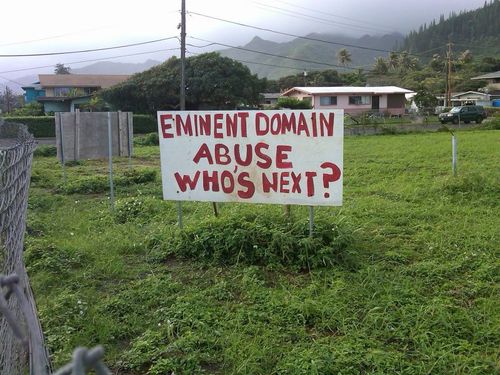
EM Hauulaeminent_domain_abuse

You remember that case about property on the rural north shore of Oahu, in which the City and County of Honolulu is condemning a vacant parcel in order to build a new fire station. The City hasn’t moved on building the station and hasn’t included money in the budget to do so. There’s even some question about whether this is a good place for a fire station.

All this caused the property owner to erect several protest signs on the parcel, one of which is depicted above. An additional brouhaha arose when the City removed and stored the signs, which caused the owner to sue the City in federal court, alleging among other things, due process and First and Fourth Amendment violations, and violations of the City’s “stored property” ordinance.  

We reported on proceedings in the first case, where the court denied the City’s motion for summary judgment. The City argued

Continue Reading Federal Court: City Stopped Blowing Hot And Cold And Had Exclusive Possession Of Property Under Quick-Take Statute, So It Was OK To Seize Anti-Eminent Domain Sign

Here’s the latest in an issue we’ve been following, the myriad legal challenges to the EPA’s recently-adopted rules expanding the scope of the definition of “waters of the United States” under the Clean Water Act.

The U.S. District Court for the District of North Dakota, one of several District Courts considering the plethora of lawsuits challenging the rule, has issued an Opinion and Order Granting Plaintiffs’ Motion for Preliminary Injunction, holding that the arguments of the several states which sued, are likely to succeed because the rule is “likely arbitrary and capricious.”

The Rule asserts jurisdiction over waters that are remote and intermittent waters. No evidence actually points to how these intermittent and remote wetlands have any nexus to a navigable-in-fact water.

Slip op. at 12.

There’s more, of course, and you should read the entirety of the Order, if this sort of thing is your bag. And others

Continue Reading Federal Court Enjoins Implementation Of EPA’s New WOTUS Rules: Intermittent And Remote Wetlands Have No Nexus To Navigable Waters

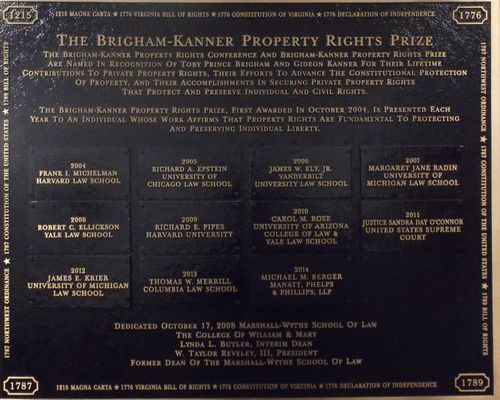
BK-plaque-2015

As we’ve done every year lately, we’re soon headed to the Brigham-Kanner Property Rights Conference at the William and Mary Law School in Williamsburg, Virginia.

This year, the B-K Property Rights Prize will be awarded to Harvard lawprof Joseph Singer, who is, shall we say, an interesting choice, given his theory that a “robust regulatory structure” goes hand-in-hand with property rights, liberty, and the free market. Robust regulation isn’t exactly what you might think of when you think “property rights,” is it? So it should make for an interesting conference.

Professor Singer publishes a blog that is worth following, “Property Law Developments.” It is not one of those blogs that are heavy on the analysis, but its a good place to keep up on recent developments in all things property law. 

The plaque pictured above is a list of prior prize winners.

Here are the conference details:

Continue Reading Join Us: 2015 Brigham-Kanner Conference At William And Mary Law School

We have learned that the North Carolina Supreme Court has granted the State’s request to review Kirby v. North Carolina Dep’t of Transportation, No. COA14-184 (Feb. 17, 2015).

That’s the case in which the Court of Appeals not only held that the property owners’ claims were ripe, but that the Map Act — which gives the DOT the ability to designate property for future highway use and prevent its development in the meantime — effected a taking. The appeals court reversed the trial court’s dismissal and sent the case back down for a calculation of the compensation owed to each property owner.

This is one to watch, for sure. We’ll keep on doing so and let you know as things develop. 

Continue Reading NC Supreme Court To Review “Map Act” Takings Case

After the Supreme Court’s decision in Horne v. Dep’t of Agriculture, 14-275 (U.S. June 22, 2015), we were waiting for this shoe to drop. And now it has.

In “Raisin ruling seen as a lifeline for endangered species,Environment & Energy writes, “[a] Supreme Court ruling that struck down an odd Depression-era raisin program may have revived a critical government defense for endangered species and other wildlife protections, legal experts say.” 

The theory is based on the Horne majority’s rejection of Leonard & Leonard v. Earle, 279 U.S. 392 (1929), the case in which the Court upheld a Maryland state tax which required oyster farmers turn over to the state 10% of the empty oyster shells which they harvested, or pay a monetary equivalent. The Horne majority concluded that Leonard was not applicable because the oysters in Leonard were government property, in contrast to raisins, which —


Continue Reading Nice Try: No, The Supreme Court Didn’t Make Wildlife Public Property In The Raisin Case

A quick one from the Michigan Court of Appeals. Murphy-Dubay v. Dep’t of Licensising and Regulatory Affairs, No. 321380 (Aug. 18, 2015) involved the claims of Mr. Murphy-Dubay, who attended 2 years at a Caribbean medical school, followed by 2 years of clinical rotations in Canada. He returned to Michigan, and passed “Step 3” of the United States Medical Licensing Examination.

But he did not secure a residency, which apparently is a requirement to practice medicine in Michigan. So he sought a “limited license” to practice. When the Department predictably rejected his application because, inter alia, the limited license is for those who are otherwise qualified but who have problems with disciplinary issues (and not for those who do not complete the educational requirements) he sued. His arguments included a takings claim, which asserted that the denial took his property — his “legitimate claim of entitlement” to practice

Continue Reading No, It’s Not A Taking To Prohibit You From Practicing Medicine Because You Think You’re Qualified

There are many ways to keep nuisance birds off of your building or away from your crops.

There’s this one, a plastic owl perched on the 4th floor of the Maui courthouse.

6a00d83451707369e201bb08668850970d-800wi

There are other devices: scarecrows, balloons, and even dead birds. But our favorite is the scare gun, a “propane powered gas gun which produces a periodic loud explosion.” Sounds like fun.

But not to the powers-that-be in the Town of Trempealeau, Wisconsin. In 2013, the Town adopted an ordinance, amended the following year, which requires anyone who wants to use a scare gun to get a permit. These permits restrict the time, place, and manner in which the owner can employ said gun. 

Farmer Klein had used a scare gun on his property since 1962 to keep blackbirds from devouring his crops. He obtained a permit, but apparently didn’t follow the ordinance closely enough because he

Continue Reading Wisconsin App: Town’s “Scare Gun” Permit Requirement Not A Taking

A piece on the humor site Cracked, “4 Thriving Communities That Rich People Destroyed On Purpose,” tells an old story: modest-but-decent places “redeveloped” into (1) Dodger Stadium, (2) Brazil’s Olympic venues; (3) the Salton Sea, and (4) Central Park, respectively.

(We note that the segment on the Salton Sea is the odd man out, and we can’t figure out how that one fits with the other three. But no matter.)

In telling the story of the destruction of Los Angeles’ Chavez Ravine to make way for the ballpark, the piece links to the above video, which contains interviews with many of the Ravine’s former residents. The video also recounts how, using eminent domain, the City of Los Angeles condemned the homes in the village, supposedly to make way for a new, modern housing project.

The homeowners were offered about $10,000 for their homes and promised

Continue Reading Breaking Up Communities For Redevelopment

Photo

Enviro Wars Episode IV: A New Court

You may have heard that the Hawaii Legislature, after an intensive years-long effort by environmental groups, recently created a new court with specialized jurisdiction that could have a big impact on how property and business owners are treated by Hawaii’s courts. 

Known as the “Environmental Court,” this new court has been given the exclusive jurisdiction to hear most civil and criminal cases affecting the environment. Because Hawaii’s court is only just getting off the ground and is in uncharted territory (only one other state—Vermont—has a court with a similar statewide mandate), those who stand to lose the most in this new court—property and business owners—have many unanswered questions.

Here’s what you need to know.

Why A New Court?

According to its proponents, the new Environmental Court is not expressly intended to change outcomes in environmental cases, and is merely designed

Continue Reading What You Need To Know About Hawaii’s New Environmental Court

Takings nerd alert: we posted about this case late last year, when the Wisconsin Court of Appeals held that two separate parcels owned by the same family must be treated as a single unit for purposes of determining whether there’s been a taking. Eventually, the Wisconsin Supreme Court denied review.

So here’s the next step, the cert petititon in Murr v. Wisconsin, No. ___ (filed Aug. 14, 2015), which asks the U.S. Supreme Court to review a single Question Presented:

In a regulatory taking case, does the “parcel as a whole” concept as described in Penn Central Transportation Company v. City of New York, 438 U.S. 104, 130-31 (1978), establish a rule that two legally distinct, but commonly owned contiguous parcels, must be combined for takings analysis purposes?

Read this post for more background. Disclosure: the petitioners are represented by Pacific Legal Foundation, and we manage PLF’s Hawaii

Continue Reading New Cert Petition: Does The Takings “Denominator” Rule Require Two Parcels To Be Treated As One?