


September 2015

Check this out, a story in the September 28, 2015 edition of the New York Times, “Owner of Grand Central Sues Developer and City for $1.1 Billion Over Air Rights.”

Reminds us of this obscure Supreme Court case we heard about…

The Times reports that the current owner of Grand Central Terminal is, with the counsel of uberlawyers, suing New York City in federal court, alleging a taking and related. So what’s this all about (we thought this was “old, unhappy, far-off things, And battles long ago”)?

Apparently, the city granted a Grand Central neighbor permission to build a massive 1500 feet high office tower, and in doing so, took Grand Central’s property (its air rights) without compensation:

On Monday, Mr. Penson filed a $1.1 billion lawsuit in United States District Court in Manhattan that argued that the administration of Mayor Bill de Blasio, a Democrat

Continue Reading Penn Central, Part Deux? A New Complaint Alleges A Taking Of Grand Central Air Rights

We don’t want to take too much time away from our usual land use, takings, and eminent domain fare, but we just couldn’t let this one go by without comment.

Last Friday, we posted our amici brief in Evenwel v. Abbott, No. 14-940, the reapportionment case which the U.S. Supreme Court is considering. The issue in the case is whether Texas’ use of total population when it reapportions its state legislature is consistent with the Equal Protection Clause, or whether districts must be apportioned to consider voting power. After all, the phrase is “one person, one vote,” not “one person, one … constituent.” Our brief argues that both voting equality and representational equality are valid Equal Protection principles, but the representational equality principle is the more important. Thus, it is never a violation for a state to count its entire Census-counted population, which includes those who cannot vote (aliens, minors

Continue Reading Chutzpah, Exhibit “A”

20150910_144339

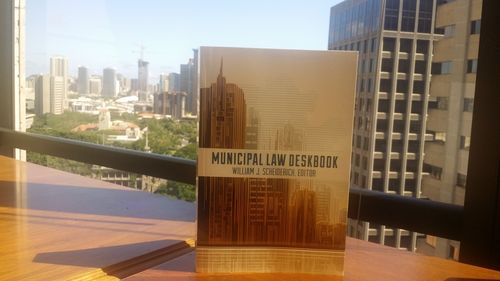
Look what arrived in the mail, a copy of the ABA Section of State and Local Government Law’s recently-published Municipal Law Deskbook, edited by our friend and colleague, Oregon’s Bill Scheiderich

We received a gratis copy because we authored the chapter on Regulatory Takings. The book is designed as a quick reference guide for you muni law types who don’t keep the entire set of McQuillin Municipal Corporations in your library, or for you non-muni law lawyers who want a handy reference guide when these issues come your way:

[The] Municipal Law Deskbook offer[s] legal guidance to municipal attorneys, private practitioners, city administrators, and educators. The book covers a full range of those issues that commonly arise in day-to-day local government administration and the content is intended for attorneys and nonlawyers alike. The chapters cover such topics as when and how federal laws and regulations preempt local legislation

Continue Reading New Book: Municipal Law Deskbook

Who gets counted for reapportionment purposes?

Everyone!

Please forgive the deviation (a pun for our election law colleagues) from the blog’s usual land use and takings fare, but frequent readers understand that we also have an interest in election law, and occasionally post up items of interest.

Today we filed this amici brief in Evenwel v. Abbott, No. 14-940, the case on appeal to the Supreme Court which asks which “population” states must use when reapportioning their state legislatures and drawing district boundaries. We’ve covered this case, as well as our own case in which we (unsuccessfully) challenged Hawaii’s practice of basing reapportionment on  “permanent residents” and excluding military personnel and their families. Our brief argues:

The parties in this case suggest answers to a deceptively simple question: who constitutes the body politic in the states? This question is one the Court has avoided answering explicitly for nearly half a century. Amici

Continue Reading Amici Brief In SCOTUS Reapportionment Case: Close Scrutiny For Anything Less Than Total Population

We’re continuing our Detroit-themed posts today, with this one about auto bailouts and takings.

We generally don’t post trial court decisions, preferring to wait until we have a published opinion from a court of appeals. But from time to time, we have made exceptions, like here, where the counsel involved are well-known and the issue looks like one that might eventually go up the chain, and indeed has once already.

So it is in Colonial Chevrolet Co., Inc. v. United States, No. 10-647C (Sep. 9, 2015), in which the Court of Federal Claims denied the government’s motion to dismiss a takings claim. The plaintiffs are (former) General Motors and Chrysler dealers whose dealership contracts were sloughed off as part of the $38 billion bailout of the auto manufacturers. As part of the deal, the companies were required to cancel many of their franchise agreements, “forcing the dealerships to close.” According to the plaintiffs, “Chrysler

Continue Reading CFC: Auto Bailout Could Have Resulted In A Taking Of Dealerships’ Contracts

20150919_170343

We’re in Detroit and environs for the weekend, doing some scouting for an upcoming meeting of the ABA’s Section of State and Local Government Law.

Had a Faygo Redpop at the site of Tiger Stadium in Corktown, dinner in Poletown, a fresh peach at the Saturday Eastern Market, and read this recent Sixth Circuit opinion reinstating the Insane Clown Posse‘s lawsuit against federal prosecutors over the DOJ’s inclusion of Juggalos on its gang list.  

Although things look like they’re on the uptick here, Detroit has a long way to go. For some insight on how they got this bad, check out Professor Kanner’s recent article, “Detroit and the Decline of Urban America,” 2013 Mich. State. L. Rev. 1547 (2013). 

Parsons v. U.S. Dep’t of Justice, No. 14-1848 (6th Cir. Sep. 17, 2015)

Continue Reading Detroit Travelogue

We’re not exactly sure why, but the facts in State of Texas v. Treeline Partners, Ltd., No. from the Texas Court of Appeals just crack us up.

First, the court comes up with a definition of “lowball” —

In attempting to ask potential jurors whether they believe that the State “lowballs,” the State’s attorney properly inquired about whether the venire members held a preexisting bias or prejudice that the State underestimates property values. See WEBSTER’S NEW WORLD COLLEGE DICTIONARY 801 (3d ed. 1996) (defining “lowball” as a verb meaning “to give an understated price, estimate, etc. to (someone), esp. without intending to honor it” or “to so understate (a price, etc.)”).

Slip op. at 7. Save that one for your briefwriting databank.

The case involved the State’s attempt to ask potential jurors and make arguments about whether they believed that the State lowballs eminent domain valuations. Now the

Continue Reading Condemnor Entitled To Ask Jurors Whether They Believe DOT “Lowballs,” If Condemnor Hints It Does

In those states with a commission process in condemnation, any guess where an appellate court comprised of judges will come down on who gets to make the final call about what evidence is admissible — a judge or the commissioners?

Well, if you guessed the judge, you’d be right. In Regional Transportation Dist. v. 750 W. 48th Ave., LLC, No. 14SC64 (Sep. 14, 2015), the Colorado Supreme Court summed up the applicable rule of law succinctly: “commissioners have some implicit authority to make evidentiary rulings without the oversight of the trial judge,” but “the judge is still the judge,” and she gets the final call. Slip op. at 11. So the commissioners cannot “overrule” or “reconsider” a judge’s earlier ruling that evidence is admissible, nor can they ignore a judge’s instruction that they disregard other evidence.

It shouldn’t have been too hard to presage that judges would conclude that judges have the final say (judges, not lay commissioners, are

Continue Reading Colorado: Judicial Evidentiary Rulings, Not Commission’s, Control In Eminent Domain Valuation Hearings