October 2015

Here are some upcoming events in which you may be interested, in chronological order:


Continue Reading Upcoming Events And CLE’s – Appellate, RLUIPA, Sharing Economy, And More
ALI-CLE-2016-masthead

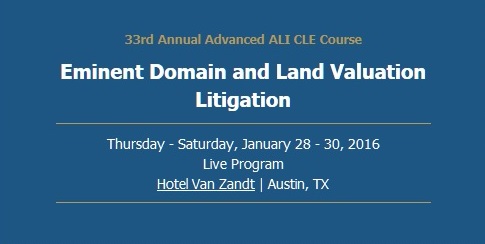
Here’s the full agenda for the 2016 Eminent Domain and Land Valuation Litigation / Condemnation 101 Conference, January 28-30, 2016, in Austin, Texas. 

Together with our friend and colleague Joe Waldo, we think we’re put together a pretty good program that covers a lot of ground. This is the first time the conference has been to Austin, and we’re starting off with a talk by Austin Mayor Steve Adler, who in his former life was an eminent domain lawyer. Other highlights:

  • Professor Ilya Somin will speak about his recently-published book in a segment entitled “The Impact of Kelo and the Limits of Eminent Domain.”
  • Pipelines and Energy Corridors: Valuation Perspectives of Condemnors and Condemnees” with the lawyers on the front lines of one of the hottest topics in eminent domain law nationwide.
  • Retired Minnesota Supreme Court Justice Paul H. Anderson will give us his tips


Continue Reading It’s Here – 2016 ALI-CLE Eminent Domain Conference: Complete Agenda, Faculty, Registration Information

Here’s the Brief in Opposition in the case which asks whether takings claims against the federal government — which we described as subject to a “jurisdictional ambush” due to the old Tucker Act Shuffle — are subject to the rule of 28 U.S.C. § 1500 set out in the Tohono O’odham case. 

If that’s a lot to digest in one sentence, here’s the slightly longer story. The core issue is one we’ve dealt with extensively before, and which the Supreme Court dodged in in United States v. Tohono O’odham Nation, 131 S. Ct. 1723 (2011), namely, whether § 1500’s jurisdictional bar operates in takings claims, which are required to be split between the CFC and the district courts (aka the “Tucker Act Shuffle”). We filed an amicus brief in Tohono O’odham, arguing that the statute cannot be read to deprive takings plaintiffs of their right to secure just compensation, when they

Continue Reading BIO In Tucker Act Jurisdictional Ambush Case: Takings Claims Subject To § 1500’s Rules

Our friend and colleague Alan Ackerman posted a note on his blog about a recent District Court ruling from the Western District of Virginia which upheld the power of a potential condemnor to enter property for the purposes of survey, without formally taking the property. See “Virginia Federal Judge Follows What May Be the Majority Rule for Surveys.” But Alan didn’t post the court’s written ruling. So here you go, all 35 pages of it.

The issue was whether a Virginia statute, which “authorizes a natural gas company to enter private property without the landowner’s written permission and perform a survey for a proposed natural gas pipeline,” is a facial violation of the U.S. and Virginia Constitutions, and “is thus void and unenforceable.” Slip op. at 1. The court granted the gas company’s motion to dismiss. It concluded that the facial challenge failed because the property

Continue Reading Federal Court: Virginia’s Entry Statute Not Facially Unconstitutional

A short one from the Federal Circuit, Rasmuson v. United States, No. 14-5089 (Oct. 5, 2015), that comes out of a rails-to-trails case, but has wider applicability. 

The case involved the usual: plaintiffs owned lands over which the railroad had rights of way, and when the railroad ceased operating and the Surface Transportation Board issued a Notice of Interim Trail Use, the owners’ takings claim ripened because but for the issuance of the NITU, under Iowa law the land otherwise would have reverted back to the owners. So far, so good. 

In the valuation trial, the Court of Federal Claims applied the “before and after” method, and concluded that the “before” condition of the land was as it existed before the trails easements, but that the appraisers should “ignore any physical remnants of the railway’s use, which would have remained if the railway easement had been permitted to lapse.

Continue Reading Federal Circuit: “Before” Condition Must Account For Railroad Junk That Would Have Been Left Behind

Followers of the blog understand that in addition to our usual fare of eminent domain, land use, regulatory takings and the like, we also cover another area, election law and voting rights. That’s a weird feature of our practice, so we post about it. Call it “editor’s prerogative” or something. 

But there are actually some areas of crossover, or at least a few places where those who practice in one can learn from the other. Continue Reading “One-Person, One-Vote,” Regulatory Takings, And Why You Can’t Rely On The Supreme Court’s Words Alone

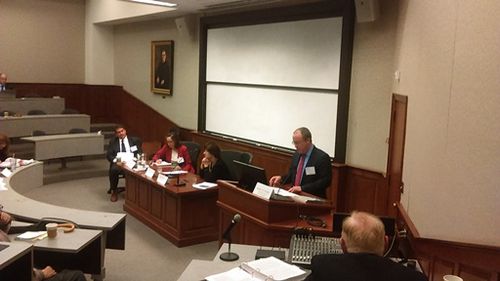
Earlier today, I moderated a panel of expert speakers on the topic of “Civil Forfeiture of Property” at the 12th Annual Brigham-Kanner Property Rights Conference at William and Mary Law School in Williamsburg, Virginia. 

Sara Sun Beale of Duke Law, Scott Bullock of the Institute for Justice, and Sandra Guerra Thompson of the University of Houston Law School were our speakers. Here are my introductory remarks:

Is the right of private property a “poor relation” to other civil rights, as the Supreme Court once warned? Or is the Takings Clause like the Pirate Code in Pirates of the Caribbean — more like what you’d call ‘guidelines’ than actual rules? 

If you were to look only at civil forfeiture laws — what one of our speakers has eloquently referred to as “policing for profit” — you might think so.

These laws allow government to seize private property without first convicting or even charging

Continue Reading Introduction To The Civil Forfeiture Panel At The 2015 Brigham-Kanner Property Rights Conference

WIN_20151002_13_15_51_Pro

Greetings from the William and Mary Law School in (rainy) Williamsburg, Virginia, where we’re speaking at the 12th Annual Brigham-Kanner Property Rights Conference

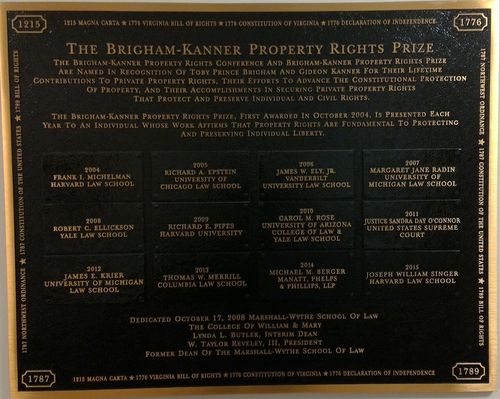
This year’s B-K Prize winner is Harvard Law’s Joseph Singer, who we wrote is “an interesting choice, given his theory that a ‘robust regulatory structure’ goes hand-in-hand with property rights, liberty, and the free market. Robust regulation isn’t exactly what you might think of when you think property rights, is it?” As another lawprof noted about Professor Singer, he “is such a believer in private property that he thinks everyone should have some.”

If that quote doesn’t quite compute for you — it’s a nice thought, for sure, but how do you get from here to there is what we want to know — you are not alone. Last year’s B-K Prize winner, Michael Berger spoke during the first morning session, and submitted this piece

Continue Reading “Joe is such a believer in private property that he thinks everyone should have some” – The 2015 Brigham-Kanner Property Rights Conference

We don’t often post trial court decisions, but this recent ruling from an Idaho trial court awarding a property owner approximately $400,000 in fees and costs was a good read, and we’d like to share it with you all.

This is a ruling issued after a trial to determine just compensation for the partial taking of property for road improvements. The jury awarded approximately $146,000 to the property owner. There’s a lot of detail in the order, and we suggest you read the entire thing. But what grabbed us was the way the judge treated property rights, starting on page 11 of the order. 

Noting that “the Court’s analysis is rooted in the Constitution and this country’s long history of jealously protecting individual property rights,” (now there’s something you don’t hear from courts, much less trial courts, these days), the order concluded that the property owner was the “prevailing party,”

Continue Reading A Trial Judge Who “Gets” Eminent Domain