


2015

We visited Think Tech Hawaii’s downtown studios for a chat with Chris Lethem about Evenwel v. Abbott, the one-person-one-vote reapportionment case currently being briefed in the U.S. Supreme Court. As we’ve written, Evenwel could directly affect how Hawaii has reapportioned its legislature since statehood, and is a case to follow closely.

We also discussed Hawaii’s new Environmental Court and the recent Hawaii Supreme Court oral arguments in the “Thirty Meter Telescope” case

We didn’t know until earlier in the day that Chris would be the host. Which was a pleasant surprise because he is a former client in a successful case we took to the Hawaii Supreme Court a few years ago. Small town, no? Continue Reading From Think Tech Hawaii: SCOTUS Reapportionment, The New Environmental Court, And The TMT Oral Arguments
Those of you who are members of the ABA Section of State and Local Government Law, tune in tomorrow, Friday, September 11, 2015 for the Land Use Committee’s monthly call.

It will feature two speakers, talking about the California Supreme Court’s recent decision upholding San Jose’s “workforce housing” requirement against a claim that it was an “exaction” and thus should have been subject to the nexus and rough proportionality requirements of Nollan, Dolan, and Koontz.

Law of Affordable/Workforce Housing Exactions and Set-Asides 

FREE Teleconference Sponsored by the Land Use Committee
Friday, September 11, 2015
2:00 p.m. EST
Dial-in 888-3967955
Passcode 797687#
 
Speakers: David L. Callies, FAICP, Kudo Professor of Law at the University of Hawaii

Tim Iglesias, Professor of Law at the University of San Francisco School of Law (Professor Iglesias organized and co-authored an amicus brief in support of the City of San Jose).

Continue Reading Tomorrow: ABA Land Use Committee Talk On The California Workforce Housing “Exaction” Case

Here’s one from the Connecticut Appellate Court which combines two of our favorite geeky topics: takings and muni law.

In Turn of River Fire Dep’t, Inc. v. City of Stamford, No. AC 36468 (Sep. 15, 2015), the court concluded it was not a violation of the Takings Clause for the voters of the city to amend their charter to consolidate the city’s six fire departments (the city-operated Fire and Rescue Department, and five independent volunteer fire departments) into a single city department, commanded by a city-employed official, the fire chief.

After amendment of the charter, one of the volunteer departments sued, alleging among other things a takings claim: “Specifically, they claim that the amendments constitute a per se regulatory taking because they deprive Long Ridge of all economically beneficial use of its property by forcing it to either participate in the Stamford Fire Department or cease operating as a fire department.” Slip op. at 11. The

Continue Reading Merging Volunteer Fire Companies Into An “Official” Municipal Fire Department Isn’t A Taking

Here’s what we are reading today, eminent domain with a slightly offbeat theme:


Continue Reading Eminent Domain Round-Up: Aliens, Exotic Dancers, And Princesses

From the Texas Court of Appeals in Sloan Creek II, LLC v. North Texas Tollway Authority, No. 0-5-14-1456-01456 (Aug. 28, 2015):

This is an interlocutory appeal of the trial court’s orders granting two pleas to the jurisdiction challenging an inverse condemnation counterclaim under article I, section 17 of the Texas Constitution. In its counterclaim, Sloan Creek II, L.L.C. alleged the increased amount and rate of erosion of creek banks on its property due to increased rainwater runoff from highway improvements was an inverse condemnation in violation of the Texas Constitution. Because we conclude Sloan Creek II failed to create a fact issue on whether the governmental entities involved knew the highway improvements were substantially certain to increase the amount and rate of erosion, we affirm the trial court’s orders dismissing the article I, section 17 counterclaim.

Slip op. at 1. 

We don’t have much more to add, except to

Continue Reading “Should Have Known” Isn’t Enough To Show Intent In Inverse Condemnation

Every year at around this time, we note the anniversary of the blog. Our first post was back in August 2006, which means that we have nine years of this under our belt. In blog years, that’s apparently a lot. 

It’s a gas to think about our favorite topics, and write up my thoughts about them. But the best part of this enterprise is the people whom I have met over the years as a result. So I’d like to recognize those who send in items, who make comments, and who gently prod with suggestions.

I’d also like to hail my fellow law bloggers who, like me, make the time to share thoughts about the legal issues of the day. Although you’re not quite “Real Men [and Women] of Genius,” today we salute you, Mr. Law Blog Blogging Guy (and Gals):


Continue Reading Entering Our Tenth Year

From the Ninth Circuit, a published opinion in a case challenging a Napa Valley city’s mobilehome rent control ordinance, Rancho de Calistoga v. City of Calistoga, No. 12-17749 (Sep. 3, 2015). Here’s a complete summary of the issues in the case, along with the Ninth Circuit merits and amici briefs. We’ve been following it because we filed an amicus brief in support of the property owner’s argument that it pleaded enough to get by a motion to dismiss for failure to state a claim. 

The Ninth Circuit didn’t agree, and affirmed the District Court’s dismissal. The panel concluded the case was ripe under Williamson County (an issue that seemed to occupy a lot of the judges’ time at oral arguments), but that the owner’s theory that “even if the taking is for a public purpose, the rent subsidy should be paid by the government if the rent is

Continue Reading Where’s Palazzolo, Ninth Circuit? Owner Bought Property Subject To Regulation (Just Not These Regulations), So Has No Takings Claim

Here’s the latest in a case that we’ve been following, which was in both state and federal court, Bridge Aina Lea v. Land Use Comm’n

The litigation is a series of two lawsuits that originated in state court in the Third Circuit (Big Island), one an original jurisdiction civil rights lawsuit, the other an administrative appeal (that’s a writ of administrative mandate for you Californians). The State removed the civil rights lawsuit to U.S. District Court in Honolulu and promptly moved to dismiss, and this portion of the case nearly caused us to flash back to our Federal Courts class in law school, since it raised a host of procedural questions such as the effect of removal, whether certain defendants are “persons” under 42 U.S.C. § 1983, whether the federal court must abstain from addressing the federal takings claim, whether there is a state damage remedy for

Continue Reading Hawaii Federal Court Gets Rid Of Most Claims Against Land Use Commission, But Allows Takings And Vested Rights Claims To Go Forward

Oral Arguments part I

Oral Arguments part II

Three points before we get to our more involved thoughts on last week’s oral arguments in what is known as the “Thirty Meter Telescope” case, Mauna Kea Anaina Hou v. Bd. of Land and Natural Resources, No. SCAP-14-0000873: 


Continue Reading Not Quite “Where No Man Has Gone Before” – Hawaii Supreme Court Considers Mauna Kea’s 30 Meter Telescope

EM Hauulaeminent_domain_abuse

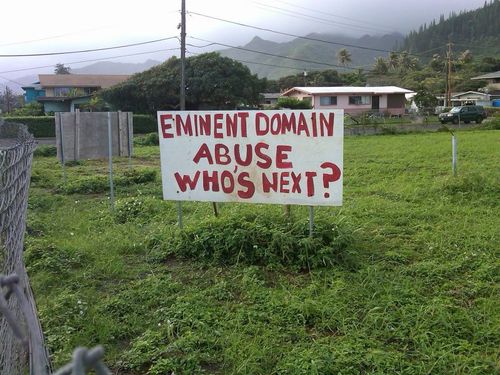
You remember that case about property on the rural north shore of Oahu, in which the City and County of Honolulu is condemning a vacant parcel in order to build a new fire station. The City hasn’t moved on building the station and hasn’t included money in the budget to do so. There’s even some question about whether this is a good place for a fire station.

All this caused the property owner to erect several protest signs on the parcel, one of which is depicted above. An additional brouhaha arose when the City removed and stored the signs, which caused the owner to sue the City in federal court, alleging among other things, due process and First and Fourth Amendment violations, and violations of the City’s “stored property” ordinance.  

We reported on proceedings in the first case, where the court denied the City’s motion for summary judgment. The City argued

Continue Reading Federal Court: City Stopped Blowing Hot And Cold And Had Exclusive Possession Of Property Under Quick-Take Statute, So It Was OK To Seize Anti-Eminent Domain Sign