February 2016

Hawaii has recently become the second jurisdiction to create an Environmental Court, a topic which we’re written about earlier (“What You Need To Know About Hawaii’s New Environmental Court“). We’ve asked whether Hawaii also might need a Property Rights Court, too.

Well, it looks like the good people of Guahan (“Guam” in the old parlance) may beat Hawaii to the punch, because according to this story, the Legislature is considering creating a special court to handle “inverse condemnation cases as well as real property boundary disputes and land registration proceedings.” SeeLandowner compensation bill again up for debate.”

The bill would streamline the settlement process of what’s known as “inverse condemnation” – when the government takes land but does not compensate the owner. According to the bill, agencies that took private property would be required to pay for any costs associated with proving

Continue Reading Time For A “Property Court?” Guahan (aka Guam) May Be Getting One
20160215_095312
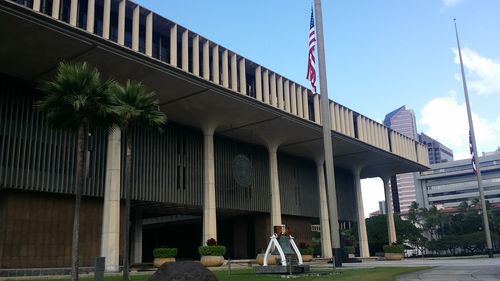
The U.S. and Hawaii flags at half-staff this morning at the Hawaii Capitol

So Justice Scalia is gone. We all knew this day had to come, eventually. But we were not prepared for it so soon.

With his opinions in Nollan, Lucas, Rapanos, and Stop the Beach Renourishment, I think it is fair to say that he was a champion of private property rights, even though I am always uncomfortable when judges are called “champions” of certain causes, because they really aren’t supposed to have causes. I’d imagine that Justice Scalia probably would agree that the only “cause” judges should serve is to call the law objectively as they see it. Fair enough. But even a cursory review of his property law jurisprudence tells us that his absence will leave a large hole, unlikely to be filled.  

There are a lot of retrospectives on the man

Continue Reading “Unless the permit condition serves the same governmental purpose as the development ban, the building restriction is not a valid regulation of land use but an out-and-out plan of extortion.” Goodbye To Justice Scalia

The Pennsylvania eminent domain code requires a condemnor to file the declaration of taking within a year of its being authorized:

The condemnor shall file within one year of the action authorizing the declaration of taking a declaration of taking covering all properties included in the authorization not otherwise acquired by the condemnor within this time.

26 Pa. Consol. Stat. § 302(e). Condemning agency gets authorization, and it has a year to file the declaration of taking. We’re not Pennsylvania lawyers, but the cues are there: “shall,” “within one year,” and the like. Seems simple enough. 

Not so fast, according to the Pennsylvania Commonwealth Court. In In re Condemnation of Right-of-Way for State Route 0095, Section BSR, No. 1308 CD 2014 (Jan. 29, 2016), the court held that a condemnor can take pretty much as long as it wants, provided it “reauthorizes” the taking before the one-year time

Continue Reading Pennsylvania Condemnors: You Can Keep Property Owners Hanging On Indefinitely, Despite The One-Year Statutory Clock

Those of us who represent private parties in litigation know that when we appeal and we want to suspend enforcement of the judgment, we can do so if we post a supersedeas bond (aka appeal bond). In other words, if we put our money where our mouths are. We also know that some parties — generally governments — are often exempt by statute from this requirement, and can appeal without having to post a bond.

But here’s a case where that exemption may have come back to bite a city which exercised it.

Holmquist v. King County, No. 733354 (Feb. 8, 2016) started off as a quiet title action for property which became private after the County vacated a Seattle-area street back in the 1930’s. A dispute arose about ownership, and the private owners sued the County. The City of Seattle thought it owned the property — it also

Continue Reading City’s Treating Private Property Like City Property During City’s Appeal Is A Taking

Here’s what we’re reading today:


Continue Reading Tuesday Round-Up: Inversely Condemning Flint, “Well Nigh Conclusive?,” Parcel-As-A-Whole

20160114_125445

Here’s the latest on a takings case that is winding its way through the U.S. District Court in Honolulu. Yes, you read that right: a takings case being litigated in federal court.

Intrigued? Read on. 

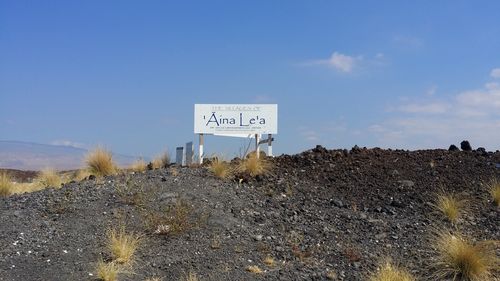
We’ve covered this case and the related state court litigation several times here before, so this isn’t entirely unfamiliar ground. This is a case in which a property owner (the developer of the Aina Lea project on the Big Island, just north of the Waikoloa beach area) filed a case in Hawaii state court seeking, among other things, just compensation for the temporary taking of its right to develop its property. The case ended up in federal court because the State of Hawaii Land Use Commission waived the State’s 11th Amendment immunity and removed the case from state court under federal question jurisdiction. 

The litigation began as two lawsuits originating in state court in the

Continue Reading Latest On The Latest Hawaii Takings Case: Unconstitutional Conditions, Statutes Of Limitations, And Vested Rights

Are you a lawyer and need something to do for the next 6-12 months? Want to make a recommendation to the Department of Land and Natural Resources about whether it should issue a Conservation District Use Permit to the Thirty Meter Telescope project on the top of the Big Island’s Mauna Kea? Want your decision gone over with a fine-tooth comb by the DLNR, the Circuit Court, and the Hawaii Supreme Court? Are you a glutton for punishment? If so, you are in luck: the DNLR is looking for someone to serve as the Hearing Officer for the contested case (administrative trial) about the TMT.

This is the remand from the Hawaii Supreme Court, which invalidated the DLNR’s earlier issuance of a CDUP to build the telescope. Here are the official qualifications for the job:

  • Being an attorney licensed to practice law in the State of Hawaiʻi and in good


Continue Reading State Looking For A TMT Hearing Officer – You Know You Want To Do This

As you probably are aware, Kelo v. City of New London has generated a ton of legal response: articles, books, cases. It has also rippled out to the broader culture with a movie and a book. At the recent ALI-CLE Eminent Domain conference, for example, we interviewed the producer of “Little Pink House,” the forthcoming feature film about the case. (We’ll share some soundbites from the interview soon, once we edit the podcast.) 

And now, music. A Connecticut group called “Swamp Yankee” has produced an EP, “Kelo v New London,” which, in addition to the title track (above), will contain cuts such as “Norwich,” “Dirge for Jewett City,” and “Shoreline East Rag.” Listen to the tracks here, where you can also order the

Continue Reading Kelo And The Cultural Zeitgeist: Movies, Music

Hoffer-wisconsin

Here’s a decision from the Wisconsin Supreme Court, similar to a recent case from the Oregon Supreme Court involving highway improvements which cut off existing access. 

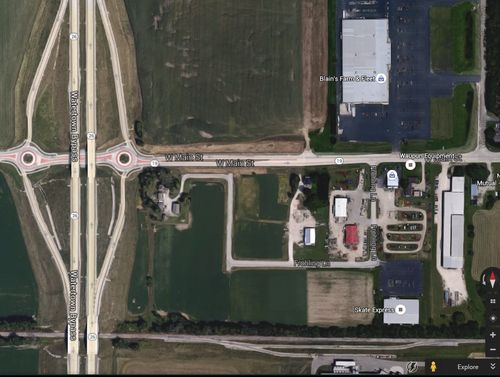
The issue in Hoffer Properties, LLC v. Wisconsin Dep’t of Transportation, No. 2012AP2520 (Feb. 4, 2016) was whether a property owner whose parcel enjoyed direct access to a state trunk highway via two driveways was entitled to compensation when a road project cut those driveways off, but still left the parcel with access via a side road.

The Wisconsin court’s approach isn’t the “hot mess” that the Oregon Supreme Court’s opinion is, even though it reached roughly the same result: as long as there is some access remaining after the taking, no compensation for the loss of the direct-access driveways.

Some quick background. Hoffer owned a parcel with two driveways on Highway 19. Six years before the taking, the DOT designated the highway

Continue Reading Wisconsin: Cutting Off Highway Access Is Not Compensable, If The Property Isn’t Totally Landlocked

We’ve posted a lot lately reporting on the 2016 ALI-CLE Eminent Domain and Land Valuation Litigation Conference, recently held in Austin. We have a couple of more posts for you before we turn to other things. Here is the first, a run-down of the blogs of faculty members, and others we were in the audience. If your blog is missing from this list, email me the link and I will update the post to include it.


Continue Reading The Blog Lineup From The 2016 ALI-CLE Eminent Domain Conference