January 2017

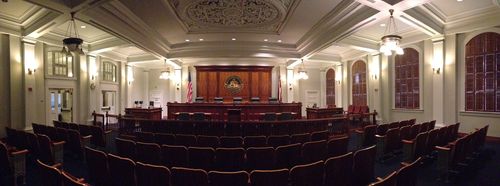
Our colleague Rebecca Copeland has posted a preview and the briefs in an election law case we’re arguing next week in the Hawaii Supreme Court. SeeWrit to Watch: Hyland v. Gonzales.” We’ve written about the case earlier here and here

The question for the court’s review is whether an appeal in a voter registration challenge case is timely brought — when mailed by the appellant, or when received by the Board of Registration Appeals? Under the statute, challengers have ten days in which to “bring” an appeal, and the Intermediate Court of Appeals concluded that it must be delivered to the Board within that time, not merely mailed. The court’s decision in this case could have an impact beyond the relatively rare election law context, because many administrative procedures and appeals are subject to similarly-phrased deadlines.  

Rebecca writes:

In the underlying case, Hyland challenged the
Continue Reading Upcoming Election Law Hawaii Supreme Court Argument Preview: When Is A Registration Challenge “Brought?”

Photo

After the Hawaii Supreme Court decided GATRI v. Blane, 962 P.2d 367 (Haw. 1998) one big question remained.

In GATRI, the court held that in the coastal zone, a county Community Plan (also known as a “General Plan” in some counties) is a binding land use regulation, and thus has the force and effect of law. (Outside the coastal zone, the CP/GP’s don’t actually control any land uses, and are general statements of long-term planning goals. The zoning, and the zoning alone, regulates the uses of land.)

But the state legislature in the Coastal Zone Management Act mandated a different result in the coastal zone and there, the planning also controls land use, as the court held in GATRI. Thus, in order to develop property in the coastal zone in accordance with the applicable zoning, the applicable CP/GP must also permit the use. This is know as “plan-zone consistency,” and

Continue Reading Hawaii Supreme Court Oral Arguments In Lucas “Economically Beneficial Use” Taking Case

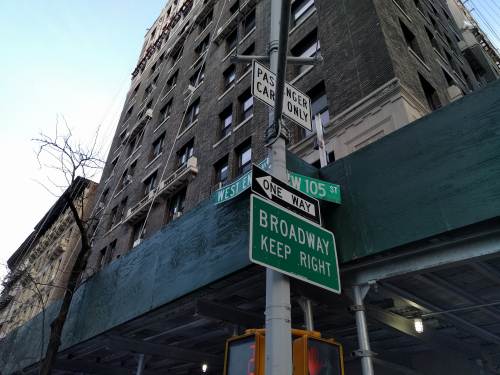
You take the uptown subway, the 1 train, destination the Bronx — the IRT for those of you who still refer to New York City’s subway lines that way — and exit at the 103rd Street Station, just before you cross the unofficial border to Harlem. Walking north on Broadway for a couple of blocks, turning on West 105th Street west towards the Hudson, crossing West End Avenue. 

IMG_20170109_152104 (1)

This is the formerly rural part of the city now known as the Upper West Side, then known as Bloomingdale. The Dutch, who originally named it that back when this was all New Amsterdam, didn’t spell it that way, of course. They wrote Bloemendael, because it reminded them of a flower growing area in Holland. Not too many flowers to be found here these days, unless you continue on towards Riverside Park. 

A quarter of a block down on your right

Continue Reading Takings Pilgrimage, Upper West Side Edition

There have been a lot of takings and takings-related decisions coming out of the Court of Federal Claims lately, and we’ve held off on posting them individually. So to start off your New Year, here is a pop quiz.

Your task: guess whether the CFC held there was a taking, or no taking (answers below):

Case 1: Sheikh Djibouti 

  • Global Freight was a subcontractor providing services to a Navy base in Djibouti. The Navy ordered it to move its vehicles from the Navy base into Djiboutian territory, after which the Djiboutians seized the vehicles. Taking or no taking? 
  • Taking. Or at least not “no taking.” In Global Freight Systems, Co. v. United States, No. 15-378C (Fed. Cl. Dec. 29, 2016), the CFC denied the government’s motion to dismiss for failure to state a claim (which argued that it was the Djiboutians and not the U.S. which took the


Continue Reading Court Of Federal Claims Pop Quiz: Taking Or No Taking?