May 2018

A water district, with regulatory approvals and permits from the California Department of Health Services, added chemicals — “secondary disinfectants” — to the tap water system to make the water safe to drink. The water complied with all federal and California drinking standards. 

Sounds good. No one wants undrinkable drinking water. Problem was these additives caused copper pipes in private homes to corrode.

The owners brought class actions under both nuisance (tort) and inverse condemnation theories. The Superior Court concluded the claims were preempted by both federal and state law. 

In Williams v. Moulton Niguel Water District, No. G053002 (May 3, 2018), the California Court of Appeal affirmed, although for different reasons. 

The nuisance claim was out because the District is immune from nuisance liability. Under California Civil Code section 3482, “[n]othing which is done or maintained under the express authority of a statue can be deemed a nuisance.” The
Continue Reading More Tort vs Taking: No Inverse Condemnation When Water District Added Chemicals Which Damaged Copper Pipes

IHtakings

Another week, another Federal Circuit panel opinion on takings authored by Judge Timothy Dyk (following the recent MR-GO opinion). And you know what that means: property owners lose.

The Court of Federal Claims concluded that the feds had taken the plaintiff’s lease of of a part of Dallas’ Love Field — under both a Lucas and Penn Central regulatory and physical taking theory — and rendered a verdict of $135 million in just compensation.  In Love Terminal Partners, L.P. v. United States, No. 16-2276 (May 7, 2018), the Federal Circuit, in the Judge Dyk-authored opinion, reversed. 

The facts of the case are not terribly complex. Back in the day, Braniff Airways (those of you of a certain age will remember Braniff) leased land at Love Field. Decades later, in order to spur the growth and use of Love Field’s competition Dallas-Fort Worth airport (DFW), Congress adopted the

Continue Reading Judge Dyk Strikes Again: No Love For Taking Of Leasehold Of Love Field

20180504_091644_HDR
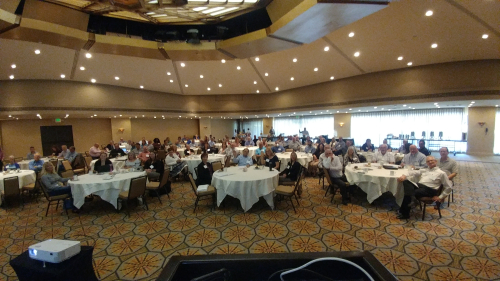
The conference is being held at the Arizona Biltmore.

Proof that we are actually in the room (and not on the golf course).

Here are the cases which I mentioned at today’s conference. What a great turn out (130+ lawyers, appraisers, right-of-way professionals, and others).

Many thanks to colleagues Chris Kramer and Jennifer Cranston for planning the conference and for the the invitation to present, and to my co-panelist Laura Curry.

Public use, public purpose, and necessity


Continue Reading Links From Today’s Arizona Condemnation Conference

20180504_091644_HDR
Surge pricing applies!

You really have to feel for taxi operators who invested what could be huge amounts of money to obtain a taxi medallion getting whacked by the competition from ridesharing outfits like Lyft and Uber. These services look and feel an awful lot like taxis, don’t they? As we wrote in a recent article:

These services—at least from the consumer’s standpoint—operate a heck of a lot like taxis do. You hail a ride (not with your arm and a sharp whistle, but with your fingers and your smartphone), you get in, you go, you get where you are going, you pay the driver (again, with the app, not by handing the driver cash or your credit card). Is that enough of a difference to say that ridesharing isn’t taxicabbing? On that, I am mostly with the taxicab operators. Having used Uber and Lyft more than a few

Continue Reading New York City Allowing Ridesharing Isn’t A Taking Of Taxi Medallions

Untitled Extract Pages

Here’s one we’ve been waiting to drop, but when it did, we were tied up so couldn’t get to it quickly. 

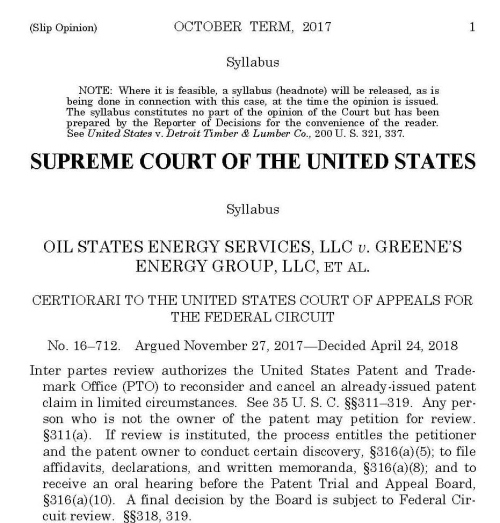
Yes, it’s a patent case. But as we explained here, a case that property mavens should be following because it deals with what is “property,” and where an owner goes to resolve disputes about that property. 

In Oil States Energy Services, LLC v. Greene’s Energy Group, LLC, No. 16-713 (Apr. 24, 2018), the Court’s majority held that patents are a form of “public property” (more like a government-created entitlement), and thus Congress can withhold the usual Article III tribunal and a jury when the validity of that property is challenged. In an opinion by Justice Thomas (joined by everyone but the Chief Justice and Justice Gorsuch), the Court held that “inter partes review,” under which the Patent and Trademark Office administratively reconsiders (and may cancel) previously-issued

Continue Reading Property Lawyers, Read The Supreme Court’s Latest Patent Case