


December 2018

1205181530f_HDR

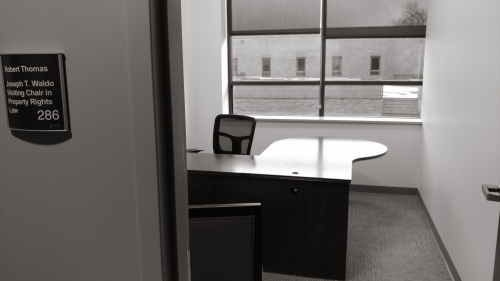
With the first snow of the season beginning to fall in Williamsburg, today was the final day of classes at the William and Mary Law School. Which means that my time serving as the inaugural Joseph T. Waldo Visiting Chair in Property Rights Law is beginning to wrap up. There’s still the reading period, exams, and grading, but today was the last day we met as a class.

What a great law school, and wonderful students. I learned way more than I conveyed. A welcoming administration, faculty and staff, too. This was the best experience of my professional life.

A huge thank you to law school dean Davison Douglas, and Professors Lynda Butler and James Stern, for guiding and supporting me, and making me feel like I belonged. And to my students, who challenged me. And, of course to Joe Waldo, who made it all possible.Continue Reading End Of The Term For Law 608: Eminent Domain And Property Rights

The U.S. Court of Appeals for the Third Circuit recently heard oral arguments (stream above, or download the mp3 here), in a case involving an issue we briefed recently in another circuit: whether state or federal law governs the determination of Just Compensation in federal court Natural Gas Act takings.

Now, you might automatically assume that because the case is in federal court under federal law, that federal standards for Just Compensation (and not the law of the state in which the property is located) provides the rule of decision. But it is not that simple. 

Short answer to the question posed by our title: no, the state’s law of just compensation does not govern. But the state’s law of property does govern.

Thus, we think that which law governs compensation in federal condemnations is determined by the law of the state. After all, the particular “sticks” in

Continue Reading In Federal Pipeline Takings, Does The State’s Law Of Just Compensation Govern?

Here’s the third (and final) supplemental letter brief in Knick v. Township of Scott, No. 17-647 (which is set for reargument before the Supreme Court next month).

Of course, you should not be surprised that the Township disagrees with both Ms. Knick’s arguments, as well as the SG’s supplemental brief, and argues instead that all’s well in Williamson County, and that the Court should not disturb it one bit. 

Indeed, if there’s a fault here, it lies with Congress (according to the Township), which could have provided for federal jurisdiction to consider “questions” of federal law, not merely “violations.”

Finally, it is worth recalling that petitioner’s only quarrel with Williamson County is that it recognizes limits on the subject-matter jurisdiction of lower federal courts to hear claims for just compensation. But those limits are statutory, not constitutional, and Congress has discretion to lift them. See

Continue Reading Township’s Supplemental Brief In Knick: This Is A Statutory, Not Constitutional, Issue

As we wrote in this post, the federal government”s position in Knick v. Township of Scott, No. 17-647, which is set for reargument next month, has us a bit perplexed.

On one hand, the SG’s bottom line is good: property owners can bring their takings claims against local governments in federal as well as state courts. On the other, however, the SG’s supplemental letter brief disagrees with Ms. Knick’s supplemental brief, and argues that no, a “municipality does not violate the Takings Clause when it adopts a regulatory measure that may constitute a taking of property for a public use, even if it denies that such a taking has occurred[.]” SG letter at 3. The fact that state law provides a means for the owner to “still establish the existence of a taking and obtain just compensation through a reasonable, certain, and adequate state inverse-condemnation lawsuit,” means

Continue Reading SG’s Supplemental Knick Brief: No Fifth Amendment Violation If Govt Does Not Admit To A Taking, But Property Owners Should Still Be Able To Come To Federal Court Anyway To “Vindicate” The Right To Compensation