2018

For those of you who have not recently attended the ALI-CLE Eminent Domain and Land Valuation Litigation Conference (just wrapped in Charleston, planning Palm Springs 2019), here’s a small sampling of the kind of thing we do.

It’s U. Virginia lawprof Molly Brady talking about the U.S. Supreme Court’s regulatory takings decision in Murr v. Wisconsin, in the session she shared with John Groen (the Murrs’ Supreme Court counsel). A really informative session, and these clips only give a small taste. More here, from ALI-CLE, including links to the on-demand video sessions we recorded in Charleston.  

And it’s not too early to mark your calendars for Palm Springs, January 24-26, 2019. Stay tuned here for further details as they become available. 
Continue Reading Professor Molly Brady On Murr – Video Clips From The ALI-CLE Eminent Domain Conference

We’re not going to be filing an amicus brief in support of the petition for cert in the case involving Martin’s Beach on the Northern California coast. Masters of the Universe like Paul Clement and his team hardly need help from the kids in the back row.*

The case has been getting a lot of press, first in Northern California where it is a bit of a cause célèbre, and now nationally, with pieces like this article from the Los Angeles Times (“With Supreme Court challenge, tech billionaire could dismantle beach access rights — and a landmark coastal law“). Besides, the poor signal-to-noise ratio in beach cases (as we’ve written before) often makes hoping for a rational result futile. But the way the LA Times article framed the case (uber rich guy is trying to blow up your beach access!) made

Continue Reading Our Unfiled* Amicus Brief In The California Beach Access Case

Missingmoney

A very interesting (pun intended) read today from the Minnesota Supreme Court.

In Hall v. Minnesota, No. A16-0874 (Mar. 7, 2018), the court held that Minnesota’s Unclaimed Property Act, under which unclaimed property is presumed abandoned and then held by the State, works a taking when the State takes possession of an interest-bearing bank account, but does not pay interest to the owner when the property is eventually reclaimed. 

That conclusion should not be all that surprising, and what makes the opinion well worth your time to read is the contrast between abandoned accounts which were interest-bearing, and those which were not. The State took possession of money and accounts of several of the plaintiffs, ranging from an unclaimed final paycheck under $100, to an interest-bearing bank account of more than $100,000. 

The Act sets out the process for reclaiming abandoned property, and the plaintiffs did so. But when

Continue Reading Minnesota’s Unclaimed Property Act Is A Taking If State Holds Interest-Bearing Account, But Doesn’t Pay Interest

Here’s the Reply Brief in a case we’ve been following, Brott v. United States, No. 17-712, in which the U.S. Supreme Court is being asked to consider whether property owners who sue the federal government for a taking are entitled to both an Article III forum, and to have the issues determined by a jury. We filed an amicus brief in support of the petition.

The Reply responds to the federal government’s brief in opposition which acknowledged the Just Compensation Clause is “self-executing” and that you have a right to “recover just compensation,” but before you can actually recover compensation, Congress must deign to recognize your Constitutional right by agreeing to be sued. And if Congress can withhold its consent to pay compensation, it surely (in the Government’s view) can dictate the terms on which an owner can recover compensation.And if that means the Court of Federal Claims and

Continue Reading SCOTUS Reply: Determining Compensation For Taking A Private Right Is A Judicial Function

If the headline of this post throws you off a bit, not to worry: it was designed to. Because the situation in the North Carolina Supreme Court’s recent opinion in Wilkie v. City of Boiling Spring Lakes, No. 44PA17 (Mar. 2, 2018), turned the usual arguments on their heads.

In condemnation cases, if the owner objects on the grounds that is being accomplished for a private — and not public — use or benefit, the remedy they seek is to stop the taking or unwind it. We can’t recall a case in which an owner sought compensation for what was claimed to be private taking. The question in the Wilkie case was whether that same approach applies in inverse condemnation cases — those in which the owner alleges that some government act other than an affirmative exercise of the eminent domain power has taken private property.

In that case

Continue Reading When Is A Taking For Private Benefit Compensable? When It’s A Statutory Inverse Condemnation In North Carolina

The last time the U.S. Supreme Court faced Williamson County in a merits case, the property owners made the mistake of not challenging that case’s “state procedures” requirement directly. An exchange with Justice O’Connor went like this; from the transcript:

Justice O’Connor: And you haven’t asked us to revisit that Williamson County case, have you?

Mr. Utrecht: We have not asked that this Court reconsider the decision in Williamson County.

Justice O’Connor: Maybe you should have.

Ouch.

But fool me once, shame on you; fool me twice…we won’t get fooled again!

This time, therefore, no mistake: the owners raised a challenge to Williamson County squarely, and as a result, there may now be a light at the end of the very bizarre ripeness tunnel that has mostly kept federal courts from reviewing claims that the U.S. Constitution has been violated.

This morning, the Court agreed to hear a case

Continue Reading New Cert Grant: Overrule Williamson County’s Exhaustion Of State Procedures Requirement?

ZPLR front page

Here’s an article (“Murr v. Wisconsin: The Supreme Court Rewrites Property Rules in Multiple-Parcel Regulatory Takings Cases“), which we authored along with a colleague, published in February 2018’s Zoning and Planning Law Report, about the U.S. Supreme Court’s decision in Murr v. Wisconsin, the case about the “larger parcel” in regulatory takings.

As you might predict, we concluded that the Murr majority’s analysis was vague, unsatisfying, and generally not helpful. Strong letter to follow!

Here’s a passage from the Introduction:

The U.S. Supreme Court’s 5-3 long-anticipated ruling in Murr v. Wisconsin, expected to resolve the “larger parcel” or “denominator” issue in regulatory takings cases, has instead created a test that neither property owners, lawyers, nor government officials can understand or rely on.

The majority opinion, authored by Justice Anthony Kennedy, addressed a long-standing question in regulatory takings law: when a claimant who owns more

Continue Reading New Article: Murr And Other “Blurred Lines”

Thanks to a colleague for giving us the heads-up about a recently-filed cert petition involving an issue we covered in a different case recently: judicial takings. Specifically, an allegation that a federal court has taken property, and as a consequence, the United States owes just compensation. The background of the case is pretty interesting because it also raises the specter of civil forfeiture

The petition isn’t all that long, so it’s a quick read, and we recommend you do so. But here’s the short story. Mr. and Mrs. Stanford got divorced. Apparently, Mr. Stanford was a bad guy, or at least was accused of being a bad guy. Securities fraud. But Mrs. Stanford had no part of it, and was, everyone agreed, an “innocent spouse,” having been separated from the miscreant for 15 years. The Securities and Exchange Commission, however, asked the local District Court to appoint a

Continue Reading New Cert Petition: When A Federal Court Takes Possession Of “Innocent Spouse’s” Property For Securities Fraud, Is This A Judicial Taking?

Rogerspointmaine

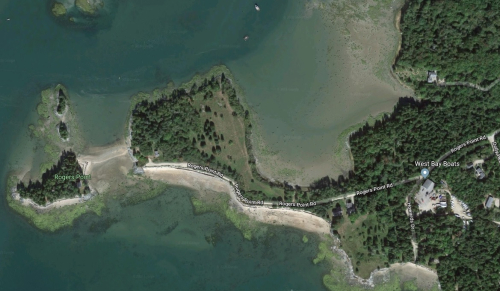
In Bayberry Cove Children’s Land Trust v. Town of Steuben, No. Was-17-258 (Feb. 27, 2018), the Maine Supreme Judicial Court considered whether the Town’s exercise of eminent domain to take an interest to a road the public had apparently been using for decades (if not centuries) was for public use.

A 2013 survey, however, concluded that a part of the road “strayed outside the the bounds of the right of way as laid out by the Town in 1825, 1887 and 1944.” Slip op. at 3. The Trust, which owned the land on which that portion of the road was located, filed a quiet title action. In response, the voters of the Town, in a Town meeting (how very New England of them), rejected the Trust’s offer to pay the Town $150,000 in return for “discontinuing the road” (we presume that means discontinuing the public use of the

Continue Reading Maine: Condemnation To Wipe Out Quiet Title Action Is A Taking For Public Use

Here’s the cert petition, recently filed in a case we’ve been following from South Dakota

The statute at issue — the federal Uniform Relocation Assistance and Real Property Acquisition Act — isn’t one that gets a lot of attention, particularly at the Supreme Court. But it’s an area that is ripe for review. The issue in the case is whether a state may deny a property owner recovery of attorneys’ fees for a successful inverse condemnation claim resulting from a federally-funded SDDOT highway project.   

Here’s the Question Presented:

Congress, in 1970, established a uniform policy for compensation of legal costs as the result of unconstitutional takings of real estate. Congress required all federal agencies to pay a successful Plaintiff ’s legal costs when a citizen’s constitutional property rights were vindicated in an inverse condemnation action.

South Dakota refuses to comply with the policy Congress established. This Petition requests

Continue Reading New Cert Petition: Are The Relocation Act’s Attorneys’ Fee Provisions Merely Guidelines?