2018

Here’s the written testimony submitted by the Hawaii State Bar Association’s Section on Appellate Law for today’s hearing on a bill making its way through the Hawaii Legislature.

The bills, HB 2191 and HB 2194, would return the state court appeals system to the way it was prior to the 2006 amendments, and would expressly give the Supreme Court jurisdiction to issue advisory opinions. The 2006 amendments made the Hawaii Supreme Court a truly discretionary court, allowing it to handle most of its docket by way of applications for certiorari from decisions of the Hawaii Intermediate Court of Appeals, which currently considers direct appeals in most cases from state trial courts.

Prior to 2006, the Supreme Court was the court of first appeal, but it had the option to send cases to the ICA for a first look. If you didn’t like the ICA’s decision, you could then seek review

Continue Reading HSBA Appellate Section Testimony: Please Don’t Muck Around With The Appeals Process

Sketch

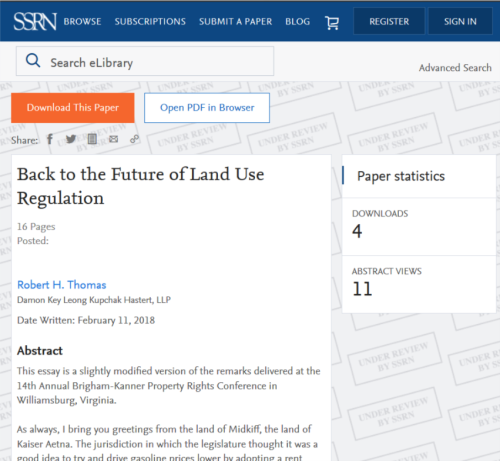
Here’s the (draft) article from our poriton of the first panel at the 2017 Brigham-Kanner Conference, “Back to the Future of Land Use Regulation.” (Also posted on SSRN here.)

This is an expanded version of our talk (listen to the audio here) during the Conference during which the William and Mary Law School awarded U. Hawaii lawprof David Callies the Brigham-Kanner Prize. Our summary of the conference is posted here.

We were part of the panel entitled “The Future of Land Regulation and a Tribute to David Callies,” along with Professors Shelly Saxer and Jim Ely, and past B-K Prize winner Michael Berger. Professor Callies also delivered his opening remarks during this session.

This article has been submitted to the Brigham-Kanner Property Conference Journal which should be published later this year. 

Back to the Future of Land Use Regulation (draft Feb 11, 2018) Continue Reading Back to the Future of Land Use Regulation – Brigham-Kanner Article

Here is the video of last Friday’s oral arguments in a case we’ve been following, in which the owners of a mobile home park successfully challenged a California municipality’s rent control ordinance as a taking.

In Colony Cover Properties v. City of Carson, a U.S. District Court for the Central District of California jury awarded the park owner just compensation, concluding that under Penn Central, the rent control ordinance was a compensable taking. The total award to the park owner, including damages for lost rental income, attorneys’ fees, and interest, was over $9 million. As far as we can tell, this is the first case in which a mobile home park owner has succeeded in obtaining compensation for a taking for rent control.

Predictably, the city went ballistic, and its brief in the Ninth Circuit argues the City is the aggrieved party:

In April 2006, Plaintiff Colony Cove

Continue Reading Video: Ninth Circuit Penn Central Oral Arguments

Like AmadeusEmperor Joseph, today’s 4-1 ruling from the Hawaii Supreme Court in Nelson v. Hawaiian Homes Comm’n, No. SCAP-16-0000496 (Feb. 9, 2018), pretty much tells the lower courts (and, by extension, the state legislature) that the court thinks the HHC is underfunded and that the Legislature can do a much better job, but the courts aren’t going to actually determine how many dollars will count as “sufficient sums” in the agency’s budget, other than the bare minimum amounts which the constitution’s drafters considered in 1978. But just add a few, “and it’ll be perfect.”

This is Chapter 2 of the story, the first being the 2012 opinion in which the court concluded the issue of whether the HHC is sufficiently funded by the Legislature isn’t a “political question” and is subject to judicial scrutiny. See Nelson v. Haw’n Homes Comm’n, 277 P.3d 279 (Haw. 2012). 

Continue Reading HAWSCT On Sufficiency Of Hawaiian Homes Commission’s Legislative Funding: Quality Work, But There’s Too Many Notes

Urban_lawyer3.jpg.imagep.980x179

For you land-users out there, be sure to check your inboxes for the link to the latest issue of The Urban Lawyer, the law review published by my section of the ABA, the Section of State and Local Government Law. With articles on privacy and public real estate records, neighborhood opposition to zoning changes, greenhouse gas regulation, planned communities, land use and cannabis, RLUIPA, and more.

If you are not a member of our Section, you really should be because in addition to a subscription to UL, you get to hang with a crew of lawyers, judges, and legal scholars who are smart, fun, and generous with their time. See this post for more on the reasons you should join us.

Want to see what we’re all about? Plan on joining us for our next in-person conference, the 32d Annual Land Use Institute and Spring State and Local

Continue Reading Latest Issue Of The Urban Lawyer

Page

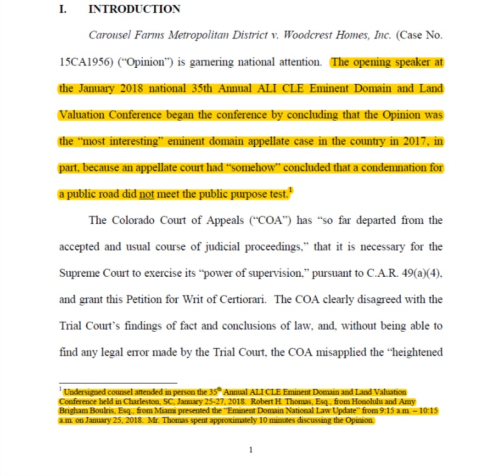
Check this out: the first page of the recently-filed Reply Brief in the cert-stage briefing in a case we’ve been following out of the Colorado courts, and which we highlighted at the ALI-CLE Eminent Domain and Land Valuation Litigation Conference which we wrapped just last week in Charleston, South Carolina.

Talked about last week, on the pages of cert briefs this week!

The condemning agency is asking the Colorado Supreme Court to review the Court of Appeals’ conclusion that property eventually being put to a public use was not sufficient, and the condemnor needed to show a public purpose for the taking. The Reply brief correctly notes we featured the case in our opening session and labeled it “interesting” — perhaps the most important public use case from a state appellate court in 2017 — precisely because we thought the Colorado Court of Appeals got it exactly right

Continue Reading See What You Miss When You Don’t Come To The ALI-CLE Eminent Domain Conference?

In Sierra Palms Homeowners Ass’n v. Metro Gold Line Foothill Extension Const. Auth., No. B275241 (Jan. 29, 2018), a condomimium homeowners’ association sued a municipal transit authority and its private-entity partner, claiming that they built and maintained the Gold Line railway in such a way that it interfered with the association’s quiet enjoyment of their condo. They alleged inverse condemnation. The trial court sustained the demurrer without leave to amend (dismissed the complaint, for you non-Californians) for lack of standing because the homeowners’ association didn’t actually own the condo. 

The Court of Appeal reversed, in part, concluding the association might be able to amend the complaint to show standing. Although the usual rule in inverse cases is that the plaintiff must have an actual ownership interest in the property alleged to be taken, “multidwelling condominium projects present a special concern. Frequently, the common areas of the complex are owned

Continue Reading Cal App: Condo Association Has Standing To Assert Inverse Condemnation Claim

2012-02-06_11-19-58_634

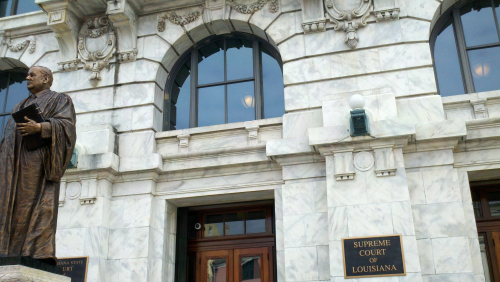
Here’s an important case we’ve been following out of Louisiana. 

The case is an appeal to the Louisiana Supreme Court in an expropriation case from a quick-take of a Mississippi River docking facility downriver from New Orleans. The Port took the entire VDP facility, made no change in how the property was used, and eventually turned over operation of the facility to a “hand-picked” private operator.

In St. Bernard Port, Harbor & Terminal District v. Violet Dock Port, Inc., No. 2017-C-0434 (Jan. 30, 2017), the Louisiana Supreme Court upheld the taking  of VDP’s property by the Port so that the Port could run it itself. The owner challenged the power to take, as well as the compensation awarded. The Supreme Court held that the Port has the power to take the docking facility so that the Port could operate the facility: 

Consistent with the authority given to

Continue Reading Louisiana Supreme Court: Port Can Take Docking Facility To Run It Itself, But Fell Short Of Fully And Fairly Compensating Owner

20180127_091506_HDR

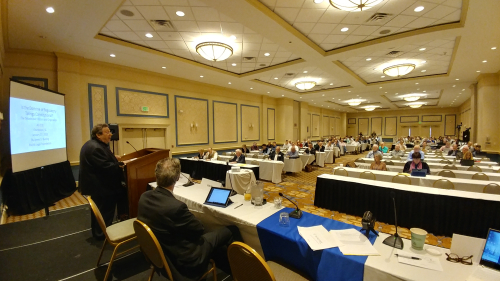
We’re on our third day at the 2018 ALI-CLE Eminent Domain and Land Valuation Conference in Charleston, SC, and as usual, we’re having our headline presentations by takings guru Michael Berger (pictured above), who is updating us on the most interesting and important cases of the past year, and Jim Burling, who will be answering the question, “Should We Rethink Regulatory Takings Law? The Takings Clause, Privileges and Immunities, and Due Process.”

DUjbnOtV4AEgwXW.jpg large

Here are links to the

Continue Reading ALI-CLE Eminent Domain Conference, Third Day: Berger And Burling On Takings

20180126_111558_HDR

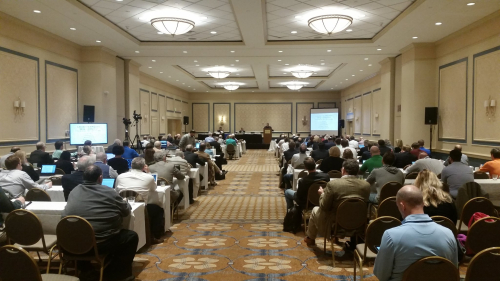
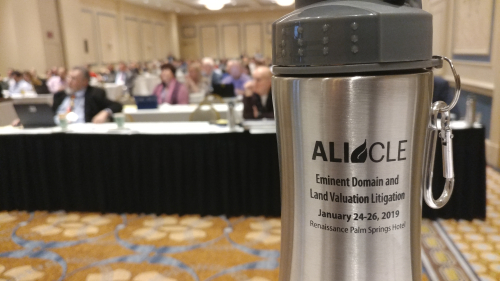
This morning, at the 2018 ALI-CLE Eminent Domain and Land Valuation Litigation Conference in Charleston, South Carolina, we announced the dates and venue for the 2019 Conference: Palm Springs, California.

The conference hotel is the Renaissance Palm Springs Hotel, which has the advantage of being a resort facility, but right in town (so you will have many options for “off campus” activities like art museums, the aerial tram, golf, and whatever suits your fancy). Plus, it’s a short hop from the Palm Springs airport.

This in-person registrations for 2018’s Charleston program sold out, as did our conference hotel, so for 2019 we chose a location and hotel which can accommodate the growth of the conference. But one of the lessons learned from this year’s conference is that you should hold the dates on your calendar now, and when ALI-CLE releases the registration page, you should not wait to

Continue Reading 2019 ALI-CLE Eminent Domain & Land Valuation Litigation Conference Venue Announcement: Palm Springs, CA, Jan 24-26, 2019