


Here. Continue Reading Latest Briefs In Cal Wildfires Inverse Condemnation Cert Petition
Cases And Links From Today’s Eminent Domain And Pipelines Conference (Houston)
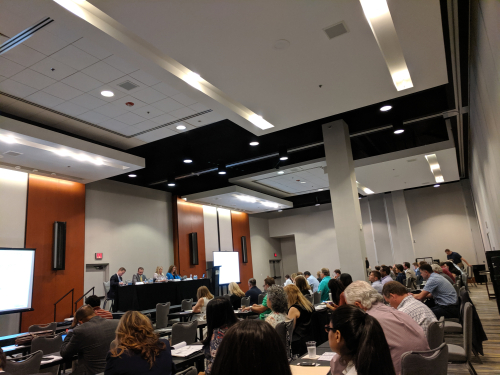
I am grateful that planning chairs Justin Hodge and Jeremy Baker invited me to their conference. A room full of experts. Here are the links to the cases and other items I spoke about:
- Knick v. Township of Scott: initial thoughts on what might be a dawning “golden age” of property cases
- Knick, Entirely in Memes
- Givens v. Mountain Valley Pipeline, LLC (SCOTUS considering whether private pipeline condemnor can use a Rule 65 preliminary injunction to get quick-take by another name)
- Cert Denied In Immediate-Possession-By-Injunction Case (But There’s One More In The Pipeline)
- Bump Stocks and Takings
- Is Seizing Prescription Drugs for Use as Evidence a Taking?
- Barboan: Eminent Domain and the Taking of Indian Property
- Colorado (Carousel Farms): A Lot Of Private Benefit Today Does Not Overcome Smattering Of Possible Public Future Benefit
- Protip for Megaproject – How to Not Name Your Project
- All Your Race
Continue Reading Cases And Links From Today’s Eminent Domain And Pipelines Conference (Houston)
Where’s Palazzolo? Washington Appeals Court: Subsequent Purchaser Has No Taking Claim
Posted without significant comment, the Court of Appeals of Washington’s recent unpublished opinion in Darland v. Snoqualmie Pass Utility District, No. 36002-4-III (July 16, 2019):
Snoqualmie Pass Utility District argues that the subsequent purchaser rule bars the Darlands’ inverse condemnation claim. We agree.
In Hoover v. Pierce County, 79 Wn. App. 427, 433, 903 P.2d 464 (1995), this court reinforced the general rule that a grantee or purchaser of land cannot sue for a taking or injury occurring prior to his acquisition of title, but rather, the subsequent purchaser may sue only for a new injury or taking. A prior owner’s right to damages for injury to property does not pass to a subsequent purchaser unless expressly conveyed. Crystal Lotus Enterprises Ltd. v. City of Shoreline, 167 Wn. App. 501, 505 n.8, 274 P.3d 1054 (2012). An exception to the doctrine exists when additional governmental action causes
New (Federal Court!) Complaint: NY’s New Rent Laws Are Takings
Looking for something to do this Tuesday? How about reading a 120-page federal court complaint challenging New York’s recently-adopted rent control/stabilization statute as a taking?
Thank you, Knick.
Continue Reading New (Federal Court!) Complaint: NY’s New Rent Laws Are Takings
Friday Round-Up: California Inverse Condemnation, Lawprof Epstein Litigates Public Trust, Property In Ecology, And More
Here’s what we’re reading this Friday:
- Plaintiffs Cannot Bring Inverse Condemnation Claims Before a Public Agency Makes a Final Determination on Allowable Development – California Land Use & Development Law Report
- One reason for the high cost of housing in California may surprise you — overregulation – Los Angeles Times (Barista’s note: is anyone surprised at all by this?)
- Law Prof Richard Epstein to Lead Challenge of Obama Center in Jackson Park – Chicago Maroon
- Property in Ecology – PERC
- Black People’s Land Was Stolen – New York Times Opinion
- Injunctions Give Teeth to Property Rights – Human Events
- In a Turnabout, SCOTUS Now Says Federal Takings Claims are Ripe When the Government Fails to Compensate Property Owners – Sarah Beachy (Axley)
- Update on the Preakness Takings Case – Ilya Somin (Volokh Conspiracy)
- It would be cheaper to buy coastal homes than to keep fighting nature, new report says –
Knick Already Taking Effect, Even Where It Isn’t Necessary
No sooner was the ink dry on the Supreme Court’s opinion in Knick v. Township of Scott, than the Court’s decision started to have some effect.
First, the Court granted another pending cert case on takings ripeness and sent back down to the Ninth Circuit for more in light of Knick.
And now this order from the Seventh Circuit in a case that had been argued (listen above, or download here), but held pending Knick. Jensen v. Village of Mount Pleasant, No. 18-2187 (7th Cir. July 3, 2019).
This was a case where the federal district court had dismissed the owners’ Fifth Amendment claims as unripe under Williamson County. After argument in the Seventh Circuit, the Supreme Court granted cert in Knick, and the Seventh Circuit delayed deciding the case until the Supreme Court decided Knick.
Shortly after the Supreme Court opinion, the Seventh Circuit
Continue Reading Knick Already Taking Effect, Even Where It Isn’t Necessary
Video: What Federal Takings are like post-Knick
Yes, we did memes in our Knick brief, and in a follow-up blog post.
But colleague Benjamin Tozer has taken it to the next level.
We’re not worthy! Continue Reading Video: What Federal Takings are like post-Knick
Cal App: Business Goodwill “is compensable separate and apart from the parties’ interests in the property taken.”
We were all set to offer our deep analysis of the California Court of Appeal’s recent (published) opinion in Three Aguila, Inc. v. Century Law Group, LLP, No. B289452 (July 2, 2019), when our colleagues at the California Eminent Domain Report blog beat us to it.
In “Court Decision Serves as Important Reminder on Crafting Lease Condemnation Provisions,” Brad Kuhn writes about a case in which the condemnation clause in a lease provided that the landlord would be entitled to “[a]ll awards for the taking” (subject to the usual/common limitations).
In California eminent domain cases, businesses may recover goodwill by statute. When the premises were condemned, the landlord invoked the condemnation clause and asserted that it, not the tenant, was entitled to recover the goodwill. Brad writes:
On appeal, the Court held that the property owner was not entitled to compensation for the business’ goodwill. While parties
Dirt Lawyer CLE At ABA Annual Meeting (San Francisco)
If you are going to be attending the ABA Annual Meeting in San Francisco next month, here are some of the CLE and other programs of interest to property, land use, and eminent domain types, sponsored by our Section, the State and Local Govt Law Section:
Thursday, Aug. 8
- Knick Overrules Williamson County: What Does it Mean for Eminent Domain (in person, or webinar)
In June 2019, the Supreme Court overruled its Williamson County precedent, which required that property owners, as a practical matter, must bring their Fifth Amendment takings claims against state or local governments in state courts. The Court’s new decision, in Knick v. Township of Scott, allows them to bring their inverse condemnation claims directly in federal court. Their insights into this important decision and its ramifications will be discussed by panelists who pled both sides of this case. Moderator: Steven J. Eagle, Professor Emeritus,
Continue Reading Dirt Lawyer CLE At ABA Annual Meeting (San Francisco)
10th Cir: Federal Takings Claim Against State Prison Officials For Withholding Interest Barred By 11th Amendment
The flag of the State of Hatu
Williams, a prisoner, thought that Utah prison officials should have paid him interest on his prison account. Acting as his own attorney, he sued under § 1983 for a taking and for a deprivation of due process in federal court, raising claims against the Utah Department of Corrections, several state prison officials in their official capacities, and the bank in which his prison account was housed (and several bank employees). The federal district court dismissed, but not on the Eleventh Amendment grounds you might think.
Williams appealed to the Tenth Circuit, which, in Williams v. Utah Dep’t of Corrections, No. 18-4058 (July 8, 2019), affirmed the dismissal, expressly analyzing the claims under the Eleventh Amendment.
That provision, as you are aware, establishes a state’s immunity from lawsuits in federal court. Over the years, courts have created exceptions to the general rule that