2019

On the day we celebrate Constitution Day (or should we say Khaaaaan-stitution Day?) we have to admit that pretty much nothing beats One Named Kirk’s reading of the Preamble

He might be from Iowa, but that guy who plays him is from north of the border, so our kudos to a Canadian for the best dramatic rendition of our founding document.

“This was not written for chiefs!” 

Beam me down, Scotty!

Continue Reading “This Was Not Written For Chiefs!” Happy Constitution Day

Dragonmap

Here’s the amici brief we are filing today in support of the Petitioner in a case we’ve been following, Smyth v. Conservation Comm’n of Falmouth, No. 19-223 (cert. petition filed Aug. 20, 2019). 

The Massachusetts Court of Appeals held that a judge, not a jury, determines Penn Central takings questions, and that the owner lost anyhow because, you know, Penn Central.  Here are the Questions Presented:

  1. Whether the loss of all developmental use of property and a 91.5% decline in its value is a sufficient “economic impact” to support a regulatory takings claim under Penn Central.
  2. Whether a person who acquires land in a developed area, prior to regulation, has a legitimate “expectation” of building and, if so, whether that interest can be defeated by a lack of investment in construction?
  3. Whether the Court should excise the “character” factor from Penn Central regulatory taking analysis.

Rather

Continue Reading Here Be Dragons: New Amicus Brief Asks For A “Fresh Look” At The Penn Central Test

Klingonsnippet

Takings mavens know lawprof Ilya Somin. Among other things, he’s authored some of the more interesting and useful scholarship in our field.

Here’s his latest, published in the 2019 Cato Supreme Court Review, about the Supreme Court’s latest takings case, Knick v. Township of Scott

We naturally recommend you read the entirety of his article, Knick v. Township of Scott: Ending a Catch-22 that Barred Takings Cases from Federal Court, which he has posted on SSRN here

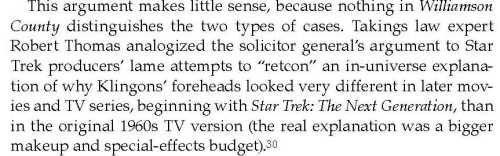
And for those of you wondering about the snippet above, Prof. Somin was brave enough (or geeky enough) to include a reference to our commentary on the SG’s amicus arguments in Knick, comparing it to the weak-sauce Klingon forehead “retcon” in Star Trek. How could we resist highlighting the inclusion of an impossibly nerdy Trek reference in a published scholarly work? 

Thank you, and bravo, Sir. 

Continue Reading New Article: “Knick v. Township of Scott: Ending a Catch-22 that Barred Takings Cases from Federal Court”

Arrest-em

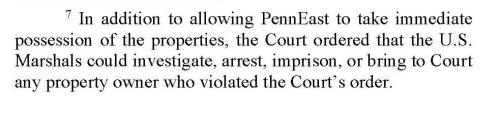
Today’s post is kind of long, but we think the opinion is well worth your time. 

NGA Preliminary Injunctions

Regular readers know that we’ve made no secret of our disapproval of the prevailing practice in federal courts of using preliminary injunctions to allow private for-profit pipelines to grab immediate pre-condemnation possession of property using the Natural Gas Act’s delegated federal power of eminent domain, even though everyone agrees the NGA delegates only the straight (slow) taking power. 

Save the Seventh Circuit, every other federal appeals court that has considered this practice has figuratively shrugged its shoulders, rejecting arguments made by the property owners that this exceeds the powers which Congress delegated in the NGA, and violates separation of powers and basic eminent domain principles. The courts of appeals simply pay no mind. And two cert petitions have been denied, and one more is teed up

But yesterday, the

Continue Reading What A Difference The Defendant Makes: The Federal Courts Finally Locate A Natural Gas Act Preliminary Injunction They Don’t Like

Barista’s note: today’s post is mostly by Benming Zhang, one of my William and Mary law students. He likes property, land use, takings, state and local government law, and related subjects. And he walks the walk: his day job is serving as an elected member of the Williamsburg, Virginia, city council. (It is his night job, actually, since he’s a full-time student, and the council meets mostly in the evenings)  This post is built on his summary of the case, and includes my edits and comments.

Welcome to our conversation. 

——————————-

RT: In Starkville Lodging, LLC v. Mississippi Trans. Comm’n, No. 2018-CA-01405-COA (Aug. 27, 2019), the Mississippi Court of Appeals did what most courts do with public use and necessity challenges — it rejected them. Not too surprising, I suppose, given the highly deferential standard of review (“well nigh conclusive,” as the Supreme Court noted in

Continue Reading Miss App: Taking Of Road To Access A Single Parcel Is For Public Use

A great result for colleague Carolyn Elefant, who represents property owners in a case and issue we’ve been following

This is one of those Natural Gas Act pipeline cases. Not on the issue of immediate-possession-by-injunction (we’ll have the latest development in that chapter very soon), but on the administrative law side, involving FERC’s approval of a certificate of public convenience. That, as you know, is the trigger to a private pipeline exercising the NGA’s delegated power of eminent domain, because it effectively settles the question of whether the takings are for a public use or purpose. Also, as you know, an agency’s decision is, generally speaking, subject to a highly deferential judicial standard of review under the APA: a certificate may only be set aside “if it is arbitrary and capricious or otherwise contrary to law.” Slip op. at 9.  

Thus, the property owners had a daunting

Continue Reading Whose House? Our House. D.C. Circuit: Pipeline Taking For Partial Export May Not Be A Public Use (For US Public)

6a00d83451707369e2022ad3b86fce200d-800wi

You overwhelmingly asked for Nashville, and we’re bringing it to you!

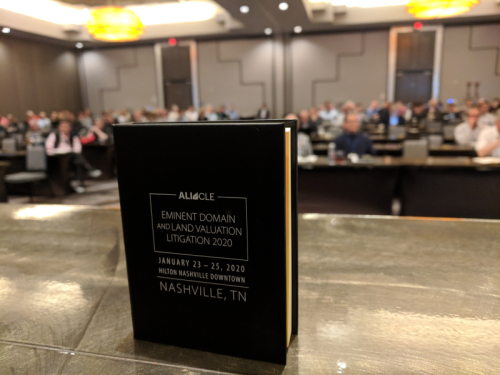
Get ready, and hold your place now: here’s the list of programs and speakers for the 36th Annual ALI-CLE Eminent Domain and Land Valuation Litigation Conference, to be held at the Downtown Nashville Hilton, January 23,- 25, 2020. Two-and-a-half days with top-notch national faculty (lawyers from both sides, judges, legal scholars, appraisers, relocation experts, and others).  

Early registration and group rates are available now

Here are just some of the programs:

  • Featured Presentation: Property Rights as Civil Rights: Seeking Justice Though the Fourth and Fifth Amendments. Hon. Jonathan Apgar, Jamila Johnson, Alan Ackerman. Moderator: Leslie Fields.
  • Making Sense of the New Rules After Knick v. Township of Scott: Where Do I Go, What Do I Do? David Breemer, Smitha Chintamaneni, Professor Bethany Berger. Moderator: Professor Steven Eagle.
  • When A River Runs Thought It: Water Rights and


Continue Reading Here’s The Agenda And Faculty For The 2020 ALI-CLE Eminent Domain And Land Valuation Litigation Conference, Nashville, Jan 23-25, 2020

Untitled Extract Pages

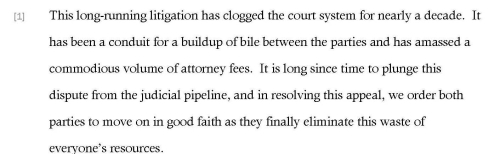
We’re posting the Indiana Court of Appeals’ recent opinion in Hoagland Family Ltd. P’ship v. Town of Clear Lake, No. 18A-PL-2088 (Aug. 28, 2019) not because it says much about eminent domain law, but more because (1) we commented on the case last time it was before the court, and (2) it’s kind of funny. 

From what we can read between the lines, the case probably involved one of those dudes who makes local municipal officials roll their eyes when he shows up. The genesis of the long-running litigation is that the Town wants Mr. Hoagland to connect his house to the municipal sewer system, and stop using his own septic system.

We’ll let you read the relatively short opinion for the details, but why we’re posting it is the court’s use of more than a few evocative words which tell you what the judges really thought of

Continue Reading Indiana Ct of Appeals: Come On Parties, Please Resolve This Steaming Pile Of A Case

Mw267903

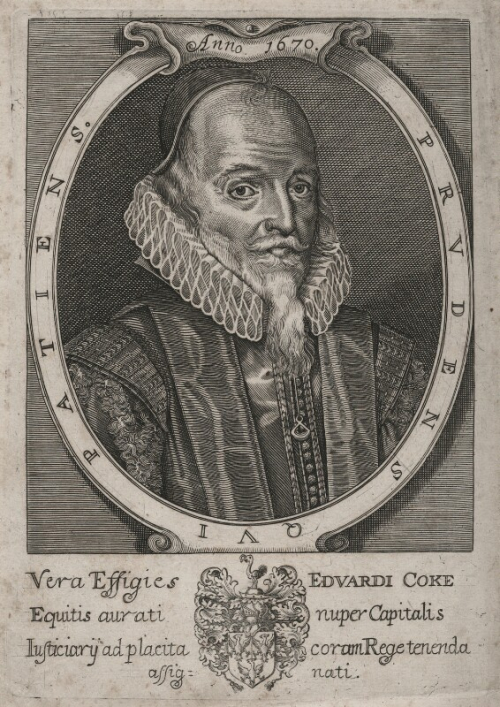
Coke – he’s the real thing.*

One of the great things about teaching at the William and Mary Law School (and there are many) is that it houses the original law book collection of George Wythe, “the first American law professor.” He is the O.G. Lawprof, both at W&M, and in the United States (they even half-named the school for him). And he had some good books. More on that in a second. 

So in class yesterday, we were discussing things like the Virginia Declaration of Rights, state constitutional protection of property, and cases like Boom Co. v. Patterson, 98 U.S. 403 (1897).  By the time Patterson gets decided, most states and the U.S. Constitution had “takings” clauses, express text which limits the sovereign’s power to take property. But it wasn’t always that way. The Virginia Declaration, which formed the basis for the Declaration of Independence, doesn’t

Continue Reading Lord Coke, The Saltpeter Case, And The Origins Of The Just Compensation Requirement

Here are the final briefs in the cert process in a case we’ve been following.

In In Guerin v. Fowler, 899 F.3d 1112 (9th Cir. 2018), a three-judge panel of the Ninth Circuit held that Washington state officials’ failure to return daily interest that was allegedly skimmed from the plaintiffs’ state-managed retirement accounts could be a taking. (En banc review denied, by the way.)

The panel rejected the State’s argument that because the Washington Court of Appeals held that Washington’s retirement statute didn’t require the payment of daily interest at all, the plaintiffs didn’t have “property” the state officials took when they kept the interest. If it isn’t “property” under state law, the State asserted, it isn’t “property” for purposes of the Takings Clause.

Not quite, the court concluded. Daily interest on principal is one of those “core” and “traditional” property rights that a state simply cannot disavow. In

Continue Reading SCOTUS Cert Briefing In “Who Gets To Define ‘Property?’ Case” (And the 11th Amendment, Too)