May 2020

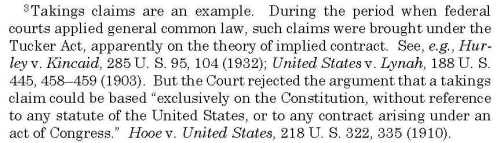
Professor Josh Blackman’s posts over at the Volokh Conspiracy on the bump-stock takings case (and follow ups taking a deeper dive into the takings question, see this post, this post, and this post), got us to thinking. So we wrote up our thoughts, in which we noted that we thought the “self-executing” nature of the Just Compensation Clause means that even in the absence of a Tucker Act waiver of sovereign immunity, the federal government could be sued in an Article III court for compensation (“Lawprof Josh Blackman Asks: “Is there an express cause of action under the Takings Clause?“). This is the position we took in the Brott litigation, where we thought that the Tucker Act is unconstitutional to the extent that it denies a jury trial for compensation claims. But as you know, Brott ended up with “cert denied.”

But that also got
Continue Reading Taking A New Look At Takings Remedies: What If Just Compensation Really Isn’t The Remedy For An Inverse Condemnation?

In addition to the Hawaii Supreme Court hearing oral arguments in an admin, water law, environmental law case today, if you tune in earlier, you can eavesdrop on the California Supreme Court’s oral arguments in an inverse condemnation case, Weiss v. People ex rel. Dep’t of Transportation, a case we are following

The case is somewhat California-centric, and asks whether portions of the California Civil Code applicable to eminent domain actions — under which the parties can ask the court to resolve certain compensation issues pretrial — also applies to inverse condemnation actions.

But still worth checking out, even if you aren’t a Californian. Go here for the livestream.Continue Reading California Supreme Court To Livestream Orals In Inverse Case (Tuesday, May 5, 2020, 9am PT)

Fire up your web browsers, turn up your speakers, and tune in tomorrow, Tuesday, May 5, 2020, at 10am Hawaii Time (1pm Pacific, 2pm Mountain, 3pm Central, and 4pm Eastern) for a first: the Hawaii Supreme Court will be livestreaming oral arguments in an important case about administrative law, water rights, environmental law, and native Hawaiian rights.

(For all you “mainland” folks, you may want to tune in even if those topics don’t interest you, just to hear the way our court crier opens the proceedings. Yes, the traditional “Oyez” call is made, but if these arguments are like in-person OA at the court, there’s a very Hawaiian touch also.)

Here’s the summary of the issues, from the Judiciary web site:

HEALOHA CARMICHAEL, LEZLEY JACINTHO, and N MOKU AUPUNI O KO OLAU HUI, Petitioners/Plaintiffs-Appellees/Cross-Appellees/Cross-Appellants, vs. BOARD OF LAND AND NATURAL RESOURCES, SUZANNE CASE, in her official capacity as

Continue Reading Hawaii Supreme Court Livestream Oral Argument In Water Rights, Admin Law Case (Tuesday, May 5, 2020, 10am HT, 1pm PT, 4pm ET)

IMG_20191209_125404 (1)

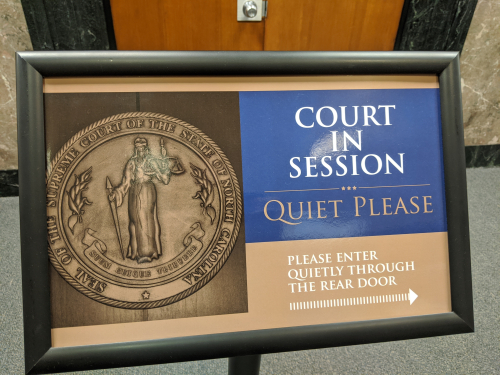
Back in December — only a few months ago, yet it seems like another world away — we attended oral arguments in Raleigh in a case we’ve been following for a long time, about North Carolina’s “Map Act.”

This case is the follow up (after remand) of the N.C. Supreme Court’s landmark decision in Kirby v. North Carolina Dep’t of Transportation, No 56PA14-2 (June 10, 2016), in which the court held that the “Map Act,” a statute by which DOT designated vast swaths of property for future highway acquisition, was a taking because the Act prohibited development and use of designated properties in the interim. The court concluded “[t]hese restraints, coupled with their indefinite nature, constitute a taking of plaintiffs’ elemental property rights by eminent domain.” The court remanded the case for a parcel-by-parcel determination of just compensation. Shortly after the decision in Kirby, the North Carolina Legislature

Continue Reading NC: There Isn’t Just One Way To Value An “Indefinite Negative Easement”

Two more complaints challenging covid shutdown orders as takings (inter alia). Add to the growing list. See here, here, here and here, for other similar complaints.

The first is from California. It asserts that ordering “nonessential” businesses to shut down is a taking. The complaint alleges that unless the shut down is for “(1) destroying a building in front of a fire so as to create a fire break, (2) destroying a diseased animal, (3) rotten fruit or (4) infected trees,” it is a taking. 

The second is from New Jersey. So rather than get into the details, we’re going to send you over to our NJ colleague Tony Della Pelle, who has some thoughts here (“NJ Shutdown Challenge – I Can’t Rent My Beach House!“). 

Will there be more of these? As we have said before, for sure. Fasten your

Continue Reading Two More Takings Complaints Challenging Shut-Down Orders

AIito-takings excerpt

(Spoiler alert: we think the answer is “yes” — see below)

Delving into the latest Supreme Court opinion related to the Affordable Care Act, lawprof Josh Blackman (who recently wrote about bump stock takings), now asks a broader question: Is there an express cause of action under the Takings Clause? More pointedly he writes about a question that takings mavens often think about (but on which there are few guideposts):

[I]s it possible to sue the federal government for an unconstitutional taking, without relying on the Tucker Act? That is, does the Takings Clause itself create an express cause of action.

What would have happened if the Congress never enacted the Tucker Act in 1887? Could the federal government take property without paying “just compensation”?

He points out that the majority opinion in the recent ACA case said no (see here, note 12 on page 25)

Continue Reading Lawprof Josh Blackman Asks: “Is there an express cause of action under the Takings Clause?”