August 2020

We know you are really busy, takings mavens, you don’t have to read all 47 pages of the California Court of Appeal’s opinion in Martis Camp Community Ass’n v. County of Placer, No. C087759 (Aug. 17, 2020). Instead, you can jump to page 44 for the good stuff.

Short story: the court held that the plaintiff — a community association for a residential subdivision — did not state a valid claim for inverse condemnation for a taking of access rights because it did not own property actually abutting a public road. The court acknowledged that abutting landowners have a property right to access the streets, a “property right in the nature of a private easement in the street upon which the property abuts.” Slip op. at 44.

But the Association did not actually own any of the parcels abutting the street in question. Instead, the Association alleged that it

Continue Reading Cal App: In Order To Have Standing To Raise An Inverse Claim For Loss Of Street Access, The Plaintiff Must Actually Own Property Abutting The Street

IMG_20200817_104808

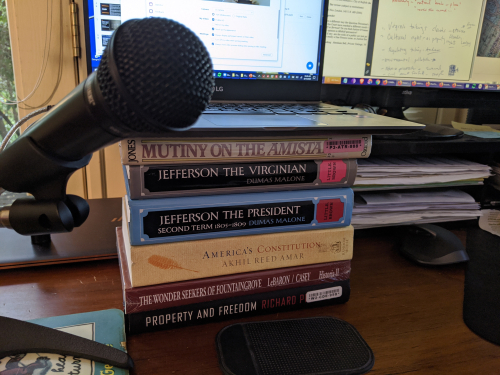
We’re done with our first day of class for the upper-level students at William and Mary. We’re teaching two courses this semester, the usual Eminent Domain and Property Rights, but also Land Use Law. We were set to begin a semester of “hybrid” instruction (some students in the classroom, with distancing in place, while others attend remotely). But late last week, due to some administrative difficulties unrelated to the law school, we had to postpone the in-person part until next week.

So we did our first two classes today via Zoom. It went as well as you might expect. We’ve had to make some adjustments to the usual law classroom, but so far, everyone is taking it in stride and adapting well. We expect to do the same and adjust and readjust as the semester progresses.

What you’re looking at above is our set-up, a remote “podium” on which we

Continue Reading What Books Do You Use For Your Remote Podium?

A short one from the U.S. Court of Appeals for the Eleventh Circuit. In Sabal Trail Transmission, LLC v. 18.27 Acres, No. 19-10705 (Aug. 3, 2020) (unpub.), the court concluded that the trial court did not abuse its discretion when it allowed the property owner to testify about the value of his property. 

This is a ruling that should not be a surprise, given the same court’s earlier published opinion holding the same thing in a case by the same pipeline condemnor against different property owners. Here, the court noted the “low bar” an owner must satisfy to testify (having “some basis” for the testimony).

One owner had some training as an appraiser. The other had experience buying and selling property in the relevant market:

Lee and Ryan Thomas satisfied the low bar of providing some basis for their valuation testimony. Lee trained as a land appraiser early in

Continue Reading CA11: In Eminent Domain, There’s A “Low Bar” For An Owner To Testify About The Value Of His Own Property

RCB

This week brought the sad news that our friend, mentor, and property-rights spiritual godfather, R. Charles Bocken, has moved on to that great plot of land in the sky.

A man of seemingly infinite talents and biography (WWII B-24 crewman, Chief Judge Advocate for the Pacific Air Forces, SCOTUS litigator (and winner, more on that below), and steady even-handed problem-solver), Charlie Bocken never raised his voice or had a bad word about anyone. From his Nebraska roots, to heady times in D.C., then finally to our shores and a named partner of the firm, he’d seen a lot, done a lot. You’d never know it from meeting him because Charlie Bocken (he would insist he was “just Charlie”) remained a humble person of good humor, even though he was a dynamite lawyer with keen practical insight.

No better example of that than his challenging established law and eventually winning

Continue Reading Aloha, Charlie B (Kaiser Aetna v. United States, 444 U.S. 164 (1979)

PENDULUMPODCAST

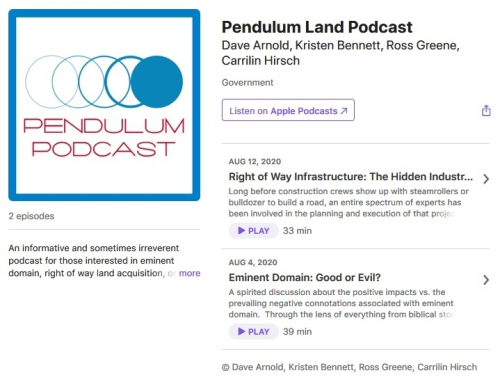
Check this out, a new podcast for your dirt lawyer types to follow, Pendulum Podcast. As it describes itself:

An informative and sometimes irreverent podcast for those interested in eminent domain, right of way land acquisition, or infrastructure development. Topics for discussion frequently include condemnation of real property for public use, just compensation, the Uniform Relocation Act, as well as your hosts’ hot takes on popular culture.

Uniform Relocation Act? Right of way and eminent domain? Be still our hearts.

Two eps are posted so far, “Eminent Domain: Good or Evil?” (embedded above), and “Right of Way Infrastructure: The Hidden Industry. From the Uniform Relocation Act to Eminent Domain.” We’ve listened to the first one, and will soon do so with the second.

Count us as subscribers. Highly recommended you become one as well. Continue Reading New Property/Eminent Domainey Podcast: Pendulum Land Podcast

Here’s the latest in a case we posted about last year. There, the North Dakota Supreme Court noted an open issue, but declined to resolve it. Now, in Fargo v. Wieland, No. 20200100 (July 22, 2020), the court addressed it head-on. 

Here’s how the noted the issue:

whether a landowner who appeals an award in eminent domain proceedings, without accepting or withdrawing deposited funds, is entitled to the payment of post-judgment interest subsequent to the deposit of the full amount of the judgment

Slip op. at 2.

After a just comp judgment, the city deposited the funds to cover the verdict, plus money for the court’s award of attorneys’ fees. The property owner appealed. Even though she could have, she didn’t withdraw the money because doing so would have waived her right to appeal on all issues except a claim for more compensation. Her appeal asserted the taking

Continue Reading Time Isn’t Money: Landowner Not Entitled To Interest On Deposited Funds Satisfying Just Comp Verdict, Even If That Forces Property Owners Into A Bad Choice

Here’s the latest in a case we posted about last year. There, the North Dakota Supreme Court noted an open issue, but declined to resolve it. Now, in Fargo v. Wieland, No. 20200100 (July 22, 2020), the court addressed it head-on. 

Here’s how the noted the issue:

whether a landowner who appeals an award in eminent domain proceedings, without accepting or withdrawing deposited funds, is entitled to the payment of post-judgment interest subsequent to the deposit of the full amount of the judgment

Slip op. at 2.

After a just comp judgment, the city deposited the funds plus money covering the court’s award of attorneys’ fees. The property owner appealed. Even though she could have, she didn’t withdraw the money because doing so would have waived her right to appeal on all issues except a claim for more compensation. Her appeal asserted the taking was invalid, so pulling

Continue Reading Interesting Just Comp Ruling: Landowner Not Entitled To Interest On Deposited Funds Even If That Forces Property Owners Into A Bad Choice

Today’s case, Hardy v. Sidoti, [2020] NSWSC 1057 (Aug. 12, 2020) is — like yesterday’s — from a foreign jurisdiction, but this one (unlike yesterday’s) is not an eminent domain case. It’s just plain old property law. Adverse possession to be precise.

But because the court’s official summary puts it this way, we could not resist posting it here. It’s just so… Australian:

These proceedings concern two very Australian phenomena: the “dunny” and dedication to home improvement. At issue is the ownership of a 3.35 square metre remnant of a “dunny lane” in Redfern, a suburb of historic significance for First Australians and in the development of Sydney as a city.

Slip op. at 1. All that’s missing is a Hills Hoist clothesline out back.

First, some terminology. A “dunny” is what we in the U.S. would call an outhouse. A “dunny lane” is a path where

Continue Reading Australian (Torrens) Title, “Dunny Lanes,” And Adverse Possession

We can’t pretend that we understand everything that is going on in the Supreme Court of India’s recent opinion in Hari Krishna Mandir Trust v. State of Maharashtra, No. 2013-6156 (Aug. 7, 2020) (but when has that ever stopped us before?), but after reviewing the decision, we thought we would post it because of the court’s holding:

96. The right to property may not be a fundamental right any longer, but it is still a constitutional right under Article 300A and a human right as observed by this Court in Vimlaben Ajitbhai Patel v. Vatslaben Ashokbhai Patel and Others. In view of the mandate of Article 300A of the Constitution of India, no person is to be deprived of his property save by the authority of law. The appellant trust cannot be deprived of its property save in accordance with law.

97. Article 300A of the Constitution of

Continue Reading Supreme Court Of India Channels Magna Carta: Although Compensation Is Not Expressly Required By Constitution, When Govt Takes Property, It Has Obligation To Pay

Title

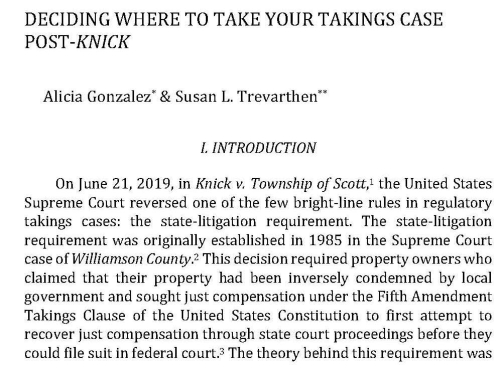
Check this out, a newly-published article on takings by two eminent Florida takings practitioners, Alicia Gonzalez & Susan L. Trevarthen, Deciding Where to Take Your Takings Case Post-Knick, 49 Stetson L. Rev. 539 (2020).

If the title isn’t enough to grab your interest, here’s the description in the Introduction,

Post-Knick,both plaintiffs and defendants have an option available to them that was previously unavailable. This Article will discuss the options that litigants on either side now have in federal takings cases and evaluate which options are desirable depending on the objectives of a particular litigant. Part II will discuss the history of the state-litigation requirement and the theoretical underpinnings of the Williamson County decision in which the state-litigation requirement was imposed. Part III will discuss Knick and the Supreme Court’s reasoning for reversing its own precedent in Williamson County. Part IV will discuss the new options

Continue Reading New Law Review Article: “Deciding Where to Take Your Takings Case Post-Knick