2020

Here’s the latest order in one of the various challenges to coronavirus-related shut down orders. (See here, here, here, here and here, for example.)

In Xponential Fitness v. Arizona, No. CV-20-01310 (July 14, 2020) (unpub.), the U.S. District Court for the District of Arizona denied preliminary relief in a case which sought an injunction against the Arizona governor’s orders. The complaint including a takings claim among others (contracts clause, due process, equal protection, as well as state law claims). The only relief sought for the taking was an injunction, not just compensation. 

[Sidebar: interestingly, there’s no mention of the Eleventh Amendment, despite the State of Arizona being the lead defendant in the case; we haven’t taken a dive into the docket to see if the State consented, or objected elsewhere to being haled into federal court.]

To the court, that was fatal to the likelihood of the plaintiffs’ success on the merits. Here’s the entirety of the court’s takings analysis:

Plaintiffs’ Fifth Amendment takings claim cannot support their request for injunction relief. See Knick v. Twp. of Scott, Pennsylvania, 139 S. Ct. 2162, 2176 (2019) (“As long as an adequate provision for obtaining just compensation exists, there is no basis to enjoin the government’s action effecting a taking.”). “The Fifth Amendment does not proscribe the taking of property; it proscribes taking without just compensation.” Williamson Cty. Reg’l Planning Comm’n v. Hamilton Bank of Johnson City, 473 U.S. 172, 194 (1985), overruled on other grounds by Knick, 139 S. Ct. 2162. Thus, even if the June 29, 2020 Executive Order did violate Plaintiffs’ Fifth Amendment rights, Plaintiffs would not be entitled to injunctive relief because damages are the proper remedy for a taking. See Bridge Aina Le’a, LLC v. State of Hawaii Land Use Comm’n, 125 F. Supp. 3d 1051, 1066 (D. Haw. 2015), aff’d sub nom. Bridge Aina Le’a, LLC v. Land Use Comm’n, 950 F.3d 610 (9th Cir. 2020).

Slip op. at 16.

Before we move on, a comment. We’re not sure that just compensation should be considered the only remedy for a taking. First, we’ve seen cases in which the Supreme Court has recognized that an award of just compensation is not the sole way to raise a takings claim. You can raise it as a defense to some government action (“you can’t do X, government, because to do X without compensation would be an unconstitutional taking” – this is more like a rule that government cannot act except in conformity with the constitution than an actual “takings” claim for compensation). The raisin case (Horne v. USDA) is a good example. Another is Kaiser Aetna v. United States, 444 U.S. 164 (1970), where the property owner raised a similar argument in response to the Corps of Engineers’ district court lawsuit under the Rivers and Harbors Act.

Or, you might raise a takings argument affirmatively by declaratory judgment:

MR. JUSTICE REHNQUIST suggests that appellees’ “taking” claim will not support jurisdiction under § 1331(a), but instead that such a claim can be adjudicated only in the Court of Claims under the Tucker Act, 28 U.S.C. § 1491 (1976 ed.). We disagree. Appellees are not seeking compensation for a taking, a claim properly brought in the Court of Claims, but are now requesting a declaratory judgment that, since the Price-Anderson Act does not provide advance assurance of adequate compensation in the event of a taking, it is unconstitutional. As such, appellees’ claim tracks quite closely that of the petitioners in the Regional Rail Reorganization Act Cases, 419 U. S. 102 (1974), which were brought under § 1331 as well as the Declaratory Judgment Act. See App. in Regional Rail Reorganization Act Cases, O.T. 1974, Nos. 74-165, 74-166, 74-167, 74-168, p. 161. While the Declaratory Judgment Act does not expand our jurisdiction, it expands the scope of available remedies. Here, it allows individuals threatened with a taking to seek a declaration of the constitutionality of the disputed governmental action before potentially uncompensable damages are sustained.

Duke Power Co v. Carolina Env. Study Group, Inc., 438 U.S. 60, 71 n.15 (1979). We get that just compensation is the usual remedy, and the most common. But the sole remedy? Jury’s still out on that one, in our opinion.

Want more on the theory and practice of challenging these type of emergency orders? Please plan on joining us next week, Wednesday, July 22, 2020, at 1pm ET (10am PT) for a long-form program on “Emergency and Police Power: Property Claims in Times of Crisis,” sponsored by the ABA Section of State and Local Government Law. Our speakers are Professors Craig Konnoth (Colorado) and John Nolon (Pace), and one of the lawyers on the forefront of the nationwide legal challenges, Harmeet Dhillon (San Francisco). I’ll be moderating, along with Professor Sarah Adams-Schoen (Oregon).

Would you like a deeper dive into takings and these type of emergency orders? Check out our soon-to-be-published article, “Evaluating Emergency Takings: Flattening the Economic Curve” (forthcoming 2020).

Xponential Fitness v. Arizona, No. CV-20-01310 (D. Ariz. July 14, 2020) (unpub.)

Continue Reading Federal Court: No Takings Claim To Enjoin COVID Shut-Down Order
It was mostly a win for the property owners in today’s Federal Circuit opinion in Hardy v. United States, No. 19-1793 (July 15, 2020).

The opinion isn’t heavy on the takings doctrine. It spent most of the time affirming the Court of Federal Claims’ conclusion that the plaintiff-owners owned property under Georgia law (their predecessors had conveyed easements, not fee simple interests, and thus maybe had their reversionary interests taken when, after the rails were abandoned, they were converted to trails use).

Check it out for the nuances of Georgia property law. Is this an easement, a fee, a right-of-way, or something else? Whatever the feds wanted them to be, the court agreed with the owners that Georgia said they were easements. And we know who defines property, mostly, for purposes of the takings clause in this case: Georgia.

The balance of the opinion was more of a draw

Continue Reading A Not Too “Takey” Takings Opinion From The Federal Circuit

In Altman v. Brevard County, No. 5D19-1839 (July 10, 2020), the Florida District Court of Appeal considered a host of owner objections to a taking of easements over five beachfront lots:

(1) the County was required to obtain separate resolutions for each taking; (2) the County’s petition in eminent domain did not strictly comply with the Florida Statutes; (3) the resolution on which the County based its petition was nullified by an amended resolution; (4) the trial court crafted takings outside of the pleadings; (5) the County failed to establish a reasonable necessity for the takings; and (6) the County failed to present a good faith estimate of value for each easement.

Slip op. at 2.

The court rejected most of the objections, but agreed with three: “[w]e find that the County’s petition failed because it did not provide clear legal descriptions of the properties to be acquired and

Continue Reading Condemnor Protip From Florida: Choose Wisely (Make Clear What You Want To Take)

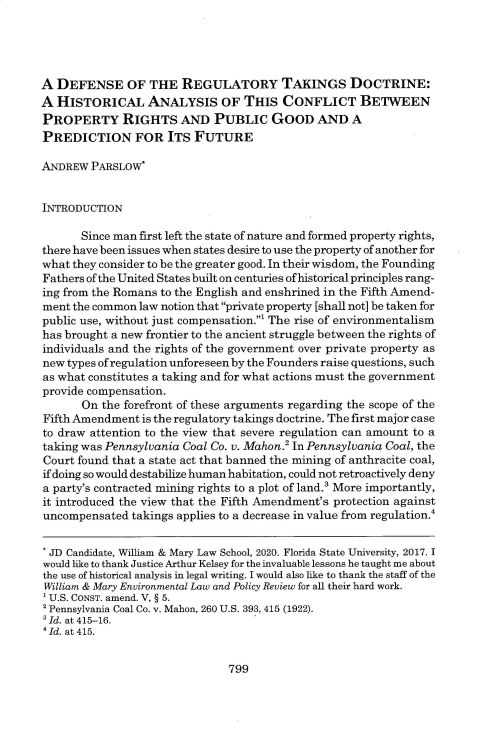
Parslow article

I must say that am pretty chuffed that one of my (now former) William and Mary Law students published a law review article, and he wrote about…takings. And Blackstone, and history.

Read it: Andrew Parslow, A Defense of the Regulatory Takings Doctrine: A Historical Analysis of This Conflict Between Property Rights and Public Good and A Prediction for Its Future, 44 Wm & Mary Environ. L. & Pol’y Rev. 799 (2020).

Well done! Continue Reading New Article: “A Defense of the Regulatory Takings Doctrine: A Historical Analysis of This Conflict Between Property Rights and Public Good and A Prediction for Its Future”

Oklahoma! where reservations were created and remain!
And the waivin’ claims, won’t abate
Cos’ the claims come years behind the pain!

Things I learned from yesterday’s Supreme Court opinion in McGirt v. Oklahoma (the one where the majority concluded that for purposes of the Major Crimes Act, eastern Oklahoma is still part of a reservation):

  • There’s a difference between sovereignty and ownership.
  • Left bloc of Court signed on to this: “There is no need to consult extratextual sources when the meaning of a statute’s terms is clear.” Slip op. at 20.
  • “[T]he magnitude of a legal wrong is no reason to perpetuate it.” Slip op. at 38. (As long as the legal wrong isn’t a court opinion, that is. In that case, stare decisis.)
  • “[T]hings could work out in the end,” and the parties may negotiate. Slip op. at 39. The epigram of history. Spoken like someone who’s never negotiated.


Continue Reading And The Land We Belong To Is Grand: What I Learned From McGirt v. Oklahoma!

Today’s case is a short one, but worth the short bit of your time it takes to read it.

In Borders-Self Storage & Rentals, LLC v. Ky. Transp. Cabinet, No. 2019-CA-000217 (July 2, 2020), the Kentucky Court of Appeals held that the assessed value of property for property tax purposes is admissible if the value was fixed by the property owner, and the condemnor offers it as an admission against interest. But if the landowner offers the same property tax assessed value, it is not admissible.

The Court of Appeals didn’t make up this uneven rule, but was merely applying a long-standing rule in Kentucky, first adopted by the Kentucky Supreme Court in Culver v. Commonwealth, Department of Highways, 459 S.W.2d 595, 597-98 (Ky. 1970). And the Court of Appeals has to follow Supreme Court precedent.

After Borders upgraded the property, it commissioned an appraisal which, in accordance

Continue Reading Kentucky App Ct: Even Though We Don’t Agree, Tax Assessment Is Admissible In Eminent Domain Only By Condemnor Against Property Owner

Check this out. In Willowbrook Apts, LLC v. Mayor & City Council of Baltimore, No. 1:20-cv-01818 (July 6, 2020), the U.S. District Court for the District of Maryland denied the plaintiff/property owner’s motion for a temporary restraining order, in a case challenging the COVID orders that pretty dramatically alter the landlord/tenant relationship in Maryland:

Specifically, the Baltimore City Council passed the Rent Increase Protection Act on May 19, 2020 (“Baltimore City Act”). On May 23, 2020, the Howard County Council passed the Rental Protection & Stability Act (“Howard County Act”), and the city of Salisbury followed suit one week later (on June 1, 2020) with Ordinance No. 2599, which amended chapter 15.26 of the city’s Municipal Code (“Salisbury Act”).

These laws (the “Acts”), while enacted in different jurisdictions, have the same three fundamental components, which Plaintiffs contend are constitutionally infirm. First, the Acts prohibit housing providers from increasing a

Continue Reading Fed Ct: Property Owners Not Irreparably Harmed By COVID Rent Orders (Because They Might Be Able To Get Compensation Later)

KingStreet

Breaking! In H.C. Cornuelle, Inc. v. City and Cnty of Honolulu, No. 14068 (Haw. July 17, 1990), the Hawaii Supreme Court held that the City and County of Honolulu inversely condemned a strip of private property in downtown when it prohibited development and use of that land because the City intended to acquire it in the future for a road-widening project.

Wait, what? “Breaking,” you say? This memorandum opinion was issued nearly 30 years ago. What gives? Well, we remember this case from back in the day when we were just starting out, but had long forgotten about it. Plus, the same case resulted in one of the first post-Williamson County Ninth Circuit opinions, because the landowners originally sued for the taking in federal court, but were bounced out for ripeness. So they tried the takings case in a Hawaii state court. The Hawaii Supreme Court’s opinion

Continue Reading HAWSCT: City’s Prohibiting Use Of Property Pending City Acquisition Is Land Banking Taking

As expected, a quick decision and opinion from the U.S. District Court for the District of Hawaii, after yesterday’s hearing on the plaintiff’s request for extraordinary preliminary relief (a TRO and PI) in the case challenging the Hawaii Governor’s imposition of a 14-day self-quarantine on all travelers inbound to Hawaii (and other emergency orders, although the TRO request was limited to the quarantine).

When the opinion starts this way, you know which way it is headed:

Claiming that there is no emergency in Hawai‘i or the United States, Plaintiffs seek temporary injunctive relief enjoining Defendant from enforcing the 14-day quarantine requirements of the Emergency Proclamations and an order to show cause why a preliminary injunction should not issue.

Op. at 1-2 (footnote omitted). I’m not sure that’s exactly what the plaintiffs were arguing (“no emergency” anywhere), but you get the drift.

The Governor challenged the plaintiffs’ standing (they have not

Continue Reading Federal Court Denies TRO: Hawaii Gov’s Coronavirus Travel Quarantine Doesn’t Stop Anyone From Coming To Hawaii