March 2021

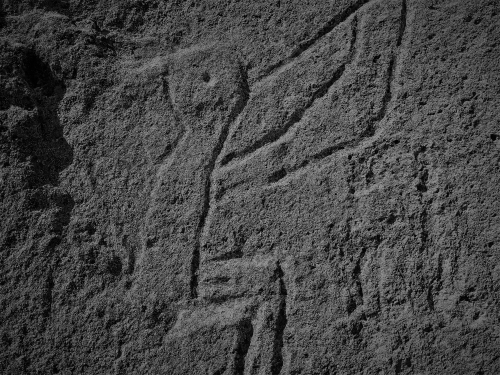
PXL_20210329_222643947This is either a petroglyph of an alien astronaut who visited Earth and gave
ancient peoples wonderful space technology like how to build
the Pyramids, or it’s a guy playing a flute.

(I’ll go with ancient astronaut.)*

When an opinion starts off by characterizing your complaint as asserting “a bevy of claims,” you know you are probably not going to be happy with the outcome.

So it is with the U.S. Court of Appeals’ opinion in Santa Fe Alliance for Public Health and Safety v. City of Santa Fe, No. 20-2066 (Mar. 30, 2021), a case in which the Alliance challenged the federal Telecommunications Act, the the New Mexico statute, and the city’s ordinance that foster the installation of cell towers on public rights-of-way. Collectively, these statutes impede or bypass the usual land-use process, which results in these (alleged) effects:

The Alliance’s membership consists of Santa Fe residents concerned


Continue Reading CA10: Plaintiffs Lacked Standing To Assert Cell Towers Took Their Property
Check out the North Dakota Supreme Court’s opinion in Cass County Joint Water Resource District v. Aaland, No. 20200171 (Mar. 24, 2021). It’s a quick read, and worth your time.

North Dakota has one of those “precondemnation entry” statutes allowing a (potential) condemnor to enter private property to check it out to see if this property is suitable for the anticipated public use. Indeed, North Dakota’s statute is modeled on California’s pre-1963 entry statute (the one analyzed by the California Supreme Court in the somewhat-recent decision in Property Reserve):

In all cases when land is required for public use, the person or corporation, or the person’s or corporation’s agents, in charge of such use may survey and locate the same, but it must be located in the manner which will be compatible with the greatest public benefit and the least private injury and subject to the provisions of

Continue Reading N. Dakota: We Understand The Right To Exclude – Non-Permanent Precondemnation Entries Went Too Far

Pop quiz: in eminent domain valuation proceedings, may an owner who is not qualified as an expert witness testify about the value of her or his own property?

If you said “yes,” most courts would agree with you, either as percipient witness testimony or as lay expert testimony. As would the U.S. Court of Appeals for the Fourth Circuit in most circumstances. As the court noted, “federal courts routinely permit landowners to testify as to the value of their real property in eminent domain cases.”

But as shown in the court’s (unpublished) per curiam opinion in Mountain Valley Pipeline, LLC v. 0.47 Acres of Land, No. 20-1306 (Mar. 23, 2021), there are limitations.

There, the owner opposed the pipeline condemnor’s motion for summary judgment on valuation by submitting his counter-declaration in which he testified about the value of his own property. Did that create a triable issue of

Continue Reading CA4 (unpub): Owner Can Testify About Valuation Of Own Property, Unless He Also Testifies About Other Stuff

Frontpage

Not our usual takings fare, but our readers are pretty forgiving about our occasional sidebars. And this one is otherwise relevant if you are wondering how governors and other executive state and municipal officials have the power to do things in events deemed to be emergencies. 

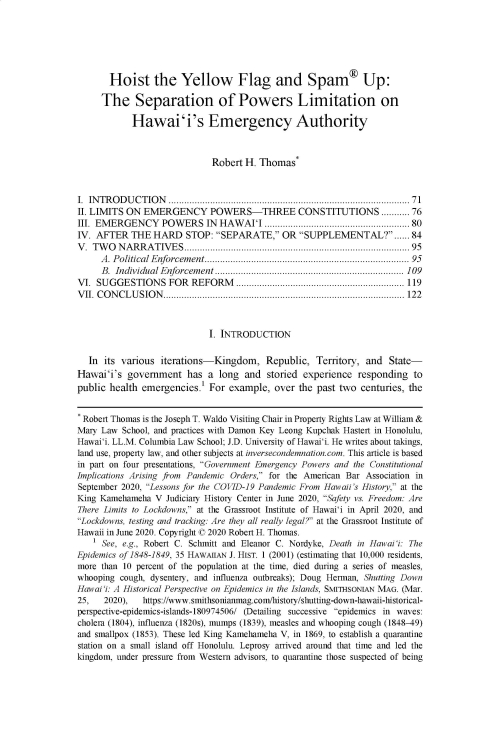
So here’s the final, as-published version of the law review article we wrote up on Hawaii’s emergency powers and suggestions for making the statute less bad, Hoist The Yellow Flag and Spam® Up: The Separation of Powers Limitation on Hawaii’s Emergency Authority, 43 U. Hawaii L. Rev. 71 (2020). 

From the Intro:

Even though legal challenges to similar emergency restrictions have developed in other jurisdictions, Hawai‘i’s courts have not dealt with many objections to the governor’s exercise of these emergency powers. Perhaps because it is mostly predictable how a court would analyze a challenge to emergency powers under the U.S. Constitution. The

Continue Reading Hoist the Yellow Flag and Spam® Up: The Separation of Powers Limitation on Hawaii’s Emergency Authority, 43 U. Haw. L. Rev. 71 (2020)

We suggest you take a read through the California Court of Appeal’s opinion in Felkay v. City of Santa Barbara, No. B304964 (Mar. 18, 2021). It’s all there: Lucas wipeout takings, futility and exhaustion, coastal zone property rights.

This is an inverse condemnation case, seeing compensation for the city denying the owner any economically beneficial use of his property, because it was on a bluff face. Under the city’s ordinances, bluff faces can’t be built on. The planning commission staff said so, but they also recommended to the commission that this would be a taking, and the commission should therefore employ the takings safety-valve provision in the ordinance which allows the city to approve development if denial would be a taking (to paraphrase that old lung-dart commercial, “it’s better to switch than to fight”).

“No deal” the commission said, rejecting staff’s recommendation, “we’ll show ’em who is boss!

Continue Reading Cal App: Taking Verdict Affirmed – When City Asserts That Its No-Development Law “trumps whatever you might submit,” It Would Have Been Futile For Property Owner To Submit Development Application

You listened live. Or you missed that, and listened to the recording. Or, you preferred to review what others thought of the arguments. Now you can read it yourself.

Here’s the transcript of Monday’s oral arguments in Cedar Point Nursery v. Hassid, No. 20-107, the case in which the Supreme Court is considering whether California’s forbidding of agricultural property owners from keeping union organizers off their land is a taking.

Some highlights, in our opinion:

  • Several of the Justices wanted to know whether it was important that the property owners called the access required by the regulation an “easement,” even though it is not formally an easement (you know, the thing where the dominant and servient estate owners agree that one can use the land of another, that is recorded, that runs with the land, and the like. Lawprof Josh Blackman writes about that here (“


Continue Reading Read And Listen To The Oral Arguments In SCOTUS’ Latest Takings Case

In which we join the Pendulum Land Podcast (again, thank you hosts!) to talk about the Virginia Supreme Court’s recent opinion in Johnson v. City of Suffolk, the case we label the “oyster takings” case in which Hampton Roads oystermen claimed that their property was taken when the City of Suffolk and the Sanitation District dumped sewage into the river and declared a “condemnation zone” (i.e., no oyster harvesting).

Short story: the court concluded that the leases of Commonwealth-owned bottomlands in the Nansemond River did not confer a property interest. Or at least not a property interest worthy of constitutional protection. Thus, no takings claim when Suffolk and the Sanitation District dumped sewage into the river and pretty plainly interfered with some kind of right the plaintiffs owned in the lease. Just not enough of a right to require compensation.  

Our thoughts on the court’s decision

Continue Reading We Join Pendulum Podcast To Debate Oysters, Property Rights, Takings

Here are links to the summaries and analysis of yesterday’s oral arguments in Cedar Point Nursery v. Hassid, No. 20-107, the case asking whether California’s forbidding of agricultural property owners from keeping out union organizers is a taking:

Neutral


Continue Reading Cedar Point Oral Arguments Round-Up

PICT1199

Here’s the recorded arguments.

  1. California will try and push the Court to seeing this as an “anti-union” lawsuit: this is not that big of an intrusion, we’ve been doing it for 50 years under both Cal and federal law, and a ruling for the property owners will upset this apple cart and prevent unions from organizing.
  1. The property owners will try and push the Court to seeing the case as one upholding the “keep out” nature of private property. There are other means of contacting the workers, so why need to do it on this private property? Convenience? [Disclosure: my law firm, Pacific Legal Foundation, represents the property owners.]
  1. Is this case different from Kaiser and Nollan in that California’s invitation to access the nursery property is not to the general public and only to union organizers?
  1. Is this case different from PruneYard in that the owner did not


Continue Reading In California, Can A Landowner Really Say “Keep Out?” Things To Look For In Today’s SCOTUS Cedar Point Nursery Arguments

Hold on. What is a criminal appeal, Comm’w of Pennsylvania v. Solomon, No. 1407 MDA 2018 (Mar. 16, 2021) doing on inversecondemnation.com?

The case involved a theft of collectible coins. The defendant was sentenced (inter alia) to pay restitution to the victim. The issue: how to value those coins.

After starting off with the timeless legal maxim “[a] penny saved is a penny earned,” slip op. at 1, the majority concluded that the coins’ value would not be calculated by their market value at the time of the crime, but by the victim’s acquisition cost. The victim testified that it took him eight years to acquire the coins and over the years between acquisition and Solomon’s theft, some of the coins increased in value while others declined. Original cost (from the victim’s receipts): $86k. Current value (derived from looking for comps on Ebay): $58k. Trial judge:

Continue Reading “A theft of property and an eminent domain proceeding both involve the involuntary transfer of property on a particular day.”